 By
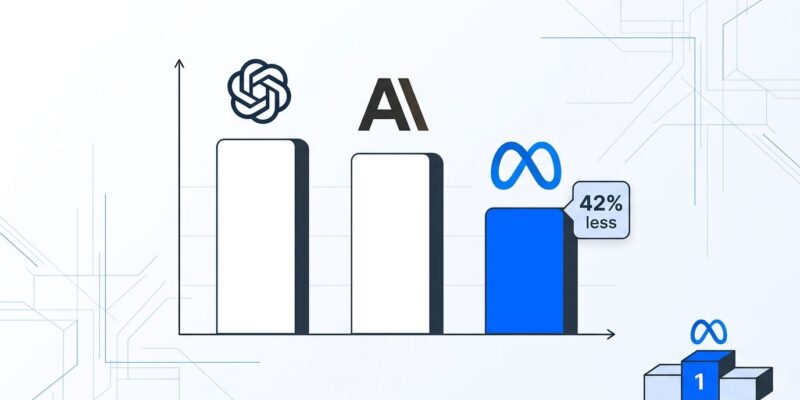
By Meta’s Superintelligence Labs released Muse Spark 1.3 on September 2nd, and the number worth paying attention to isn’t the benchmark score — it’s the cost. At $0.55 per task, Muse Spark 1.3 comes in 42% cheaper than GPT-5.6 Sol at the same intelligence score. It also beat Claude Opus 5 on the coding benchmark developers actually run: DeepSWE 1.1, scoring 75.4% to Opus 5’s 74.0%. That’s not “closing the gap.” That’s a lead.
Muse Spark 1.3 Benchmarks: What the Numbers Show
On the coding and agentic tasks that matter most for developer tooling, Muse Spark 1.3 holds clear advantages. It scored 75.4% on DeepSWE 1.1 — the highest score of any model at launch — ahead of Claude Opus 5 (74.0%) and GPT-5.6 Sol (73.0%). On Terminal-Bench 2.1, it ties GPT-5.6 Sol at 88.8%, with Claude Opus 5 trailing at 86.7%. The long-context retrieval improvement is dramatic: 98.5% on the MRCR 256k-512k test, up from 66.3% in version 1.2.
However, one caveat is worth flagging. Some benchmark comparisons in Meta’s official release materials pit Muse Spark 1.3’s max reasoning mode against competitors’ lower tiers. The max mode isn’t publicly available yet — safety testing is still underway. On general agentic tasks (OSWorld, AutomationBench), Claude Opus 5 still leads on four of six evaluation metrics. Coding is where Muse Spark wins. Everything else is less clear-cut.
The Cost Math at Scale
Muse Spark 1.3 runs at $1.25 per million input tokens and $4.25 per million output tokens on the standard tier — data stays private. Claude Opus 5 is $5 input and $25 output. GPT-5.6 Sol is $5 input and $30 output. For developers running coding agents at volume, that difference compounds fast. According to cost-per-task analysis, no model scoring at least 59 on the intelligence index had a lower per-task cost than Muse Spark 1.3 at launch.
| Model | Input ($/M) | Output ($/M) | Cost/Task |
|---|---|---|---|
| Muse Spark 1.3 Standard | $1.25 | $4.25 | $0.55 |
| GPT-5.6 Sol | $5.00 | $30.00 | $0.95 |
| Claude Opus 5 | $5.00 | $25.00 | ~$1.20 |
The efficiency gains are structural, not just a pricing cut. Version 1.3 uses roughly 20% fewer tool calls and 25% fewer tokens than 1.2 for equivalent coding tasks — the result of behavioral training improvements: the model asks clarifying questions instead of looping, confirms before irreversible actions, and produces cleaner code with fewer unnecessary turns. Community testing also found that running inside Meta’s native Muse Code harness amplifies the savings, since the model was co-trained with that framework.
Related: Claude Fable 5.1: The Cache Cut That Changes Agent Costs
The Contributor Tier Is a Separate Decision
Meta also offers a contributor pricing tier at $0.10 per million input tokens and $0.20 per million output — roughly 12.5x cheaper than standard. The trade-off: Meta trains on your data. That’s not a small footnote. Developers working with proprietary codebases, customer data, or anything sensitive should stay on the standard tier. The contributor tier makes sense for personal projects or open-source work, but treating it as a direct cost substitute for standard pricing ignores the actual trade-off.
A useful reframe from the Hacker News discussion: the price gap doesn’t reflect Meta’s eagerness to acquire data so much as enterprises’ willingness to pay for privacy. Which sharpens the question — not “is contributor tier safe?” but “what is your data actually worth to a competitor who trains on it?”
Who Should Switch, and Who Should Wait
If your workload is primarily coding agent pipelines — code review, automated fixes, terminal-based task execution — and you’re running at volume, Muse Spark 1.3 is worth a serious trial today. The benchmarks are real, the pricing advantage is substantial, and the 1M-token context window with near-perfect retrieval handles large codebases well. Use Muse Code’s native harness rather than a third-party framework if you do — the token savings are measurable.
Meanwhile, if you run broader agentic tasks, computer use, or workflows where Claude Opus 5’s general autonomy matters, don’t switch yet. The max reasoning mode being gated is a real limitation, and Opus 5 still leads outside the coding domain. The model’s verbosity also increased compared to 1.2 — about 57% more input tokens per task on benchmarks — partly offsetting per-token savings in aggregate. According to eesel AI’s breakdown, run your own cost baseline before assuming the savings translate to your specific workloads.
Related: Qwen3.8-Max-0902 Tops Coding Charts — Should You Switch?
Key Takeaways
- Muse Spark 1.3 is the cheapest top-tier model for coding agents at launch: $0.55/task vs $0.95 for GPT-5.6 Sol — a 42% cost reduction at equal intelligence scores.
- It leads on the coding benchmarks that matter: DeepSWE 1.1 (75.4%) beats both Claude Opus 5 and GPT-5.6 Sol. For general agentic tasks, Claude Opus 5 still holds the edge.
- The 25% token reduction vs 1.2 is real in coding tasks, but per-task verbosity increased — run your own cost baseline before assuming the savings translate.
- The contributor tier ($0.10/$0.20 per million) is 12.5x cheaper. It comes with Meta training on your data. That’s not a free lunch.
- Max reasoning mode isn’t available at launch. The xhigh numbers are solid, but the headline performance claims depend on it — hold final judgment until it ships.