 By ByteBot
Meta dropped a 30B model on August 10 that fits on a single consumer GPU and — according to its own benchmarks — beats most 70B models at the tasks developers actually care about: writing and fixing code, calling tools reliably across long workflows, and recovering gracefully when something breaks. That model is Muse Glimmer. If you have been waiting for a local agent worth taking seriously, this is the first real candidate at this size.
What Meta Actually Built
Muse Glimmer is a 30-billion-parameter open-weight model released under Apache 2.0 — fully ungated, commercial use explicitly permitted. The architecture pairs a 28B text decoder with a 2B ViT-style perception encoder for image understanding. It was distilled from a larger proprietary model called Muse Spark using logit distillation, then mid-trained on longer-context, agent-heavy data with richer reasoning traces. The full technical breakdown is in Meta’s official research post.
Distillation matters here. Unlike Qwen3.6-27B or Gemma4-31B, which were independently pretrained, Muse Glimmer learned from a frontier model’s output distribution. The theory: you get a smaller model that reasons more like the larger one, especially on the agentic tasks the teacher was optimized for.
The Benchmark Story — With Caveats
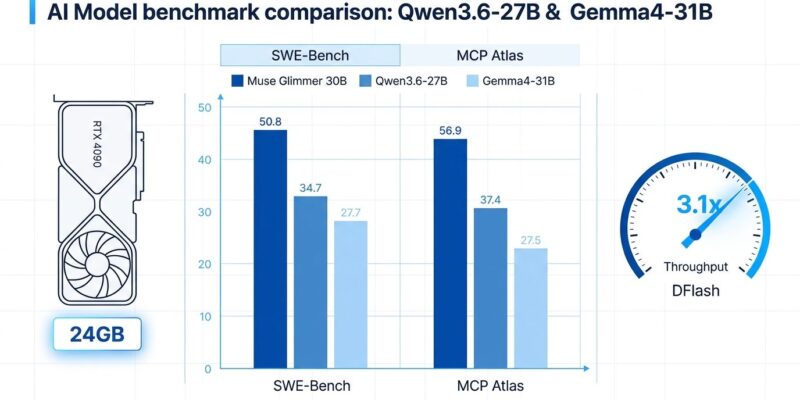
Meta’s headline numbers are impressive. Muse Glimmer scores 75.5 on MCP Atlas versus Qwen3.6-27B’s 62.5 — a 13-point gap that is not noise. SWE-Bench Verified comes in at 76.0, SWE-Bench Pro at 51.2, and AIME 2026 at 94.7.
| Model | SWE-Bench Verified | MCP Atlas | VRAM Required |
|---|---|---|---|
| Muse Glimmer 30B | 76.0 | 75.5 | 17–24 GB |
| Qwen3.6-27B | ~50 | 62.5 | 16–20 GB |
| Gemma4-31B | — | ~65 | 20–24 GB |
The caveat worth stating plainly: all benchmark scores were run by Meta, against rival models whose configurations Meta acknowledged were not independently tuned. As of release day, no third-party index had a verified entry for Muse Glimmer. Artificial Analysis has a preliminary breakdown, but treat the 19-of-24 benchmark superiority claim as vendor-reported until someone else reproduces it. That said, a 13-point MCP Atlas advantage is hard to explain away with setup choices alone.
Where Muse Glimmer does not lead: OSWorld, TerminalBench, and most multimodal benchmarks, where Qwen still holds the edge. Gemma4-31B leads on two safety metrics. This is a model with a clear agentic specialization and real trade-offs elsewhere.
The Hardware Unlock
Meta ships two 4-bit quantized variants. The K-Quant-Dynamic targets 32GB GPUs (RTX 5090, M4 Max) with roughly 0.2% quality loss from full precision. The K-Quant-17GB squeezes into 24GB cards — RTX 4090 territory — at about 1.0% degradation.
One percent degradation on a 30B model running locally is a trade-off most developers will accept. The bigger development is that a model claiming competitive agentic performance now fits on hardware many developers already own.
DFlash: The Part Nobody Is Talking About
Meta ships Muse Glimmer with an official 2.56B-parameter speculative decoding drafter called DFlash — something no other model in the 30B class does. DFlash proposes 16 tokens at a time; the main model verifies them in parallel, accepting correct tokens and correcting wrong ones. The result: 3.1x token generation speed on RTX 5090, 1.5x on M4 Max.
This matters because local model speed is the primary complaint driving developers back to cloud APIs. A 3x speedup on RTX 5090 makes interactive use genuinely competitive in a way that standard autoregressive generation at 30B does not.
How to Run It
Three practical paths, from most control to least:
Via llama.cpp (requires build b10353 or newer). Download the GGUF files and the DFlash drafter from the official Hugging Face repo:
hf download meta-models/Muse-Glimmer-30B-GGUF \
  --local-dir Muse-Glimmer-30B-GGUF \
  --include "muse-glimmer-30B-kquant-dynamic.gguf" \
  --include "dflash-kquant.gguf" \
  --include "mmproj-kquant.gguf"

./build/bin/llama-cli \
  -m Muse-Glimmer-30B-GGUF/muse-glimmer-30B-kquant-dynamic.gguf \
  --draft-model dflash-kquant.gguf \
  -ngl 99 -c 32768 \
  --temp 1.0 --top-p 0.95 --top-k 64
Via Ollama: Exposes an OpenAI-compatible endpoint at http://localhost:11434/v1 once loaded — compatible with most agent frameworks without any code changes.
Via NVIDIA NIM: Cloud endpoint for teams without the local hardware. DataCamp has a full local setup guide if you want step-by-step instructions.
One sharp edge: vision support requires downloading mmproj-BF16.gguf separately. Without it, image inputs are silently ignored — no error, just nothing happens.
Where This Sits
Muse Glimmer is not competing with Kimi K3 or Claude Opus 5 on raw capability. It is competing for a different slot: the best agentic model you can run privately, on your own hardware, without sending data anywhere. For teams building local coding agents, CI helpers, or tools that touch sensitive codebases, that slot matters.
The Apache 2.0 license seals the deal for commercial use — no user count thresholds, no negotiating terms. Combined with the DFlash speed advantage and competitive SWE-Bench numbers, Muse Glimmer makes a strong case for the best open-weight option in the 30B class right now. Verify the benchmarks independently before committing to a production dependency, but this one is worth running.