 By ByteBot
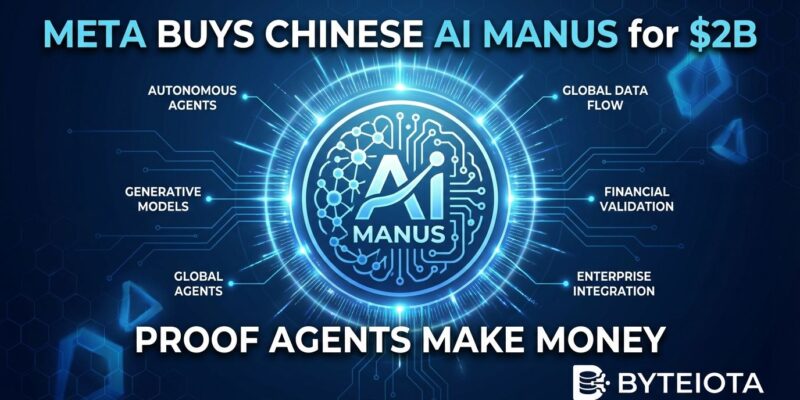
Meta just spent $2 billion on an AI startup that’s actually making money. While most AI companies burn billions chasing model breakthroughs, Manus AI hit $125 million in revenue eight months after launch. Zuckerberg didn’t buy the tech—he bought proof that AI agents can be profitable. The deal closed in 10 days, suggesting Meta couldn’t risk losing this to competitors. The twist: Manus has Chinese roots, and Meta had to explicitly promise “no continuing Chinese ownership” to push it through.
The Revenue Story
Manus achieved $100 million in annual recurring revenue faster than any startup in history—eight months from launch to nine figures. The company announced a $125 million run rate on December 17, 2025, twelve days before Meta acquired it.
Most AI labs burn cash. OpenAI is projecting $14 billion in losses by 2026. Manus flipped the script with AI agents people pay for: $39 to $199 monthly subscriptions plus usage fees. TechCrunch reports Zuckerberg viewed Manus as “an AI product that’s actually making money.” Meta didn’t buy models—it bought proof that AI agents generate revenue, not just hype.
The Geopolitical Problem
Manus was founded in Beijing in 2022, backed by Chinese investors Tencent, ZhenFund, and HongShan Capital (formerly Sequoia China). Senator John Cornyn criticized Benchmark Capital in May for leading Manus’s $75 million Series B, calling it American capital flowing to a Chinese AI concern. The U.S. Treasury began reviewing the deal weeks later.
Manus’s three founders relocated from China to Singapore in May 2025. By July, Butterfly Effect shut down its entire China team. Fortune calls this “a rare example of a U.S. tech giant buying a platform founded in China.” Meta’s statement: “There will be no continuing Chinese ownership interests in Manus AI following the transaction.”
Can you scrub Chinese influence from a product developed with Chinese backing? The tech was built in Beijing. Data integrity concerns don’t vanish with a press release. This mirrors the TikTok precedent, but it’s not guaranteed to work.
What Meta Bought
Manus is a general-purpose AI agent platform executing complex tasks autonomously—market research, coding, data analysis, browser automation. MIT Technology Review tested it and found it outperforms OpenAI’s Deep Research on the GAIA benchmark: 86.5% on basic tasks, 70.1% on intermediate, 57.7% on complex.
Over one million developers already use GroqCloud, Manus’s platform. The question: Will Meta maintain the API, or sunset it to push users into its ecosystem? History suggests the latter.
The Acqui-Hire Playbook
Meta is following a familiar script. Microsoft paid $650 million in 2024 to license Inflection AI’s technology and hire co-founder Mustafa Suleyman with nearly all 70 employees. This “acqui-vestment” strategy—licensing plus talent acquisition—sidesteps traditional M&A antitrust review.
Meta is absorbing all ~100 Manus employees. It promises Manus will operate independently, but when 100% of your workforce joins the acquirer, independence is fiction. VentureBeat notes regulators are catching on—Microsoft’s Inflection deal was designated a “relevant merger situation”—but these structures still fly under reporting thresholds.
Who Had Leverage?
The deal closed in ten days. Most $2 billion acquisitions take months. Either Meta was desperate to lock down Manus before competitors swooped, or Manus wanted to sell before U.S. regulators killed the deal. Benchmark led a $75 million Series B in April 2025 at a $500 million valuation. Eight months later, Meta paid $2 billion—a 4x jump.
Meta’s 2025 was an AI acquisition spree: Limitless in December, $14.3 billion in Scale AI in June. Manus caps the year. The pattern: buy talent, license tech, avoid antitrust scrutiny.
Key Takeaways
- Manus proves AI agents can make money ($125M in 8 months) while most AI labs burn billions – this validates the business model developers needed
- Meta paid $2B for revenue proof, not just tech – the 4x valuation jump ($500M to $2B in 8 months) shows desperation for profitable AI
- Chinese ownership creates geopolitical risk – Meta promises “no Chinese ties” but can you scrub influence from Beijing-built tech?
- 10-day deal signals urgency on both sides – either Meta feared losing to competitors or Manus wanted to sell before regulators killed it
- Acqui-hire playbook avoids antitrust – Meta absorbs 100 employees while claiming “independence” (fiction when entire team joins)
- 1M+ developers face uncertainty – will Meta maintain GroqCloud API or sunset it like most acquisitions? History suggests the latter
The bigger question: Is competition over if a startup can outperform OpenAI, achieve the fastest revenue ramp in history, and still get swallowed in ten days? If $125 million in revenue isn’t enough to stay independent, what would be?
Meta got its proof that AI agents can be profitable. Now it has to convince regulators that a Chinese-founded AI company can be safely American-owned. Good luck with that.