
 By ByteBot
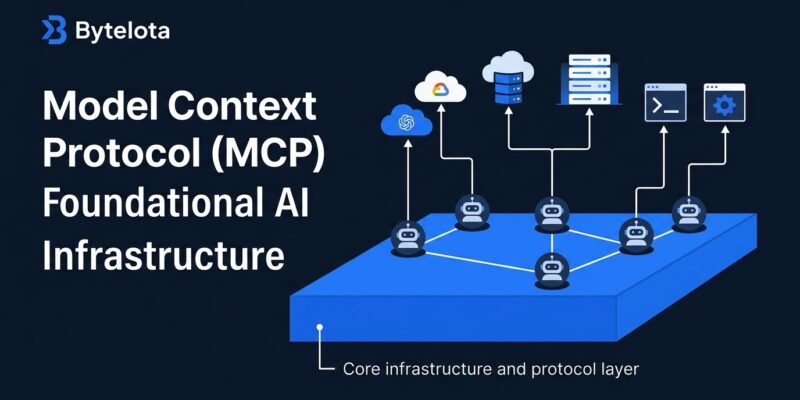
The Model Context Protocol’s first dedicated conference opened in Toronto this morning, and Anthropic’s lead maintainer Den Delimarsky used his keynote to reframe what MCP actually is. Not a tool-plugin system. The “agentic substrate” — the infrastructure layer that AI agents will run on top of at scale. Four concrete engineering priorities came with that framing, and they expose a significant gap between tutorial MCP and MCP that survives production load.
Four Priorities, One Message: MCP Is Growing Up
The August roadmap, co-authored by Delimarsky and David Soria Parra, named four items the MCP team considers blocking for production readiness. The summit is where the community works through them.
Agent identity. More callers are cloud agents acting on behalf of users who aren’t present. Right now, many MCP setups authenticate those agents by pasting an API key into a config file. That is no longer spec-compliant for remote servers — the 2026-07-28 revision made OAuth 2.1 with PKCE mandatory. Work is underway on DPoP (Demonstrating Proof of Possession) and Workload Identity Federation to handle machine-to-machine scenarios. Tokens are also now audience-bound: a token issued for one server cannot be replayed against another, which closes the token-relay attack class that security researchers flagged after July’s spec shipped.
Long-running tasks. Stateless HTTP creates a problem for jobs that take ten minutes. You can’t hold a connection open. The Tasks extension — shipped in the 2026-07-28 spec — solves this with a call-now/fetch-later pattern: submit a job, get a task ID, poll tasks/get while the conversation keeps moving. Tasks move through five states: working, input_required, completed, failed, and cancelled. One important detail: tasks/cancel is async. The server acknowledges the intent immediately, but the task can still land on a terminal state other than cancelled — don’t trigger retries with side effects until tasks/get confirms the final state.
Transport consolidation. One HTTP transport, no more SSE versus HTTP fragmentation. Stateless requests mean any request routes to any server instance — no sticky sessions, no shared state, standard load balancers just work. This sounds boring. It isn’t. It’s the prerequisite for every enterprise deployment that follows.
Progressive tool discovery. This is the one most developers aren’t watching closely enough. Tool-selection accuracy drops from 43% to under 14% as catalogs grow. Anthropic’s own internal guidance flags “significant degradation” past 30 to 50 tools. Progressive discovery — where a server exposes a minimal entry point and reveals more of its catalog as the conversation narrows — isn’t shipped yet, but a reference task dropped from roughly 150,000 input tokens to about 2,000 tokens when definitions were loaded only on demand. A 98.7% token reduction on the same task. That number matters for your API bill.
The Enterprise Gap Is Larger Than You Think
Dana Harrison from TELUS delivered a keynote on what one year of enterprise MCP actually looks like. TELUS has deployed MCP to 200,000 internal users, with 57,000 employees actively using generative AI and over 13,000 custom AI solutions in production. Their architecture includes a GitOps control plane, admission control to block unsanctioned servers, runtime detection on the tool-execution surface, and workload identity management at the gateway.
This is not how most developers run MCP. The summit’s implicit message is that the ecosystem needs to close this gap — and the four roadmap priorities are the mechanism.
Three Things to Do This Week
You don’t need to attend the summit to act on what it surfaced:
- Audit your remote MCP servers for OAuth compliance. If you’re authenticating with a pasted API key, you are not meeting the 2026-07-28 spec for remote servers. The WorkOS migration guide covers the transition path.
- Adopt the Tasks extension for anything that runs longer than a few seconds. The AAIF guide walks through the full lifecycle. Blocking tool calls that hold open HTTP connections are not going to scale.
- Audit your tool catalog size. If you’re connecting an agent to more than 50 tools, you’re already in accuracy-degradation territory. Progressive discovery patterns are available now even ahead of the official spec feature — the MCP roadmap breakdown covers the expected API shape.
Day 2 runs tomorrow. AGNTCon + MCPCon North America follows on October 22 in San Jose. The full roadmap is public. The engineering work to hit these priorities is happening in the open — the summit is where priorities get locked and sequenced.


