 By ByteBot
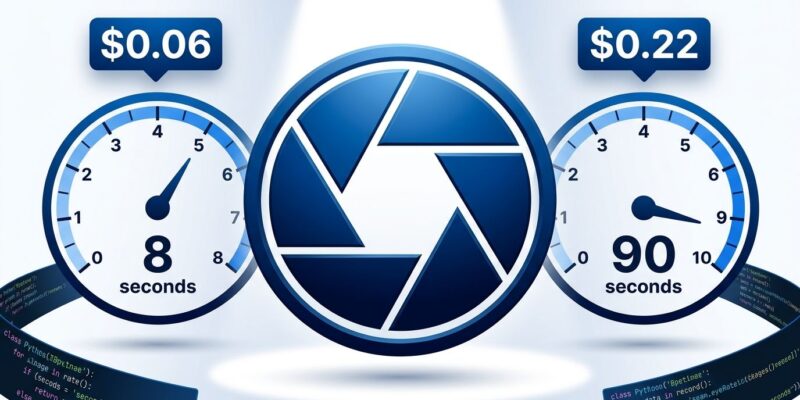
Krea launched Krea 3 in open beta today — an AI image editing model that completes native 2K-resolution edits in under 8 seconds for $0.06 per image. That puts it 3.7x cheaper and 11x faster than GPT Image 2 ($0.22, 90 seconds), and it’s available right now through the Krea API and six distribution platforms including fal, Replicate, and Together AI. This isn’t a waitlist announcement. The API is live.
The Cost and Speed Numbers
The image editing API market has had a quiet oligopoly problem: GPT Image and Nano Banana Pro set the pricing floor, and developers largely accepted it. Krea 3 breaks that. At $0.06 per 2K image, an app processing 100,000 edits per month costs $6,000 instead of $22,000 with GPT Image 2. That’s a business case that works where one didn’t before.
Speed compounds the effect. GPT Image 2 takes 90 seconds median (queue included, measured Sep 24–Oct 1, 2026). Nano Banana Pro takes 33 seconds. Krea 3 takes under 8. For interactive apps — where users are waiting — that gap is the difference between a feature and a friction point. As a16z partner Justine Moore put it: “When a top-quality edit comes back fast enough to try the next idea right away, the model stops being a step.” The workflow changes when the iteration loop closes in single-digit seconds.
Krea 3 Quality: Second-Best on CPI-Bench
Speed and cost are meaningless if quality drops off a cliff. On CPI-Bench — Alibaba’s comprehensive real-world image editing benchmark — Krea 3 Ultra scores 4.81 out of 5, placing second only to GPT Image 2.5 and ahead of every other competitor, including GPT Image 2 and Nano Banana Pro. GPT Image 2.5 is the one model that beats it on quality. It’s also slower and costs $0.21 per image. For the overwhelming majority of use cases, Krea 3 is the better economic choice.
The benchmark isn’t cherry-picked either. CPI-Bench covers three evaluation subsets: general editing diversity, practical real-user scenarios, and reasoning-heavy edits. Scoring second across all of them is not a narrow win on a contrived task. It holds up under pressure.
Fine-Tuning: The Feature Nobody Else Has
The speed and cost story is compelling, but the feature that makes Krea 3 a different category of product is LoRA fine-tuning. Krea 3 is the first image editing model that teams can train on a specific product, person, or visual style. That means a brand’s product shots stay recognizable across every AI-generated scene variant — the lighting adapts, the background changes, the product stays the product. Pixelcut CEO Dominique Yahyavi described it directly: “K3 gives them studio-quality lighting while staying true to the original product.”
This matters because every competing model has the same fundamental problem at enterprise scale: AI edits look great in isolation and inconsistent in series. Krea 3’s LoRA support is a direct answer to that. Enterprise access currently requires a partnership request through Krea’s team — self-serve is expected to expand — but the capability is there. CEO Víctor Perez framed the overall launch plainly: “Editing models are already used across e-commerce, film and advertising, but most of their potential is still held back by speed. Krea 3 removes the tradeoff.”
How to Access the Krea 3 API Today
Krea 3 is available via the Krea API and distribution partners including fal, Together AI, OpenRouter, Replicate, Baseten, and Hedra. The fal integration is pay-as-you-go with no subscription minimum. A basic edit call takes five lines of Python:
import fal_client

result = fal_client.run(
    "fal-ai/krea-3/edit",
    arguments={
        "prompt": "Change the background to a studio gradient",
        "image_urls": ["https://example.com/product.jpg"]
    }
)
The fal endpoint accepts 1–4 reference images, custom dimensions from 256 to 3200 pixels, and outputs PNG or JPEG. For higher-volume or enterprise use cases, direct API access through Krea offers additional options including on-premises deployment.
Key Takeaways
- Krea 3 is live today in open beta — API available immediately via fal, Replicate, Together AI, and others, no waitlist
- At $0.06/image and under 8 seconds, it is 3.7x cheaper and 11x faster than GPT Image 2; GPT Image 2 is no longer the default smart choice for cost-sensitive apps
- Quality holds: Krea 3 Ultra scores 4.81/5 on CPI-Bench, second only to GPT Image 2.5 which costs more and runs slower
- LoRA fine-tuning makes Krea 3 the first editing model with brand consistency at scale — the differentiator for enterprise use cases
- GPT Image 2.5 remains the benchmark winner; use it when quality is the only variable that matters