 By ByteBot
AWS launched Kiro for iOS today at the AWS Summit in New York — a native iPhone app that lets developers kick off, monitor, and approve agentic coding sessions running in the cloud, without a laptop in sight. It is in gated early access now for Kiro Pro, Pro+, Pro Max, and Power subscribers, and it is the first purpose-built mobile supervision app for a spec-driven agentic IDE.
Your Agent Does Not Need Your Laptop Anymore
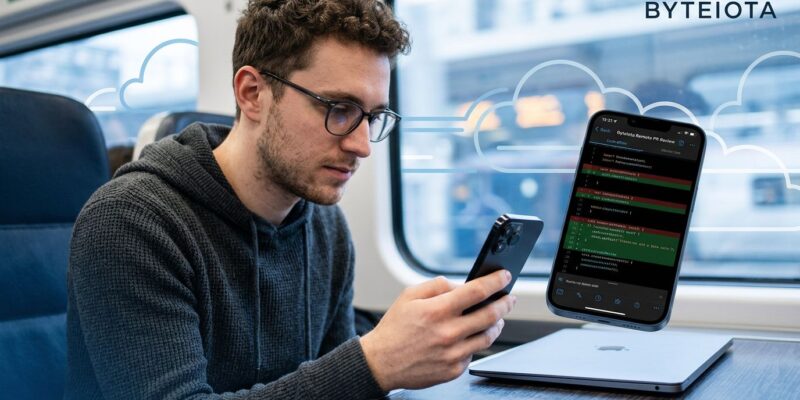
Kiro sessions already ran in the cloud — that part was live before today. What the iOS app adds is a proper supervision surface for that async model. Your agent lives in a Firecracker microVM on AgentCore, runs for up to eight hours, and keeps working whether your laptop is open, closed, or in a bag on an Amtrak train. The iOS app lets you check in on it, steer it, and approve changes from wherever you are.
That is a meaningful shift. Most AI coding tools today are synchronous by design — you and the model go back and forth, and when you close the window, nothing happens. Kiro’s cloud-first model is pushing toward something closer to what Devin does: delegate a task, let it run, review the result. Mobile supervision is the natural endpoint of that design.
Three Modes, Not a Status Dashboard
The app is not a read-only view into a running session. It has three full modes:
- Chat — Ask questions, redirect the agent mid-task
- Spec — Continue working through Kiro’s structured requirements-design-tasks workflow from your phone
- Autonomy — Hand off a full task and let the agent execute without prompting
The spec mode is the interesting one. Kiro’s core differentiator is that it generates EARS-notation requirements, design documents, and task lists before writing any code. Being able to review and approve those specs on mobile — not just see a diff — means the phone is a real work surface, not an afterthought. AWS was specific about this: native app, not a web wrapper.
Diff Cards That Actually Work on a Small Screen
Code review on mobile has historically been somewhere between painful and pointless. Kiro’s iOS team built diff cards — green and red panels with file headers that render code changes as scannable tiles rather than walls of text. You can also see PR status and code review progress at a glance on the session row. Multiple active sessions across different repositories appear in one view, with per-session model switching between frontier models and open-weight options.
These are the kind of design details that distinguish a product team that thought about the use case from one that just made a React Native port and called it a day.
The Fine Print
Two things to be clear about before you get excited.
First, this is gated early access. You can request it today, but there is no guarantee of immediate admission. Rollout is tiered by subscription level.
Second, Kiro’s pricing is layered. The base plan requirements — Pro at $20/month minimum — are clear enough. What is less clear is the total cost of running agentic sessions at scale. AgentCore charges per-second of agent execution. On top of that, AWS services consumed by your agent — CloudWatch queries, S3 reads, API Gateway calls — accrue separately. AWS itself acknowledged that trust is the single biggest barrier to adoption for agentic AI. It is worth reading the billing docs before you spin up eight-hour sessions daily.
Android support has not been announced.
How to Get In
If you are on Kiro Pro or above, head to kiro.dev/mobile and request early access. The official announcement post has the full feature breakdown. If you are not yet on a paid Kiro plan, the pricing page lays out the tiers — Pro Max at $100/month includes 5,000 credits per month and access to Claude Opus 4.8 and Sonnet 4.6, which is the tier most heavy users land on.
For context on the AgentCore infrastructure underneath all of this, AWS’s post on running coding agents on Bedrock AgentCore is worth reading. It explains the microVM model and session lifecycle in detail.
Why This Matters Now
According to Anthropic’s 2026 Agentic Coding Trends Report, 80% of developers now use AI coding agents in their workflows. But trust in AI output accuracy has dropped from 40% to 29% year-over-year. The gap between adoption and trust is where the real work is happening, and mobile supervision checkpoints are part of that answer — keep the agent running, but keep a human in the loop on anything consequential.
No other major agentic IDE has shipped a purpose-built native mobile app. Claude Code has mobile interaction via Discord and Telegram channels. Cursor and GitHub Copilot have no dedicated supervision surface at all. Whether Kiro’s iOS app becomes standard for the category or just a feature that most developers enable and rarely use depends on how well the cloud session model actually performs. But the direction is right: async agentic development needs a mobile layer, and Kiro just shipped one.