 By ByteBot
Everyone led with the number: 2.8 trillion parameters. That is technically accurate and mostly irrelevant. What actually matters is that Moonshot AI’s Kimi K3 is the first open-weight model to go toe-to-toe with proprietary frontier systems on the coding benchmarks that agent workloads actually care about — and it does so at roughly half the per-task cost of Claude Opus 4.8. The parameter count is a headline. The benchmark results are a stack decision.
The Benchmarks That Rewrite the Story
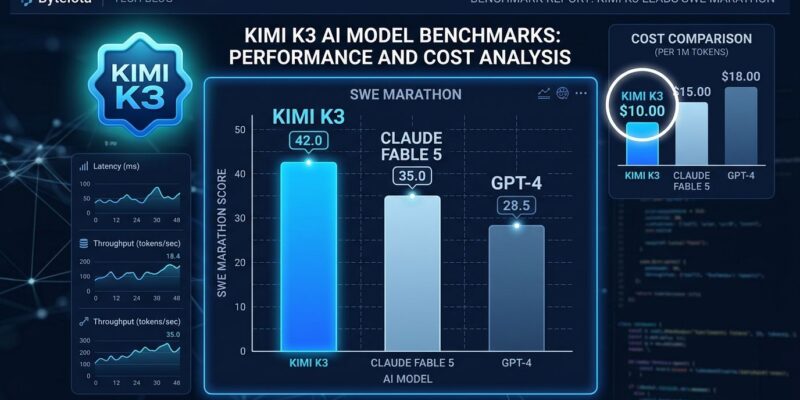
On SWE Marathon — a long-session coding benchmark designed to mirror what AI agents actually do in production — K3 scores 42.0. Claude Fable 5 scores 35.0. GPT-5.6 Sol scores lower. K3 wins outright, not by a margin that can be explained away as noise.
Program Bench tells a similar story: K3 at 77.8 edges GPT-5.6 Sol at 77.6 and Claude Fable 5 at 76.8. Terminal Bench 2.1 is a near-tie: K3 at 88.3 versus GPT-5.6 Sol at 88.8. K3 trails on Kimi Code Bench 2.0 (72.9 versus Fable 5’s 76.9) and on broader general intelligence evals. This is not a model that dominates across the board — it is a model that dominates where agentic coding workflows live.
The cost picture adds weight to the argument. At approximately $0.94 per completed task, K3 undercuts Claude Opus 4.8 at $1.80. For teams running high-volume coding pipelines, that spread compounds quickly.
Using K3 Today: Five-Minute Integration
The practical on-ramp is the managed API, and Moonshot kept it frictionless. K3 is OpenAI-compatible, so if you already call GPT-5 or Claude via the OpenAI SDK, you are minutes away from testing K3:
from openai import OpenAI

client = OpenAI(
    api_key="YOUR_KIMI_API_KEY",
    base_url="https://api.kimi.ai/v1"
)

response = client.chat.completions.create(
    model="kimi-k3",
    messages=[{"role": "user", "content": "Your prompt here"}],
    reasoning_effort="max"
)
print(response.choices[0].message.content)
K3 always runs with thinking mode enabled. The reasoning_effort parameter gives you control over how much compute the model spends reasoning before it responds. Pricing is $3.00 per million input tokens and $15.00 per million output tokens, with cached inputs at $0.30 per million — an 80% discount on repeated context. The API is also accessible via OpenRouter and Together AI if you want provider flexibility or lower latency routing.
Why 2.8 Trillion Parameters Does Not Mean What You Think
Mixture-of-Experts architecture is the reason the hardware math is not as catastrophic as the headline suggests. K3 has 896 experts total, but only 16 activate per forward pass — 1.8% of the network fires for any given token. The active parameter count per token is roughly 104 billion, not 2.8 trillion.
The architecture also includes Kimi Delta Attention (KDA), a hybrid linear attention mechanism that replaces the standard softmax attention with O(n) computation rather than O(n²). This is what makes the 1-million-token context window tractable. Combined with MXFP4 quantization-aware training — where the model learns at low precision from the start, eliminating the accuracy degradation of post-training quantization — K3 is engineered for efficient inference at scale.
vLLM announced day-0 support when the weights dropped on July 27, with Moonshot’s team contributing KDA-aware prefix caching directly to the project. Throughput on NVIDIA GB300 NVL72 with DSpark reaches 370 tokens per second.
Self-Hosting: For Regulated Teams, Not Individual Developers
The model weights are live on HuggingFace under a Modified MIT license. That openness carries real significance for healthcare, finance, and government teams — organizations where data cannot leave controlled infrastructure. When you use the Kimi API, your data transits Moonshot AI’s servers, a Chinese company. Self-hosting removes that dependency entirely.
The hardware reality is blunt: production self-hosting requires a minimum of eight enterprise-class GPUs (H100 80GB tier or better), with Moonshot recommending 64-plus accelerators in a supernode configuration. That is a six-figure infrastructure commitment. Unsloth’s 1-bit GGUF quantization compresses the weights to roughly 594 GB, but you still need 650 GB of combined RAM and VRAM — well beyond any single consumer machine. This is a cloud deployment or on-premises data center story, not a developer laptop story.
What to Do With This Information
If you are running agentic coding workflows and have not benchmarked K3, run the five-line integration above and compare it against your current provider on your actual tasks. SWE Marathon scores suggest K3 has an edge on long-session autonomy, and the cost gap is real. If you are operating in a regulated industry with data residency requirements, the open weights release is worth a serious infrastructure conversation. And if you are waiting for a consumer-grade local deployment, keep waiting — 650 GB of RAM is not in the roadmap for a while.
Open-weight models reaching frontier performance on coding tasks is not a trend that reverses. K3 is the current high-water mark. It is worth knowing what it can do.