 By
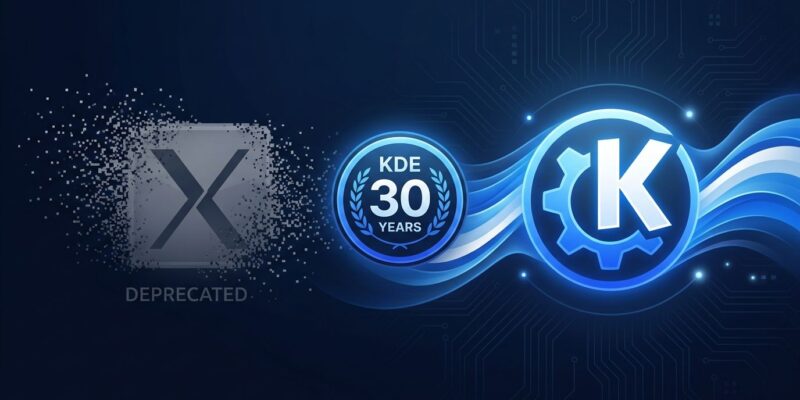
KDE turned 30 on October 14 and marked three decades with the kind of decision that actually matters: Plasma 6.8 ships without an X11 session. The official release announcement confirms it — the login screen no longer offers an X11 option. If you’re running KDE, you’re running Wayland. No toggle, no fallback, no nostalgia mode. After years of hedging, the Linux desktop’s most popular environment made the call.
Before the panic sets in, a critical distinction is worth making.
Session Gone. Apps Still Work.
KDE dropping the X11 session is not the same as dropping X11 application support. XWayland — the compatibility layer that lets X11 applications run inside a Wayland session — remains fully intact. Your legacy GTK2 apps still run. Wine and Proton still handle games. Old Java/Swing tooling still starts. Even ancient IDEs that haven’t been updated in years will mostly work through XWayland, albeit with some scaling roughness on fractional-DPI displays.
What’s gone is the option to run the Plasma compositor, shell, and session itself on X11. KDE developer David Edmundson pulled that code. The desktop environment no longer operates as a native X11 client. Everything underneath still talks to Wayland. X11 apps that run inside it are guests, not citizens — and XWayland gives them a visa, not residency.
What Actually Breaks
The distinction matters, but there are genuine breakages. If any of the following are in your workflow, you need to move:
- X11 screen capture tools:
scrot,xwd, anything that grabs screenshots via raw Xlib. These have no compositor-level access in a Wayland session. - Global hotkey tools:
sxhkd,xbindkeys,xmodmap. These bind directly to X11. On Wayland, they are inert. - Window inspection tools: Anything using XCB or Xlib to query or control other applications’ windows. Wayland’s security model deliberately prevents cross-application window access.
- LightDM headless sessions: LightDM cannot start a Wayland session without a real display. Multi-user headless remote access is explicitly flagged as not ready in Plasma 6.8.
The CI/CD Problem Nobody Is Talking About
This is the one that will bite teams running Linux-based UI test pipelines. If your CI infrastructure uses Xvfb to spin up a virtual framebuffer for automated testing, that approach is now broken on a Wayland-only KDE system. Xvfb is X11-only — it has no Wayland equivalent out of the box.
The replacement path involves headless Wayland compositors. Weston with its headless backend is the most common option. Neither Weston nor other virtual Wayland compositors are as trivial to drop into a CI pipeline as Xvfb was. If your CI runs on KDE-based Linux environments and does GUI automation, this is your action item for this week — not next quarter.
Screen Capture: The Proper Path Forward
Screen capture on Wayland is mediated differently from X11. Applications cannot grab the screen unilaterally — they must go through xdg-desktop-portal with explicit user permission, and the actual capture runs through PipeWire. On KDE, the portal backend is xdg-desktop-portal-kde.
Verify your stack is functional before you need it in production:
systemctl --user status pipewire
systemctl --user status wireplumber
For recording: OBS works with the PipeWire source plugin. wf-recorder and gpu-screen-recorder are natively Wayland-aware. As Linuxiac notes, Spectacle in Plasma 6.8 now records system audio and microphone input together — a sign that first-party tooling is catching up. Anything relying on scrot or xwd needs a replacement now.
The Performance Payoff
Dropping X11 session support is not just ideological housecleaning. Plasma 6.8 ships NVIDIA triple buffering on by default, cutting the GPU stutter that has plagued KWin for years. HDR now coexists properly with ICC color profiles. Plasma Shell initializes faster and runs leaner. Remote desktop got a significant overhaul: better adaptation to slow networks, an exclusive mode that presents a virtual display to the remote client while locking the physical screen, and bidirectional clipboard sync.
These improvements exist because KDE developers are no longer maintaining two compositor backends in parallel. The engineering debt is gone. The benefits are arriving.
Time to Stop Hedging
Over 95% of KDE Plasma 6.6 users were already running Wayland before this release. GNOME dropped X11 sessions in GNOME 46. X.org is in maintenance mode. The Register’s headline — “KDE hits 30, decides it’s time to move out of the X11 era” — captures it accurately. X11 as a first-class platform target is over.
XWayland buys you time. It does not buy you indefinitely. If you’re writing new Linux desktop applications, automation tooling, or CI pipelines in 2026 and still targeting X11 directly, you’re writing code with an expiration date. The migration path is documented, the tooling is mature, and the ecosystem has moved. The only thing left is the decision.