 By ByteBot
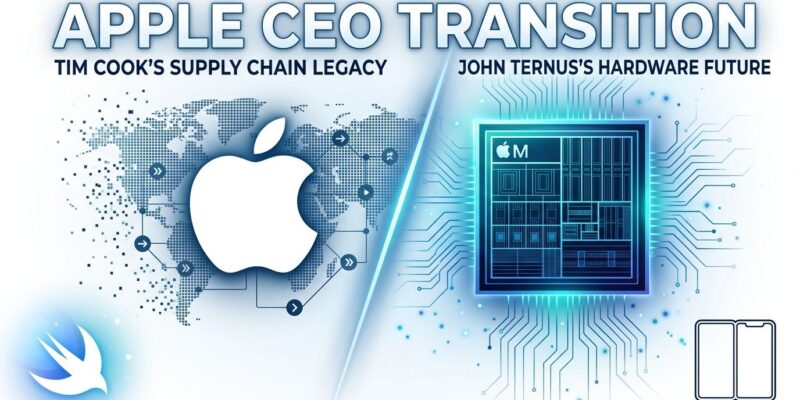
John Ternus is Apple’s CEO as of today, September 1. Tim Cook handed the keys to the SVP of Hardware Engineering — the man who built the M-series chips — after 15 years running the company. Ternus is the first engineer to lead Apple since Jobs, and he steps into the role eight days before the “Surprise and Shine” event that will unveil a foldable iPhone and force iOS developers to revisit layout assumptions they’ve held since 2007.
The Foldable iPhone Is Your First Assignment
The practical implication for developers lands before Ternus has finished his first week. iOS 27, set to reach GM shortly after the September 9 event, removes the letterboxing escape hatch that has let apps survive new form factors without changes. Any app compiled against the iOS 27 SDK will run without automatic scaling on hardware with unfamiliar screen geometry — meaning a book-style foldable display with a 7.8-inch main screen.
Apple introduced three new APIs to handle it: foldState, angleDegrees, and a display count key that returns the number of integrated screens. At WWDC 2026, the Platforms State of the Union told developers: design for “a dynamic range of sizes and aspect ratios,” not fixed dimensions. SwiftUI apps already using scene lifecycle are in reasonable shape — the framework handles basic resizability automatically when rebuilt with the latest SDK. UIKit apps will need manual layout work. Game developers have the largest burden; fixed-orientation assumptions must go.
Xcode 27 ships a resizable iOS Simulator specifically for testing fold states and aspect ratios, along with updated SwiftUI Previews. The agentic coding features have expanded significantly — the agent can now interact with the simulator directly, localize apps, execute tests, and resolve crashes from the Organizer without developer input.
Who Is Running Apple Now
Ternus joined Apple in 2001 as a product designer and spent a quarter-century inside the company before taking SVP of Hardware Engineering in 2021. He is responsible for the M-series Apple silicon line — the chips that revived the Mac as a serious development platform and gave the iPad Pro performance that outdid most laptops. He is not a finance executive or a supply chain operator. He is an engineer who spent his career thinking about how hardware enables software.
That background cuts both ways. The optimistic read: a CEO who understands silicon-to-software coupling will make hardware investments that translate into useful APIs, not marketing features. The skeptical read: hardware-first priorities could mean WWDC gets less attention and developer relations become transactional. Tim Cook’s operational genius kept Apple’s product cadence metronome-reliable; the test is whether Ternus maintains that rhythm while also closing Apple’s AI gap.
Cook isn’t going far. He remains executive chairman and keeps responsibility for geopolitics — managing the Trump administration’s manufacturing demands and Apple’s China supply chain. Ternus gets to focus on products, which is where his credibility lives.
The AI Strategy He Didn’t Design
In January 2026, Apple signed a $1 billion-per-year deal to license a custom 1.2-trillion-parameter Gemini model from Google. That deal powers the rebuilt Siri launching with iOS 27. It was a Cook-era decision, made because Apple had fallen badly behind on large language model quality and had no credible catch-up path on its own timeline.
Ternus inherits it. He also inherits the longer-term bet: Apple is building its own AI server chips, codenamed “Baltra,” with dedicated data centers coming online in 2027. The intent is to reduce Gemini dependence and bring cloud AI inference inside Apple’s infrastructure entirely.
For developers, the near-term picture is good. Apple Foundation Models — the on-device AI framework announced at WWDC — is now free for developers with fewer than two million first-time App Store downloads. The framework added image input support, a Dynamic Profiles system for multi-agent workflows, and server-side model integration that lets you call Claude or Gemini through the same Swift API. The Foundation Models framework is also going open source. Whether Ternus accelerates or modifies the Gemini arrangement is an open question, but the developer tools direction is clear.
What to Watch on September 9
Ternus leads his first product event in eight days. The agenda: foldable iPhone (likely called the “iPhone Ultra”), iPhone 18 Pro, iPhone 18 Pro Max, and new Apple Watch models. iOS 27 will likely reach GM shortly after, giving developers the final SDK to test against.
Watch for any developer-specific announcements Ternus chooses to lead with. An engineer running a hardware event has different instincts than an operations executive running one. The APIs that ship with iOS 27 GM, the final state of Xcode 27, and any Foundation Models updates announced alongside the hardware will be the real developer story — more consequential than the foldable’s price tag.
The foldable form factor is coming regardless of who is CEO. What changes under Ternus is whether the engineering leadership at the top of Apple pushes developer-facing capabilities faster than Cook’s era did. The early signals from WWDC 2026 — free AI access, open-source frameworks, a resizable simulator — suggest the answer might be yes.