 By
JetBrains released Mellum2.1 on October 8 and buried the headline in a number: SWE-bench Verified jumped from 2% to 47%. Same 12-billion-parameter mixture-of-experts architecture. Same 2.5 billion active parameters per token. No structural changes at all. What changed was the post-training — reinforcement learning moved from a short final polish pass to the core of the entire training process, run across millions of sandboxed environments over months. The result is an Apache 2.0 model that can navigate real repositories, use shell tools, and pass tests. It runs on a 12 GB GPU.
What Actually Changed: The RL Overhaul
The standard approach to RL in model training had been a brief final stage — a way to nudge the model toward preferred outputs after the main supervised work was done. JetBrains scrapped that. For Mellum2.1, they ran millions of sandboxed environment passes across domains: math, competitive programming, science, tool use, and software engineering. For the SWE tasks specifically, the model worked inside real repositories using shell and file-editing tools. The reward signal was simple and honest: did the tests pass?
That training methodology is what moved Terminal-Bench 2.1 from 0.6 to 17.4 and SWE-bench Pro from 0.0 to 28.0. The benchmarks are measuring something real — the model learned to use tools to fix code, not just predict token sequences that look like fixes. This is the same RL-at-scale lever that made frontier reasoning models work. JetBrains made an open version of it fit inside 12 billion parameters. JetBrains details the full training approach on their AI blog.
Architecture: Why It’s Fast
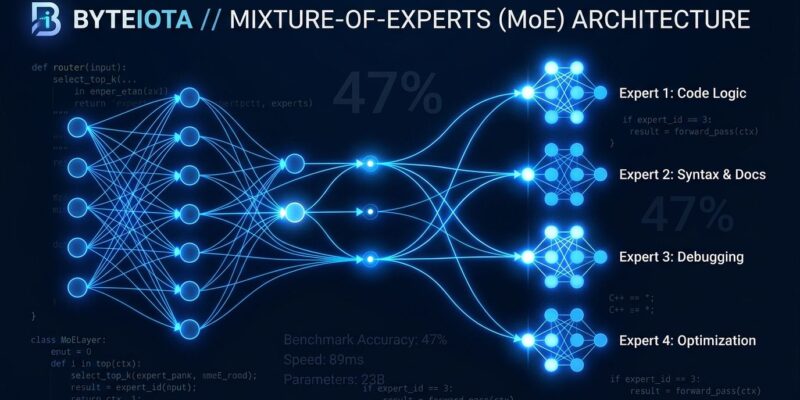
Mellum2.1 is a mixture-of-experts model with 64 experts and 28 transformer layers. Each token activates 8 experts, meaning the model does the compute of a ~2.5B-parameter dense model, not 12B. Under heavy load on a single H200, that translates to roughly twice the token throughput of Qwen3.5-9B, which is a dense 9B model doing proportionally more work per token.
The other speed lever is multi-token prediction (MTP). The model trains an auxiliary head that predicts additional future tokens alongside the standard next-token objective. At inference time, that head becomes a built-in draft model for speculative decoding — roughly 1.6x faster per single request. JetBrains lists full MTP integration as coming soon, but the throughput gains on concurrent requests are already present in the current release.
Benchmarks: The Honest Picture
Mellum2.1 doesn’t win everywhere, and it’s worth being precise about where it does and doesn’t.
| Benchmark | Mellum2 (June) | Mellum2.1 | Qwen3.5-9B |
|---|---|---|---|
| SWE-bench Verified | 2.0% | 47.0% | 50.0% |
| SWE-bench Pro | 0.0% | 28.0% | 38.0% |
| Terminal-Bench 2.1 | 0.6 | 17.4 | 21.7 |
| LiveCodeBench v6 | 69.4 | 82.0 | 75.4 |
Mellum2.1 leads on LiveCodeBench — the coding puzzle and tool-call benchmark — by a meaningful margin. On the SWE benchmarks, which measure performance against real GitHub bug fixes and harder multi-step tasks, Qwen3.5-9B still wins. If your use case is deep repository work with complex, multi-file changes, Qwen is the better choice at this parameter count. If you’re running high-throughput pipelines or short coding tasks where speed and cost matter more than ceiling performance, Mellum2.1 makes a strong case.
How to Run JetBrains Mellum2.1 Locally
The GGUF builds are on Hugging Face. Pick the quantization level based on available VRAM: Q4_K_M sits at 8.1 GB (fits a 12 GB GPU or a 16 GB Apple Silicon Mac), Q6_K at 10.9 GB for more quality headroom, and Q8_0 at 12.9 GB if you want near-lossless weights. A full local setup guide covering Ollama and llama.cpp is available here.
# Ollama — quickest start
OLLAMA_CONTEXT_LENGTH=32768 ollama run hf.co/JetBrains/Mellum2.1-12B-A2.5B-Thinking-GGUF:Q4_K_M

# llama.cpp — OpenAI-compatible server
llama-server -hf JetBrains/Mellum2.1-12B-A2.5B-Thinking-GGUF:Q4_K_M \
  --ctx-size 131072 --temp 0.6 --top-p 0.95 --top-k 20 --port 8080
One important Ollama detail: the default context length is 4,096 tokens. Mellum2.1 supports 131,072. Set OLLAMA_CONTEXT_LENGTH before running or you’ll cap out immediately on any real coding task. Once running, point any OpenAI-compatible client at http://localhost:11434/v1 — it integrates with Continue, Cline, or any other agent frontend without modification. For server deployments, vLLM supports the model directly from the Hugging Face repo in BF16, FP8, and NVFP4 formats.
Who Should Use This
Mellum2.1 is the right call for three scenarios: companies with data residency requirements that can’t send code to cloud APIs; multi-model pipelines where Mellum handles fast, narrow subagent tasks while a larger model handles planning; and local development on Apple Silicon where you want a capable coding agent without paying per token. It is not the right call if your primary need is deep, multi-file repository reasoning — that remains Qwen3.5-9B territory for now, or a larger model entirely.
JetBrains released Mellum2.1 under Apache 2.0 with no usage restrictions. The benchmark jump is real, the throughput advantage is real, and the licensing is clean. The next version will likely deliver the full speculative decoding speedup once MTP integration ships. Until then, this is the most practical open coding agent at the 12B scale — a model worth running.