 By ByteBot
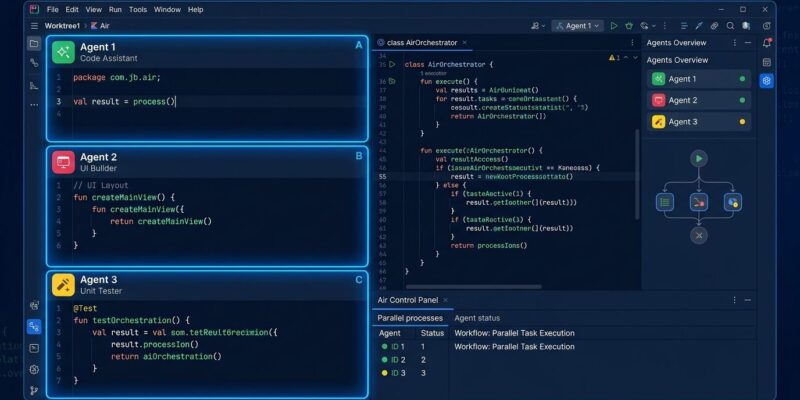
JetBrains Air is now in early access inside IntelliJ IDEA, PyCharm, WebStorm, CLion, and RustRover. Before you assume it is another Copilot clone bolted onto a sidebar: it is not. JetBrains Air IDE is a multi-agent orchestration layer — no bundled AI, no new editor, no subscription to a new model. It takes the agents you already pay for (Codex, Gemini, GitHub Copilot, Junie, Claude Agent) and runs them in parallel, each in its own isolated Git worktree. Air Governance, the org-level policy and cost layer, went GA on October 22. For a 26-year-old IDE company, this is an unusually high-stakes pivot.
What JetBrains Air Actually Is
Air is an orchestration layer built on ACP — the Agent Client Protocol, an open JSON-RPC standard created by Zed Industries in August 2025, later joined by JetBrains. The registry now has 42 agents and 19 editor clients. Air detects ACP-compatible agents installed locally and gives each one a temporary Git worktree so parallel sessions do not conflict. You see diffs, cost, and status for each agent from a single pane inside your existing IDE.
JetBrains CEO Kirill Skrygan stated the intent plainly at the September announcement: “For 26 years, we have focused primarily on the individual developer workbench. Now, we are building for the wider system through which agentic work is initiated, executed, coordinated, reviewed, and governed.”
The key distinction: Air does not compete with Cursor by adding a better chat window. Moreover, it competes by being the place where you review and govern what multiple agents produce — a different problem entirely, and one Cursor does not solve. JetBrains is not building an AI model; it is betting on being the review surface.
The Claude Problem Nobody Is Talking About
Air supports Claude Agent — but only via API key, on pay-per-token pricing. Your Claude Pro, Max, or Team subscription cannot be used inside Air. This is not a JetBrains limitation. Anthropic banned subscription OAuth in third-party tools beginning April 4, 2026, enforcing a policy that had been in the fine print since early 2024.
“We tried to make this work, but unfortunately hit a hard stop with Anthropic: their current policies do not allow us to support this integration, and we were not able to negotiate an exception.” — JetBrains employee, Hacker News
For teams routing most of their AI work through Claude subscriptions, this is a real friction point. Pay-per-token at API rates adds up fast in a multi-agent workflow. However, if your organization uses Claude Code natively (which Anthropic does support), this gap may matter less in practice. The bottom line: Air’s otherwise clean multi-vendor architecture has one notable gap, and it is the model that many developers use most.
Air Governance: The Part Engineering Managers Care About
The Governance layer, now GA, is where Air’s pitch for enterprise teams gets concrete. Administrators define which agents and models teams can use, set enforced credit limits per developer, per team, or per service account, and see a cost breakdown by agent, model, and provider. There is also a human-vs-AI code ratio metric for teams that want to track exactly how much AI is contributing.
Pricing: $20 per month per developer with AI access. AI credits are purchased separately. Bring-your-own-key support covers OpenAI, Anthropic, AWS Bedrock, and Vertex AI — meaning organizations can connect their existing contract pricing rather than paying a JetBrains markup. This is a real differentiator. Most AI coding tools give organizations essentially zero governance over agent spend. Air Governance addresses this directly, at least within the JetBrains ecosystem.
Should You Try JetBrains Air?
Try Air now if you are already on a JetBrains IDE and want to run multiple agents in parallel without switching your editor. Install the Air plugin from JetBrains Marketplace, sign in with your JetBrains account, and get Junie Lite for free as a starting point. The 2026.3 EAP builds of IntelliJ, PyCharm, and WebStorm include Air natively — no plugin install needed. ByteIota recently covered JetBrains ThinkRail, another JetBrains agentic experiment with a different approach — if you want a lightweight standalone incubator IDE, ThinkRail is the alternative to compare.
Furthermore, skip Air for now if you are a VS Code user (Air does not support non-JetBrains editors), or if your workflow centers on Claude subscription plans since you will be paying API rates. If you are already happy with Cursor at $20 per month for focused single-model work, Air solves a different problem and does not replace it.
The broader question Air raises is one JetBrains is betting its next decade on: as agents write more of the code, does developer experience consolidate around review and governance surfaces, or do IDEs fade as developers live increasingly in terminals and agent chat interfaces? The Hacker News thread on Air’s launch split predictably on this. One commenter argued that “people are barely opening their IDEs, living in agent terminals all day.” The counter-argument: reviewing LLM output across multiple files still requires IDE-quality navigation. JetBrains is betting on the counter-argument. Whether that bet pays off is the most interesting open question in developer tooling right now.