 By ByteBot
On July 15, Mira Murati’s Thinking Machines Lab released Inkling — a 975-billion-parameter open-weight multimodal model under Apache 2.0. It is not the best model on any single benchmark. The company says so themselves. The bet they are making is different: a model you own, fine-tune for your domain, and — uniquely — tune how hard it thinks at runtime. That last part is what makes Inkling worth paying attention to.
The Feature No Other Frontier Model Has
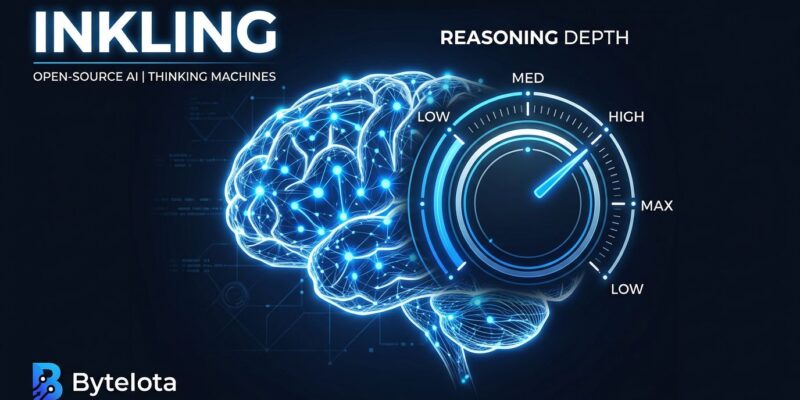
Inkling ships with a reasoning budget dial. When you call the API, you set reasoning_effort to one of seven levels: none | minimal | low | medium | high | xhigh | max. The model adjusts how many tokens it burns on internal reasoning before producing output. Low effort is fast and cheap — good for classification and extraction. Max effort (0.99) is what the benchmark numbers reflect and what you want for hard math or security-critical code review.
This is not the same as choosing between a “thinking” and “non-thinking” model version, which is how every other lab handles the tradeoff. Inkling does it in a single model at the request level. Thinking Machines trained this capability via reinforcement learning, varying the per-token cost at different effort levels so the model learned to actually manage its reasoning budget rather than just being told to.
The practical implication: one deployment, one API key, configurable intelligence per task. That matters when you are running thousands of classification calls per day alongside occasional complex code reviews. You pay for what you need.
# Via Fireworks AI — OpenAI-compatible API
from openai import OpenAI

client = OpenAI(
    base_url="https://api.fireworks.ai/inference/v1",
    api_key="YOUR_FIREWORKS_KEY"
)

# Fast, cheap: classify a support ticket
response = client.chat.completions.create(
    model="accounts/fireworks/models/inkling",
    messages=[{"role": "user", "content": "Classify this ticket: ..."}],
    extra_body={"reasoning_effort": "low"}
)

# Slow, thorough: review code for security issues
response = client.chat.completions.create(
    model="accounts/fireworks/models/inkling",
    messages=[{"role": "user", "content": "Find security vulnerabilities in: ..."}],
    extra_body={"reasoning_effort": "max"}
)
What Inkling Actually Is
Under the hood: 975B total parameters with 41B active per token via a Mixture-of-Experts architecture — meaning the compute cost resembles a 41B-parameter model, not a near-trillion-parameter one. One-million-token context window. Natively multimodal: text, images, audio, and video all processed in the same model without bolted-on adapters. Trained from scratch on 45 trillion tokens, not distilled from an existing model.
The architecture uses a hybrid attention scheme: 55 of 66 layers use sliding-window local attention for efficiency, and 11 use global attention for long-range dependencies. Instead of RoPE positional encoding — the standard since 2022 — Inkling uses a learned input-dependent relative-position bias that Thinking Machines claims generalizes better to long sequences. Sebastian Raschka’s architecture deep-dive is the best technical reference if you want to go further.
Weights are live on Hugging Face under Apache 2.0 (NVFP4 quantized checkpoint available now; full weights land July 27). Hosted inference is available today through TogetherAI, Fireworks, Modal, Databricks, and Baseten.
The Actual Business Model: Tinker
Inkling is not how Thinking Machines makes money. Tinker, their fine-tuning platform, is. The model is the base; the revenue is customization.
The pitch is that for domain-specific work, a fine-tuned mid-tier open model beats renting a closed frontier model for most production use cases. Bridgewater Associates tested this: they fine-tuned Inkling on proprietary financial data via Tinker and hit 84.7% on financial reasoning benchmarks — above the closed-model alternatives they tested — at under 10% of the cost. Those numbers are self-reported, so weight them accordingly, but the economics of the argument hold regardless of the exact figures.
If you have proprietary data and volume, owning a customized model is almost always cheaper than paying per-token for a model that does not know your domain. Inkling is Thinking Machines’ attempt to be that base for enterprises who have reached that conclusion. The Tinker documentation covers the reasoning effort API in detail.
Benchmarks: Where It Actually Lands
Inkling is honest about its place in the stack. SWE-Bench Verified: 77.6% — behind DeepSeek V4 Pro (80.6%) and roughly tied with GLM 5.2. AIME 2026: 97.1%, edging DeepSeek V4 Pro’s 96.7%. Strong at math; not the top coder among open models.
| Model | License | SWE-Bench Verified | Reasoning Control |
|---|---|---|---|
| DeepSeek V4 Pro | MIT | 80.6% | No |
| GLM 5.2 | MIT | ~78% | High/Max only |
| Inkling | Apache 2.0 | 77.6% | 7-level dial |
| Nemotron 3 Ultra | Nvidia | 70.7% | No |
The open-weight leaderboard in July 2026 is dominated by Chinese labs — DeepSeek, Zhipu, Moonshot — and Inkling does not dethrone them. What it does is put a US-developed, Apache 2.0-licensed, multimodal foundation model within striking distance of the top, which is new. Western developers who want open weights without dependencies on Chinese model providers had limited options before this week.
One caveat worth noting: Inkling’s training data reportedly includes synthetic outputs from Kimi K2.5, a Chinese model, and the architecture resembles DeepSeek-V3. For developers in regulated industries or government contracts where model provenance matters, that is worth knowing before committing.
Who Should Use Inkling
Use Inkling if: you have proprietary domain data and enough volume to justify fine-tuning, you want a single model that handles text, vision, and audio without juggling separate adapters, or you need the reasoning budget dial for mixed-workload deployments where cost per call matters.
Skip it if: you need the best possible coding benchmark scores for agentic CI/CD pipelines (DeepSeek V4 Pro or GLM 5.2 wins there), or you need weights downloadable today for air-gapped deployment (full release is July 27).
The fastest path in right now is the Fireworks hosted endpoint — OpenAI-compatible, available today. If you want to evaluate before committing to Tinker, that is where to start.