 By
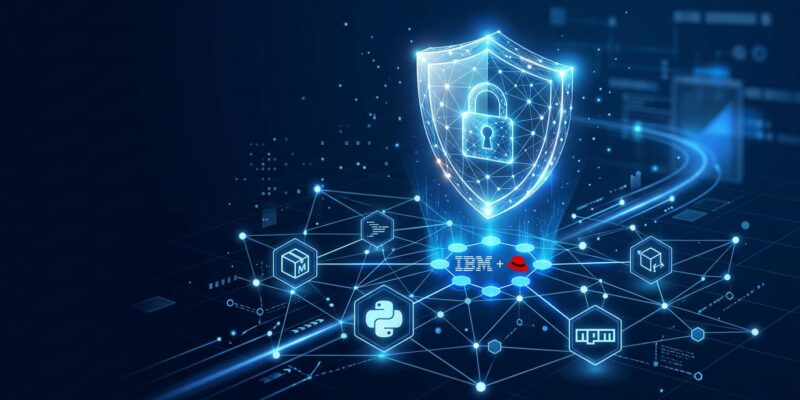
By IBM and Red Hat commercially launched Lightwell on July 8 — a platform that does something most security tools in this space refuse to do: actually fix your vulnerable open source dependencies instead of just listing them. Backed by a $5 billion investment and 20,000 engineers, Lightwell delivers pre-patched, digitally signed artifacts for over 6,500 open source dependencies directly into your existing build pipeline — no workflow change required. The timing is deliberate. AI coding assistants are accelerating dependency adoption faster than any team can vet, and the attackers know it.
Two Products, Two Problems
Lightwell ships as two distinct offerings that target different parts of the supply chain risk problem.
Lightwell Network is the developer-facing product and is generally available now. It gives enterprise teams access to a curated catalog of 6,500+ pre-remediated Java and Python dependencies, delivered as digitally signed binaries in native formats — Maven, PyPI — that drop into your existing build tooling alongside your current public repositories. Every artifact ships with a complete Software Bill of Materials (SBOM) for compliance. You get the fix without touching your pipeline configuration.
Lightwell Clearinghouse Premier is in limited availability, currently restricted to financial services. It acts as a trusted intermediary for coordinated patch embargoes: participating organizations receive a patched artifact before the CVE goes public. Given that attackers exploit vulnerabilities an average of seven days before public disclosure, this window matters — a lot.
The Fix That Scanning Tools Won’t Give You
Here is the actual insight worth paying attention to: every major security scanning tool on the market — Snyk, Sonatype, Black Duck — finds problems. Lightwell fixes them. That sounds obvious, but the implementation detail changes everything.
When a critical CVE lands in a dependency you’re pinned to, the standard playbook is to upgrade to a newer major version that contains the fix. In practice, that often means regression testing, potential breaking changes, and weeks of delay while the vulnerability sits open. Teams frequently stay pinned and accept the known risk because the upgrade cost is too high. Lightwell’s backporting model eliminates that choice: the fix comes to the version you’re already running. No upgrade. No regression window. No trade-off.
As one security analysis put it: “Standard security tools are excellent at identifying problems, but they often leave the remediation to the customer, who is then forced to ‘upgrade’ to a newer version of a library.” The scanning era is not ending — but it is being revealed as insufficient on its own.
AI Velocity Created This Problem. That’s Not a Coincidence.
IBM and Red Hat are not launching a supply chain security product in a vacuum. Black Duck’s 2026 OSSRA report documented a 107% year-over-year increase in vulnerabilities per codebase. The direct culprit: AI coding assistants accelerating dependency adoption faster than engineering teams can audit.
The numbers are stark. 80% of AI-suggested dependency versions carry risks — from hallucinations pointing to non-existent packages, to suggestions of outdated versions with known CVEs. Only 1 in 5 AI-recommended dependencies are safe to ship. Meanwhile, 65% of organizations experienced a software supply chain attack in the past year, with an average breach cost of $4.91 million and 267 days to detect and contain.
Lightwell’s pitch is essentially this: when AI writes your import statements and your code ships faster than humans can review it, you need a trust layer between “AI suggested this package” and “this artifact runs in production.”
What Developers Should Do Now
If your stack is enterprise Java or Python at scale, Lightwell Network is worth evaluating today. The 6,500-dependency catalog at launch covers a substantial slice of the ecosystems where supply chain risk is most acute. The native format delivery means adoption does not require rearchitecting your pipeline — it is a repository swap, not a workflow overhaul.
If you’re in financial services, get on the Lightwell Clearinghouse Premier waitlist. Coordinated embargo access before CVE publication is a genuine competitive advantage in regulated environments where breach timelines get audited.
For everyone else: watch the ecosystem expansion. IBM and Red Hat have announced Java and Python at launch, but Node.js, Go, and Rust are the obvious next targets. The $5 billion commitment and 20,000 engineers backing this effort suggest they’re not treating this as a proof of concept.
The scanning-only era of supply chain security has hit its ceiling. Lightwell is betting that remediation-as-a-service is where the market goes next. Given the scale of the problem, that bet looks well-placed.