 By ByteBot
One developer built a terminal runtime for AI coding agents, hit 25,000 GitHub stars and 363,000 downloads in five months, and is now joining Y Combinator’s F26 batch. Herdr founder Can Celik has made the key commitment upfront: the runtime stays Apache 2.0. No bait and switch.
What Herdr Does
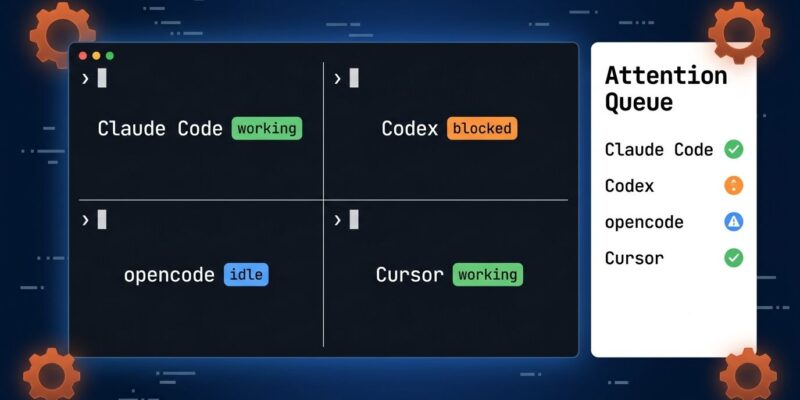
Herdr is a terminal multiplexer written in Rust that gives your existing terminal first-class awareness of AI coding agent state. Run it inside WezTerm, iTerm2, or Kitty — nothing changes about your setup. What you get is a sidebar that shows you, in real time, whether each agent is working, blocked, or idle. Nineteen agents are auto-detected out of the box, including Claude Code, Codex, Cursor, opencode, and Grok.
The core capability is persistent sessions. Agents keep running after you close your laptop. Reconnect later — from any terminal, or from the community-built iOS app — and your agents are exactly where you left them. Sessions are stored as plain JSON in ~/.config/herdr. No cloud sync. No vendor infrastructure in the middle.
The Problem It Solves
If you are running more than one AI coding agent in 2026, you already know the problem. You have Claude Code working on a refactor in one pane, opencode drafting tests in another, and Codex blocked on a prompt you forgot to answer twenty minutes ago. Tab switching becomes the job. Herdr replaces that with an attention queue — working, blocked, done — so you route your attention only where it is needed. When an agent hits something it cannot resolve alone, it shows up as blocked in the sidebar. Everything else runs without you.
The socket API extends this further. Agents can coordinate with each other directly via a local Unix socket at ~/.local/share/herdr/herdr.sock, sending JSON-RPC messages to create panes, read output, and wait for state changes. No human required for agent-to-agent handoffs.
Local-First by Design
The architecture deserves attention. Herdr is a single Rust binary. No external dependencies, no cloud connectivity, no account required. Your code never touches Herdr’s servers because Herdr does not have servers involved in your workflow. Remote execution is SSH to a machine you control: herdr --remote ssh://user@host. That is the extent of the external surface.
For developers who care about where their source code goes — and in 2026, that number is growing — this matters more than any feature list.
Installing and Getting Started
Installation is one command on macOS and Linux:
curl -fsSL https://herdr.dev/install.sh | shWindows beta is available via PowerShell. Homebrew and Nix packages exist for managed installations. Once running, a few CLI commands cover most workflows:
herdr pane split-right          # vertical split
herdr agent read                 # read pane output
herdr --remote ssh://user@host   # remote session
The BetterStack setup guide covers the full installation and configuration walkthrough if you want step-by-step instructions.
The Open-Source Question
Developers have been paying attention to the license switch. Herdr moved from AGPL to Apache 2.0 before announcing the Y Combinator partnership — not after. AGPL has real restrictions on networked services that Apache 2.0 removes. The timing of that upgrade is deliberate: it signals that the licensing is not going to tighten with VC money in the picture.
Celik’s position is unambiguous: the runtime is open, commercial products will be built on top of it for enterprise and multi-machine coordination, and the community plugin ecosystem — 531 plugins, including a Raycast extension and a Stream Deck integration, built by other developers — continues under the same terms.
Whether YC changes that calculus later is a legitimate question. The answer right now is Apache 2.0 with a public pledge. That is more than most tools offer. Read the full announcement on the Herdr blog for Celik’s reasoning in his own words.
Why This Matters Now
Herdr hit its numbers — 25,976 stars, 363,843 downloads — in a five-month window that coincides precisely with the shift to multi-agent development workflows. That is not coincidence. The tool exists because the problem became real this year: developers running one agent occasionally became developers running three or four agents in parallel, and the tooling did not keep up.
A terminal-native, local-first, open-source agent runtime is the right answer to that problem. The alternative — proprietary cloud-routed agent managers — trades control for convenience in a way that most serious developers should not accept. Herdr’s growth says a lot of developers agree.