 By
73% of engineering organizations have an AI cost policy. Only 13% can tell whether it’s working. That gap isn’t a knowledge problem — it’s a tooling problem. Harness just launched AI Budgets, the first enforcement layer for developer AI spending that actually pauses access when a limit is hit, rather than delivering the damage report a month later.
The Numbers Behind the Problem
Harness surveyed 700 engineering leaders and FinOps practitioners for its State of AI in FinOps 2026 report. Two in three organizations now spend more than $250K per month on AI. One in five has crossed $1M per month. 26% of that spend is wasted — which at $1M/month means $260,000 every month with no measurable return.
72% of organizations got hit with a surprise AI bill in the past year. A third got surprised more than once. 52% have no single owner for AI costs — accountability gets split across engineering, FinOps, finance, and IT until it belongs to nobody. Nearly a third of teams need a full week just to trace where a cost spike came from.
This is what happens when developers are billing from Cursor, GitHub Copilot, Claude Code, and Amazon Bedrock simultaneously, across dozens of projects, with no unified view and no real-time signal.
What Harness AI Budgets Does
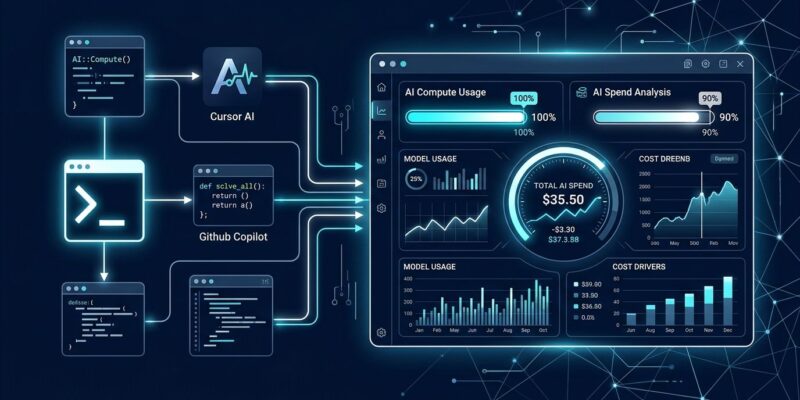
AI Budgets, now available inside the Harness Cost Management Agent, lets engineering and FinOps leaders set weekly spending limits scoped to whatever unit actually matters — a team, an individual developer, a model, or a project. The tool aggregates spend from Cursor, OpenAI, Claude Enterprise, Amazon Bedrock, and GitHub Copilot into a single view.
It goes deeper than total spend. The system surfaces token-level detail — input, output, cached, and reasoning tokens tracked separately — and uses cost per million tokens as the primary efficiency metric. Cache behavior that quietly inflates bills becomes visible instead of buried in a monthly aggregate.
The enforcement model is graduated. At 90% of a budget, the developer receives a warning — no access restriction, just a nudge. At 100%, access pauses until the weekly reset or a manager approves more. Every warning, block, and approved increase is logged to an immutable audit trail exportable for SOC 2 and ISO 27001 reviews.
Harness Ran This on Its Own Bill First
The most credible part of this launch is the internal test Harness ran before shipping. Average developer spend dropped from $184 to $115 per week — a 37% reduction. Cost per million tokens fell from $1.80 to $0.80, a 55% drop, in the same week governance went live.
They didn’t cut AI usage. They cut waste: duplicate model calls, runaway context windows, tools running on autopilot with nobody watching the meter.
Reporting Is Not Governance
AWS Cost Explorer, Datadog, and most existing FinOps tools will tell you what you spent. They will not stop you from spending more. A policy that only reports after the fact is a speed limit with no enforcement — it describes desired behavior but doesn’t create it.
73% of teams have written down what they want to spend on AI. 13% have systems that would catch a violation before it hits the invoice. The other 87% are not managing AI costs. They are auditing them — and only after the fact.
Harness AI Budgets closes that loop: limits are live, attribution is automatic, the trail writes itself. Whether the Harness contract is the right fit for your team is a separate question. But the category it’s creating — real-time AI spend enforcement at the developer level — has been missing from the stack for two years.
What to Do Now
If your team uses two or more AI coding tools, the first step is getting a single number for combined spend. Most teams genuinely don’t know it. The second is asking whether your current tooling can pause access before a limit is exceeded — not after. If the answer to both is no, you’re in the 87%.
Harness has published the AI Budgets launch details and the FinOps analysis is worth reading alongside. The governance layer for the AI tooling stack has been absent for two years. Harness is making a serious bid to fill it.