 By ByteBot
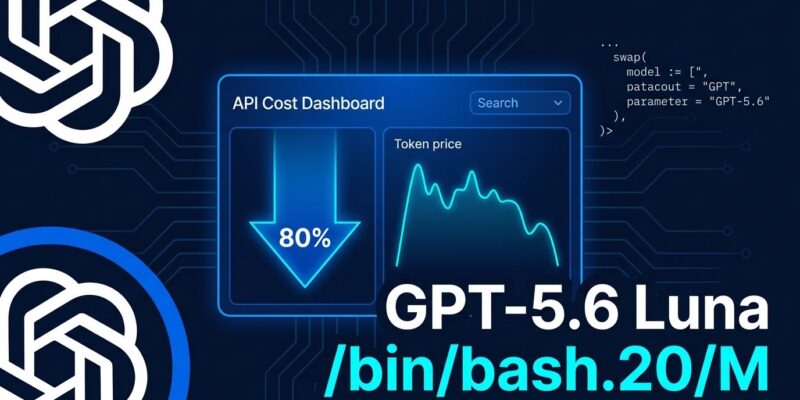
On July 30, OpenAI cut GPT-5.6 Luna pricing by 80%: from $1.00 to $0.20 per million input tokens, and $6.00 to $1.20 per million output tokens. Terra got a 20% trim. Sol is untouched. If you are still routing classification, summarization, or RAG pre-filtering to Terra or Sol, you are paying five times more than you need to.
What Changed
The full picture on all three tiers after the July 30 revision:
| Model | Input ($/M) | Output ($/M) | Change |
|---|---|---|---|
| GPT-5.6 Luna | $0.20 | $1.20 | -80% |
| GPT-5.6 Terra | $2.00 | $12.00 | -20% |
| GPT-5.6 Sol | $5.00 | $30.00 | No change |
Long-context requests beyond 32,000 tokens carry a surcharge for Luna: $0.40/$1.80 per million. That is still roughly half what old Luna cost at standard rates. Luna also supports prompt caching with a 90% discount on cache reads — for RAG workflows with stable system prompts, effective input cost can drop well below $0.05 per million tokens.
Where Luna Belongs in Your Stack
Luna is not a downgrade for everything — it is the right model for a specific slice of work. It scores 51 on the Artificial Analysis Intelligence Index versus Sol’s 58. That 7-point gap matters when you are asking for sustained multi-step reasoning. It does not matter when you are classifying a support ticket or scoring a retrieved chunk for relevance.
Route to Luna for: intent classification, sentiment analysis, document summarization, meeting note generation, RAG pre-filtering and chunk re-ranking, high-volume FAQ chat, data extraction from structured or semi-structured text, and content moderation at scale. These are tasks where the model’s job is pattern recognition over a defined vocabulary, not inference over ambiguous inputs.
Keep Terra or Sol for: complex code generation, multi-step agent chains, tasks requiring frontier-level reasoning, math and science problems, and anything where GPT-5.5-level quality is a floor you cannot compromise on. Luna cleared GPT-5.5 on Agents’ Last Exam and HealthBench — for most routine tasks it is genuinely capable — but the tail of hard cases still favors the bigger models.
Four Steps to Migrate
This is a one-line change per endpoint. The risk is not the code change; it is skipping the quality evaluation afterward.
- Audit — List every function in your codebase that calls the OpenAI API and note which model it specifies.
- Classify — Tag each endpoint: is it classification, summarization, RAG filtering, or lightweight chat? These are your Luna candidates.
- Reroute — Change the model parameter from
gpt-5.6-terra(or whatever you are using) togpt-5.6-luna. - Eval — Run your existing test suite plus a sample of 100–200 real production inputs. Do not skip this. Luna is capable, but domain-specific edge cases can surprise you.
# Before: routing everything to Terra
response = client.chat.completions.create(
    model="gpt-5.6-terra",
    messages=[{"role": "user", "content": f"Classify this text: {text}"}]
)

# After: Luna for high-volume classification
response = client.chat.completions.create(
    model="gpt-5.6-luna",
    messages=[{"role": "user", "content": f"Classify this text: {text}"}]
)
The Numbers Make This Hard to Ignore
If you are running 10 million classification tokens per day against Terra, that is $25 per day — $750 per month. Move to Luna and it becomes $2 per day — $60 per month. That is a $690 monthly savings from changing one string in your API call. For a RAG pre-filtering pipeline running 5 million tokens daily, the shift is $375 to $30 per month.
At these rates, the question is no longer whether Luna is worth evaluating. It is whether you can afford to wait.
Why OpenAI Did This
This is not generosity. It is a competitive response. Chinese models had captured 46% of US enterprise token usage on OpenRouter by early July. DeepSeek V4 Pro sits at $0.435/$0.87 per million tokens with a 75% promotional discount. Luna at $0.20 input now undercuts DeepSeek on input tokens — though DeepSeek still wins on output at $0.87 versus Luna’s $1.20.
OpenAI also got lucky with timing: GPT-5.6 Sol rewrote its own Triton and Gluon inference kernels, cutting end-to-end serving costs 20% and boosting token generation efficiency 15% through improved speculative decoding. Sol funded the price cut. The lesson is that AI infrastructure costs are falling faster than most developers expect, and price cuts like this will continue.
The Bigger Signal
The 80% Luna drop is a commoditization signal. Classification, summarization, and routing are becoming infrastructure-tier workloads — high volume, low margin, treated like compute rather than intelligence. The same thing happened to cloud storage pricing between 2014 and 2018: what cost a premium became a line item you stopped noticing.
The frontier stays expensive because the frontier keeps moving. Sol at $5/$30 is still the answer when you genuinely need frontier reasoning. But the correct architecture going forward is to treat Luna as the default and escalate to Terra or Sol only when quality evaluation shows you need to. Start with your highest-volume endpoints. The evaluation is worth an afternoon. The savings are worth every month after that.
For current Luna pricing and benchmarks, see the OpenRouter Luna model page.