 By ByteBot
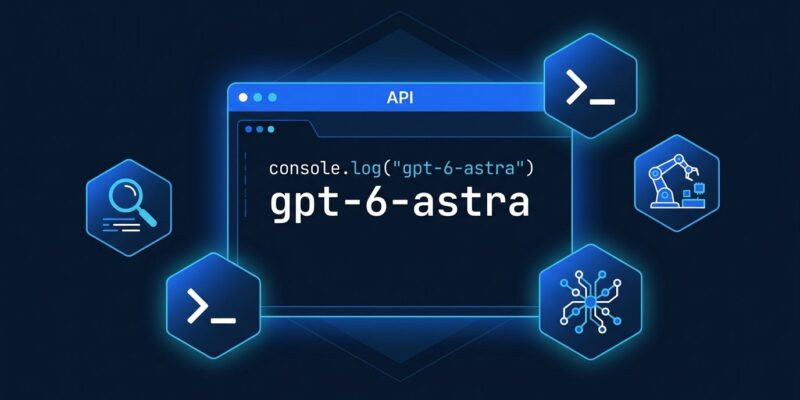
GPT-6 Astra landed in the OpenAI API on September 3 under the Daybreak access program, with broader rollout to Plus, Pro, Business, and Enterprise plans arriving within days. The model ID is gpt-6-astra, the context window is 1.05 million tokens, and OpenAI president Greg Brockman called it a potential AGI. Skip the existential framing — here are the concrete details developers actually need.
What’s in the API
Astra ships with a native tool suite that goes well beyond previous generations: web search, file search, code interpreter, hosted shell, apply-patch, computer use, image generation, and MCP support. That last item is notable — OpenAI’s flagship model now supports the Model Context Protocol natively, which means your existing MCP tool servers work out of the box without a wrapper. That’s the clearest sign yet that MCP won the tool-interoperability debate.
The context window is 1,050,000 tokens with a maximum output of 128,000 tokens. In practice, you can load a full specification, a codebase summary, tool definitions, and conversation history into a single request and still have room. The knowledge cutoff is April 2026. The model is also available on Amazon Bedrock for teams already on that path.
Pricing: Use This Selectively
Standard API pricing is $10 per million input tokens and $50 per million output tokens. Fast mode doubles the price for 2x speed. That puts Astra at roughly 2.5x the cost of the previous generation, at pricing parity with Claude Mythos 5.1 and Fable 5.1.
The honest take: for most production workloads, GPT-4.x or GPT-5.x series remains the economical choice. Astra earns its price on long-horizon agentic tasks — multi-step bug reproduction, autonomous browser workflows, extended research pipelines — where you need maximum quality per token and the task complexity justifies frontier-model spend. Don’t default-upgrade everything to Astra and then wonder why your API bill tripled.
Access and Enterprise Controls
Rollout is staged. The Daybreak program gets access first — that’s OpenAI’s approved-tester tier. Broader access to all ChatGPT and API tiers follows within days of the September 3 launch.
For enterprise teams, the critical note: Astra is disabled by default in workspace settings. Admins need to navigate to workspace settings and explicitly enable it. Daybreak-tier access also requires provisioning fresh API credentials for the relevant project — existing keys won’t automatically gain Astra access. Zero Data Retention is available for eligible API customers, but eligibility depends on your contract tier. Healthcare, legal, and finance teams should confirm before sending sensitive data.
What You Can Actually Build
The most useful new capability isn’t the context window — it’s the combination of hosted shell and apply-patch with computer use. Astra can reproduce a bug, trace it across files, write a patch, execute it in a hosted shell, and verify the fix without a human supervising each step. For front-end work, it can start from a screenshot or design file, generate a UI, and then use computer use to QA the result in an actual browser.
In Codex, Astra maintains notes across context windows and keeps earlier windows searchable — solving the context-collapse problem that made long coding sessions frustrating. This matters for teams running Codex on large refactors or extended research tasks.
On benchmarks, Astra scores 57.7% on Terminal-Bench 4.0 versus Fable 5.1’s 55.8%, and 97.6% on FrontierMath Tier 4 v2 versus 87.8%. Where it doesn’t lead: the coding index, where Claude Fable 5.1 scores approximately 70 to Astra’s 67. If your primary workload is coding, that distinction matters.
The Cybersecurity Restriction
Astra is the first OpenAI model to reach “Critical” status under the Preparedness Framework — meaning it can autonomously find zero-days and develop exploits across well-protected systems. OpenAI’s response is to gate those capabilities even from Daybreak users. The safety overview details layered controls: model-level refusals, system classifiers, and full trajectory monitoring including chain-of-thought.
For security engineers: standard API access does not give you the full capability stack. Offensive security use cases require separate Daybreak approval. That’s inconvenient. It’s also the right call — an unrestricted zero-day-finding model sold per-token is not a defensible product. The Bloomberg report on the cyber safeguards is worth reading if you’re building in that space.
What to Watch Next
OpenAI is testing Private Safety Processing — a mode where even safety classifiers run without retaining data, likely a future enterprise offering for regulated industries. The broader rollout to Plus, Pro, and API tiers should complete within the week. Check the OpenAI API model page for live access status and any pricing updates as Fast mode pricing gets finalized. If you’re on enterprise, get your admin to enable Astra in workspace settings before your team starts requesting it.