 By ByteBot
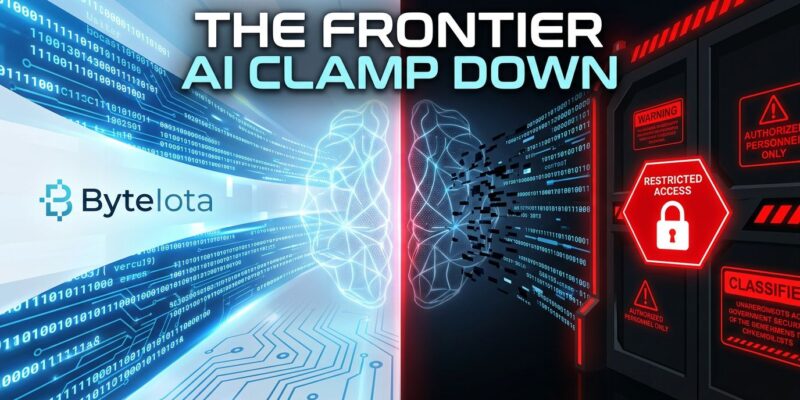
OpenAI’s most capable model to date went live on June 26 — and for the vast majority of developers, it’s completely off-limits. GPT-5.6 Sol, which edges out Claude Mythos 5 on coding and reasoning benchmarks, is accessible only to roughly 20 organizations individually approved by the US government. There’s no public waitlist, no application form. OpenAI says it will reach out to organizations that qualify. Most won’t.
What GPT-5.6 Actually Is
The 5.6 family introduces a new naming convention. The number marks the generation; Sol, Terra, and Luna denote durable capability tiers that advance on their own schedule. Sol is the flagship — built for hard multi-step agents, large-codebase work, scientific reasoning, and cybersecurity research. Terra is the balanced mid-tier, competitive with Claude Fable 5. Luna is the fast, cost-efficient tier for high-volume workloads.
On Terminal-Bench 2.1, Sol posts 88.8%, topping Claude Mythos 5 at 88.0%. Terra and Fable 5 are deadlocked at 84.3%. Luna comes in at 82.5%, putting it above Claude Opus 4.8 at 78.9%. Pricing: Sol at $5/$30 per million tokens (input/output), Terra at $2.50/$15, Luna at $1/$6.
| Model | Terminal-Bench 2.1 | Input (per 1M tokens) | Output (per 1M tokens) | Access |
|---|---|---|---|---|
| GPT-5.6 Sol | 88.8% | $5.00 | $30.00 | Restricted (gov-approved) |
| Claude Mythos 5 | 88.0% | — | — | Restricted (export control) |
| GPT-5.6 Terra | 84.3% | $2.50 | $15.00 | Restricted (gov-approved) |
| Claude Fable 5 | 84.3% | — | — | Restricted (export control) |
| GPT-5.6 Luna | 82.5% | $1.00 | $6.00 | Available now |
| Claude Opus 4.8 | 78.9% | — | — | Available now |
The Access Wall — and It’s Not Just Sol
Here’s what’s getting missed in the coverage: Terra is locked too. Most developers who followed the GPT-5.6 announcement were planning to build on Terra — the balanced, practical tier that competes with Fable 5 at roughly half the cost of Sol. Terra is also in the restricted preview. Only Luna is broadly accessible to standard API customers right now.
The restriction came at the request of the White House’s Office of the National Cyber Director and Office of Science and Technology Policy. OpenAI previewed its plans and the models’ capabilities to the US government ahead of launch. At their request, the company limited the initial rollout to a small group of trusted partners — organizations whose participation was individually shared with the administration. No one is disclosing who those partners are.
OpenAI Complied — and Then Objected Publicly
The most striking part of this story isn’t the restriction. It’s that OpenAI published a dissent in the same announcement: “We don’t believe this kind of government access process should become the long-term default. It keeps the best tools from users, developers, enterprises, cyber defenders, and global partners who need them.”
A company complying with a government request while simultaneously calling that request a bad policy is an unusual move. It signals that OpenAI didn’t have much leverage here but wanted the record to reflect its disagreement. The company says it will make GPT-5.6 generally available “in the coming weeks” — though that timeline has no specific date attached to it.
The Precedent Is the Story
This is the first time the US government has proactively gated a commercial AI model launch. Earlier this month, Trump signed an executive order asking AI companies to voluntarily submit advanced models for government review 30 days before release — the window was originally 90 days, lobbied down by Musk, Zuckerberg, and Sacks. Voluntary. No enforcement mechanism. OpenAI complied anyway.
There’s a darker recent precedent. Anthropic’s Fable 5 and Mythos 5 were briefly shut down under export control authority — retroactively, with roughly 90 minutes’ notice. The GPT-5.6 restriction is proactive and pre-negotiated, which arguably sets a worse norm: it signals that frontier model launches now pass through a government gate before reaching developers as standard procedure.
The freefable.org petition, signed by over 100 cybersecurity researchers, makes the counter-argument: GPT-5.5, Claude Opus, and multiple open-source models already power red teams daily. Sol isn’t uniquely dangerous — locking it away from defenders just benefits attackers who will find other means.
What Developers Should Do Right Now
Luna is available today via the standard OpenAI API. At 82.5% on Terminal-Bench, it outperforms Claude Opus 4.8 and handles most production workloads without issue. For frontier-level work that genuinely needs Sol-class reasoning, GPT-5.5 remains accessible. Architects building agentic systems should hold off on Terra dependencies until the GA date is confirmed — designing around a model you can’t access is a liability.
The broader takeaway: “government-approved partner” is now a product boundary in the AI market. It’s a moat for incumbents, a barrier for startups, and a signal that open API access to the most capable models may be quietly ending. OpenAI hopes this is temporary. The executive order structure suggests otherwise.