 By ByteBot
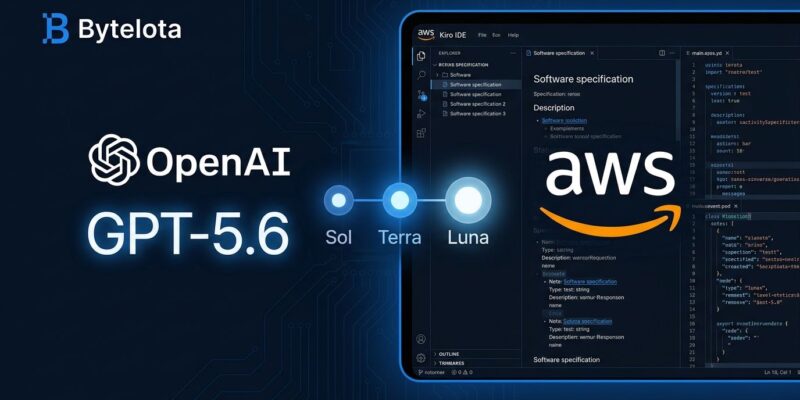
OpenAI’s full GPT-5.6 model family — Sol, Terra, and Luna — landed inside Kiro, AWS’s spec-driven coding agent IDE, on August 24. The joint announcement comes with a headline number: 82% cost reduction per completed agentic task on Terminal-Bench 2.1. That figure needs unpacking before you restructure your agent stack around it.
What the 82% Actually Measures
The 82% is not a price cut. GPT-5.6 did not get 82% cheaper overnight. The claim measures token consumption: when you run GPT-5.6 inside Kiro’s structured workflow, completing a Terminal-Bench 2.1 task requires 82% fewer tokens than an unstructured agent session.
The reason is plausible. Kiro hands the model requirements documents, technical designs, and a concrete task list before generation begins. The model wastes fewer tokens on misaligned outputs, fewer turns retrying bad patches, fewer iterations figuring out what it is supposed to build. Spec-driven context reduces noise in long agentic loops.
The caveat is real: OpenAI and AWS do not break out how much of the reduction comes from Kiro’s scaffolding versus the model’s own efficiency improvements. The benchmark is legitimate, but it is not your production codebase. Treat 82% as directionally honest, not literally applicable.
Three Models, Three Price Points
GPT-5.6 in Kiro comes in three tiers, and picking the right one matters more than the aggregate cost claim:
- Luna (/bin/bash.20 input / .20 output per million tokens): Optimized for high-volume, low-latency work — routing, extraction, summarization, voice agents. At this price, continuous background agents become economically viable.
- Terra (.50 / 5 per million): The workhorse tier. AWS lowered Terra’s credit multiplier specifically for Kiro sessions. Right for most professional development tasks — middleware, test generation, code review, schema transforms.
- Sol ( / 0 per million through November, then / 0): Frontier-level reasoning. On Terminal-Bench 2.1, Sol scored 88.8% and Sol Ultra reached 91.9%, edging Claude Mythos 5 at 88.0%. Use Sol when the codebase is large, the logic is complex, or a wrong answer is costly.
Default to Terra. Move to Sol when complexity or stakes demand it. Reserve Luna for high-volume automation where throughput matters more than precision.
How Kiro’s Workflow Actually Works
The cost reduction only applies if you use Kiro as designed. The IDE adds a structured planning layer that most coding agents skip:
- Specs: You define requirements, user stories, and acceptance criteria. Kiro generates a technical design and breaks it into an ordered task list.
- Steering files: Persistent markdown files versioned in your repo that specify tech stack, architecture patterns, and conventions. Every agent session inherits them automatically.
- Agent hooks: Event-driven triggers — like GitHub Actions inside your IDE — that fire agentic tasks on file saves, changes, or commits.
A steering file looks like this in practice:
# tech.md
Stack: Next.js 15, TypeScript 5.9, PostgreSQL via Prisma
Testing: Vitest for unit, Playwright for E2E
Never use: any-typed returns, inline styles
Auth: Always use NextAuth v5 patterns
Once it is in the repo, Kiro includes it in every agent context window. You stop repeating yourself; the agent stops making the same category of mistakes. This is where the token savings actually come from — not from the model being smarter, but from the model being less confused.
Why OpenAI and AWS Did This Deal
The partnership is mutually convenient. OpenAI gets distribution through AWS’s enterprise customer base without building its own IDE. AWS gets a second model family for Kiro alongside Claude, reducing vendor lock-in concerns and giving developers a real cost lever — Luna is substantially cheaper than Claude Sonnet on Bedrock for equivalent volume tasks.
This follows a pattern: OpenAI put GPT-5.5 and Codex on Amazon Bedrock in April 2026 (limited preview). August’s move is GA and workflow-integrated — deeper than a model listing on a marketplace.
Where Kiro Fits in the Current Field
The AI coding agent landscape in late August 2026 is crowded: Claude Code, OpenAI Codex, Cursor (now SpaceX-owned), Grok Build (Apache 2.0, eight parallel subagents), Google Antigravity. Each tool is carving a lane.
Kiro’s lane is structure. The spec-driven approach adds friction upfront — writing a proper spec takes real effort — but reduces chaos downstream. For a 20-minute prototype, that tradeoff is bad. For a week-long autonomous agent run that needs to stay on spec, it is exactly the point. Adding GPT-5.6 means developers can apply that structure with the model they already trust, rather than being locked into Claude.
Read OpenAI’s full announcement and the Kiro pricing update before adjusting your agent configuration. The Kiro documentation covers steering file setup in detail if you want to test the workflow yourself.