 By ByteBot
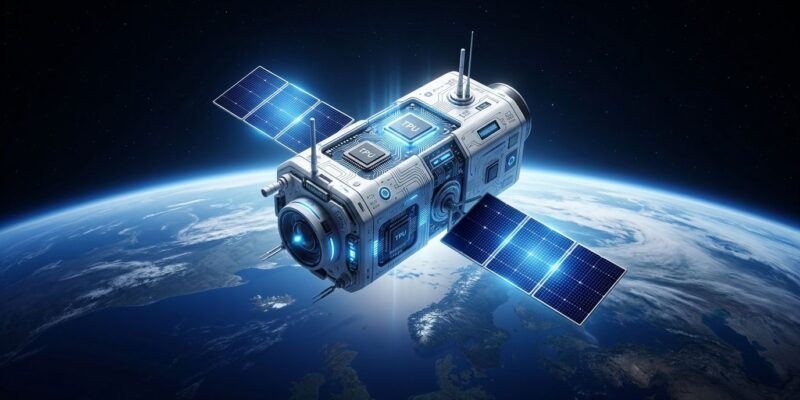
On October 1, Google strapped a refrigerator-sized satellite onto a SpaceX Falcon 9 and sent it into orbit. Inside: four of Google’s own Tensor Processing Units, a kilowatt of solar panels, and enough thermal engineering to run AI inference for exactly fifteen minutes before the whole thing needs to cool down. This is Project Suncatcher — Google’s first real test of space-based AI compute. It’s not a product. It’s not even close to a product. But it’s a serious bet on where AI infrastructure is going, and it launched yesterday.
The Energy Crisis That Made Space Sound Reasonable
To understand why a serious company is building data centers in orbit, you have to look at what’s happening on the ground. Global data center electricity consumption is projected to hit 1,000 TWh by the end of 2026 — up from 415 TWh just two years ago. That’s Japan’s entire annual electricity budget, consumed by servers. Major tech companies spent roughly $650 billion on AI data centers this year. Morgan Stanley projects a 49 GW power shortfall in the US by 2028.
The bottleneck isn’t money. It’s the grid. You can throw capital at a data center, but you can’t build new transmission lines on the timeline AI deployment demands. Space sidesteps the problem entirely: the sun delivers roughly 1,300 watts per square meter in orbit, with no grid operators, no permitting delays, and no brownout risk. That’s the pitch.
What Google Actually Launched
The MVP satellite — Google’s name for it, fittingly — carries four Trillium TPUs with aggregate compute comparable to a single data-center server. Its solar array produces about 1 kilowatt of power. For reference, that’s a household hair dryer. That budget runs a version of Google’s Gemma open-weight model handling simple inference queries during 15-minute windows, after which the chips need to shut down and radiate heat into space before the next cycle.
The orbit is sun-synchronous, meaning the solar panels stay in near-constant sunlight. The partnership is with Planet Labs, the satellite imagery company that knows how to keep hardware alive in LEO. The launch was SpaceX. Google is not reinventing rockets — they’re bringing the chips.
The Result That Actually Matters
The 15-minute runtime is the number everyone’s leading with, and it’s a real constraint. But the engineering result that should interest developers is the radiation hardening finding. Google tested the Trillium TPUs at Crocker Nuclear Laboratory, exposing them to cyclotron radiation simulating five years of space exposure. The chips experienced bit flips — random errors caused by cosmic ray strikes. The fix? Restart the chip. The errors cleared.
That sounds underwhelming until you consider the alternative: chips that fail permanently and permanently brick a satellite. A restart-recoverable error model is the difference between a serviceable orbital compute cluster and a very expensive piece of space junk. It’s not a solved problem, but it’s a tractable one. According to NPR’s coverage, the full system still needs production-grade fault tolerance — but the underlying chip behavior is more forgiving than expected.
Google Is Not Alone in This Race
Starcloud, a startup that raised $170 million in March, already has a satellite in orbit carrying an Nvidia H100 GPU and has been running AI workloads since November 2025. SpaceX filed FCC plans in January for a million-satellite constellation targeting 100 gigawatts of orbital AI compute — connected to Starlink via 1 Tbps laser links. Three serious players, real hardware, real money.
Google’s bigger vision, outlined in their published research, is an 81-satellite cluster spanning a 1km radius, with satellites communicating via laser links. Two more prototypes are planned for 2027 to test those inter-satellite connections. The architecture is modular — smaller satellites flying in close proximity, forming a distributed data center in orbit.
The Honest Timeline
Travis Beals, the project lead, called this “a very minimal test” and expressed uncertainty about economic viability within five years. That kind of candor is rare in tech announcements, and it’s appropriate here. Current space compute costs around $8.64 per GPU-hour versus $2.37 on the ground. Launch costs need to drop from today’s ~$1,500–$2,900/kg to roughly $200/kg for the economics to work. BCG’s analysis puts cost parity at around 2040.
That’s fifteen years. In 2006, nobody believed enterprises would run production workloads on AWS virtual machines. The infrastructure assumptions that feel permanent today have a history of being wrong at exactly the moment the energy math stops adding up. Right now, the energy math on the ground is starting to fail. That’s what made a fridge full of TPUs in orbit worth the experiment.