 By
By Google published its 2025 open source retrospective this month, and most of the coverage focused on the numbers. Twenty thousand non-Google contributors. Four hundred million Gemma downloads. Two million dollars in project funding. Impressive figures, but they’re the wrong thing to pay attention to. The real story is a behavioral pattern — one Google shares with Anthropic and OpenAI — that tells you exactly where AI infrastructure is heading and what you should be building on.
The Playbook Nobody Announced
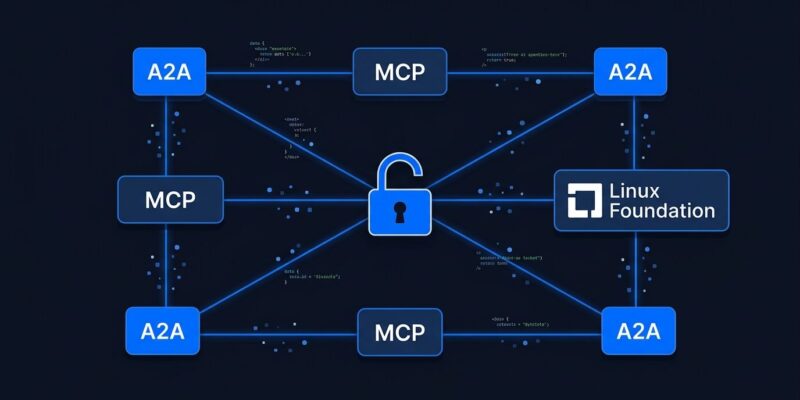
In 2025, every major AI company executed the same move: donate the protocol, keep the product. Google donated its Agent2Agent (A2A) protocol to the Linux Foundation in June. Anthropic donated the Model Context Protocol (MCP) to the Linux Foundation’s Agentic AI Foundation in December. OpenAI contributed AGENTS.md to the same foundation. AWS, Cisco, Microsoft, Salesforce, SAP, and ServiceNow all signed on as backers.
This is not altruism. Donating a protocol to a vendor-neutral foundation locks in the standard — one the donating company helped shape — while preventing any competitor from forking, closing, or deprecating it on a whim. It’s a calculated move that happens to benefit developers. If you build your agent communication layer on A2A and your tool-connection layer on MCP, you’re building on infrastructure that no single company can pull out from under you. That is not a small thing in 2026, when 81 percent of enterprise leaders report being concerned about AI vendor dependency.
A2A: Build on It Now
Agent2Agent is an open protocol for communication between independent AI agents. It lets agents built by different vendors discover each other, exchange messages, manage tasks, and return artifacts — using HTTP, SSE, and JSON-RPC rather than bespoke integration code. The Linux Foundation formally launched the A2A project with more than 100 backing companies. Version 1.0.1 shipped in May 2026 with an extension mechanism for new data types and RPC methods.
The comparison to HTTP is useful but imprecise. HTTP standardized how documents and data move between servers and clients. A2A standardizes how agents delegate tasks to each other. If you’re building a multi-agent system in 2026 without A2A, you’re writing custom integration code that will look like a liability within 18 months. The standard is here, it’s backed by the right organizations, and the adoption curve is steep.
MCP handles the other half: connecting agents to external tools, APIs, and data sources. With 97 million monthly SDK downloads and 10,000 active servers, MCP is already infrastructure. If you’re on Python, the MCP Python SDK v2 migration is worth reviewing before building new servers. A2A and MCP together give you the full interoperability stack for multi-agent systems. Neither is going anywhere.
Gemma 4 and the Apache 2.0 Flip
The other signal buried in Google’s 2025 retrospective is Gemma 4. Released in April 2026 under Apache 2.0 — no monthly active user caps, no acceptable-use enforcement, full commercial freedom — Gemma 4 is the first model in the Gemma line that engineering teams can legally treat as a drop-in replacement for frontier API calls in production.
The numbers support taking it seriously: 400 million total Gemma downloads, 100,000 community-built variants, real-world deployments including government automation in Ukraine and multilingual AI across India’s 22 official languages. Meta used the same playbook with Llama to dominate self-hosted model deployments. Google has now matched it. If your use case involves latency-sensitive inference, privacy-sensitive data, or cost-sensitive API budgets, Gemma 4’s Apache 2.0 license removes the legal ambiguity that previously made the evaluation conversation awkward.
What the Numbers Actually Signal
Google’s OSPO put $2 million into 40-plus projects across Apache, CNCF, Eclipse, Linux Foundation, and Python Software Foundation in 2025. Two million dollars is a rounding error for Alphabet. What’s more meaningful is the 20,000 non-Google contributors to Alphabet-led projects. When LLVM, vLLM, Kubernetes, Envoy, and gRPC draw that kind of external participation, it means Google-initiated infrastructure has become community infrastructure — projects that don’t die when Google loses interest in them.
Google Summer of Code 2025 saw 1,280 contributors across 185 organizations and a record 98,698 registrations — a 124 percent increase over the previous high. The talent pipeline for these projects is healthy. That matters when you’re deciding whether to build a long-term dependency on any of this infrastructure.
Three Things to Do Now
Audit your agent communication layer. If your multi-agent system uses proprietary or custom protocols for agent-to-agent coordination, plan the migration to A2A now. The window before it becomes the obvious default is shrinking fast.
Revisit Gemma 4 for self-hosted workloads. Especially if you’re running on GCP, where integration is frictionless. Apache 2.0 means your legal team has nothing to complain about.
Check your inference stack governance. vLLM, LLVM, Envoy — verify you’re on community-governed versions, not vendor-locked forks. The governance structure determines what happens when priorities change.
Google’s retrospective is a PR document. The information inside it is real. The pattern it confirms — open protocol, closed product — is the defining infrastructure bet of 2026. Make it consciously.