 By ByteBot
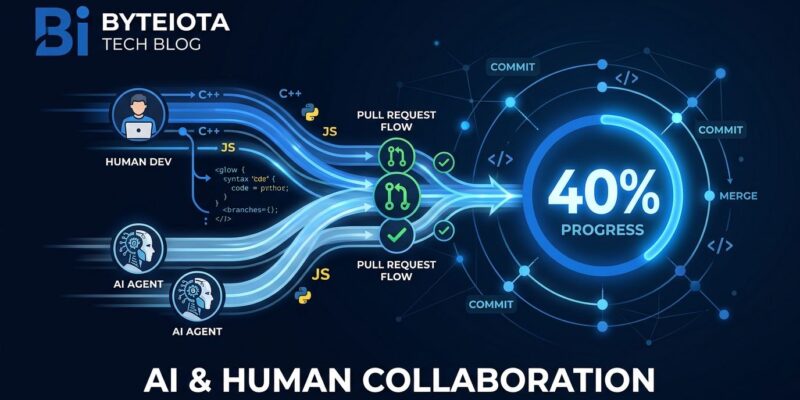
GitHub’s Octoverse 2026 report, released yesterday at GitHub Universe, puts a hard number on something developers have been debating in the abstract: as of September 2026, more than 40% of pull requests on GitHub started with an agent’s first draft. That was 17% in March. Six months, 2.4x growth, 110 million agent-started PRs in a single month. The inflection point wasn’t coming — it already happened.
GitHub Had to Buy 4 Million CPU Cores
The headline stat doesn’t land until you understand what it did to GitHub’s infrastructure. September logged 7.4 billion commits — five times the volume from a year earlier. That surge caused repeated outages; on May 7, GitHub’s 90-day availability dropped to roughly 84%. The platform that hosts most of the world’s code was getting crushed by the volume of code being written on it.
GitHub’s response: 4 million additional CPU cores, 160 petabytes of high-speed storage, and 50 Tb/s of additional network capacity. The company is also separating compute from storage — a structural change it says will deliver 35x more throughput. A migration to multi-region Azure deployment is planned for early 2027. When a platform has to rebuild its architecture because developers started using agents, agents are no longer a feature. They’re load-bearing infrastructure.
The Agent Configuration File Is a Force Multiplier
Here is the most actionable finding in the report: among repositories created in 2026, repos with an agent configuration file logged eight times more commits than repos without one. Not 20% more. Eight times.
If your team hasn’t added an agent configuration file to your repository, you’re operating at roughly 12% of the commit velocity of teams that have. That’s not a philosophical stance about AI — it’s a setup problem with a straightforward fix. The 8x gap is the practical cost of not having one.
Agent PRs Are Broader — and Merge Faster
There’s a persistent assumption that agent-generated code is lower quality. The Octoverse data complicates that story. Agent pull requests changed multiple files 87% of the time, versus 79% for human-only PRs. They’re broader in scope. And 90% of agent PRs merged within two weeks, compared to 86% for traditional ones.
The exception is security work. Security-adjacent agent PRs face longer review cycles and lower merge rates — human maintainers are more cautious there, and reasonably so. The broader research on this is consistent: agent PRs aren’t worse on average, but they require reviewers who know what to look for. GitHub’s own guidance on reviewing agent PRs is worth reading before your team hits the 40% threshold internally.
No Single Model Runs Your Team Anymore
The multi-model shift is accelerating. Developers on paid Copilot plans used 29 distinct models in May and 47 by September. No single model handled more than 25% of requests in September. Sixty-one percent of users who manually selected a model used more than one model across their sessions.
The single-model workflow — “we use GPT-X for everything” — describes an increasingly small fraction of how professional developers actually work. The Copilot Fusion announcement at Universe (GA as of this week) is partly a response to this: let the system route tasks to the right model rather than making developers manage that manually.
The Rest of the Octoverse Numbers
The full Octoverse report covers more ground. Total commits hit 34.3 billion for the year — 3x two years ago. GitHub Actions ran 45 billion jobs: 1,440 per second, triple last year. India is now the second largest developer community at 32 million, growing at 46% year-over-year versus the US at 37%. TypeScript holds the top language spot; Rust doubled in the past year and has the fastest percentage growth in the top 10.
The picture the data paints: software development volume is growing faster than at any point in GitHub’s history, agents are the primary driver, and the developers who’ve integrated agents into their repositories from day one are running a fundamentally different operation from those who haven’t. The 8x commit gap won’t close by watching from the sidelines.