
 By ByteBot
Anthropic built Scion to survive 30,000 agent merges a day and explicitly said you can’t have it. Someone did not take that well. A developer forked GitLab’s Gitaly, implemented Scion’s published design in Go, released it MIT-licensed, and shipped four versions in ten days. It’s called git-ai.
Git Isn’t Broken. The Client Model Is.
The framing matters here. AI agents aren’t destroying Git’s data model — they’re destroying the assumption that each participant maintains a full local clone and queues merges linearly. That assumption held for teams of humans. It fails for teams of agents.
The numbers are specific enough to take seriously. A study of 33,596 agent pull requests found that 79.4% execute in temporal overlap with at least one other PR. Cross-agent conflict rates hit 41.7%. Even same-agent deployments clock in at 19.8% conflicts. At Anthropic, Claude coding agents pushed their internal monorepo from 2,500 merges per day in May 2026 to 30,000 by September — a 12x surge that no merge queue architecture was designed to absorb.
Anthropic’s response was Scion: a server-centric VCS where clients don’t clone full history, the server handles commits and merges, and the global merge lock is gone. Infrastructure footprint dropped 200x. CI checkouts went from minutes to seconds. They also said Scion is internal and won’t be open-sourced.
What git-ai Actually Does
git-ai is an independent Go implementation of Scion’s published design. It starts from GitLab’s Gitaly — existing Git clients work over the same wire protocol — and adds three architectural changes that standard Git doesn’t have.
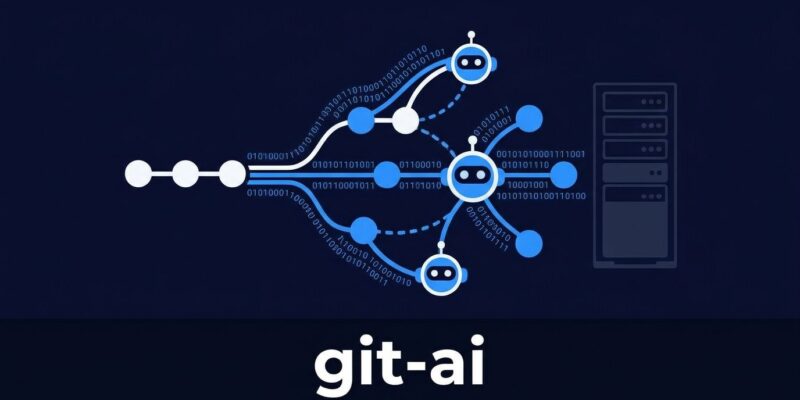
Compare-and-swap landing. Instead of queuing merges sequentially, each agent rebases its change onto the current tip and attempts a single CAS operation. Concurrent lands on the same branch are batched into one reference update server-side. No global lock, no serialized wait.
LLM-assisted conflict resolution. When a land conflicts, it goes to a resolver you configure — any LLM provider, any deterministic tool, or nothing. The model’s output is treated as a proposal: it only lands if your verify.command passes on the exact tree that would merge. If verification fails, the agent receives the conflict package with the proposal. The server never calls an LLM directly — every AI feature is opt-in and vendor-neutral.
Post-merge auto-revert. A separate tool, graft-verify, watches branch updates, runs your test command against the tip, and — if you opt in — bisects failures and reverts the exact change that caused them. Auto-bisection is disabled by default.
The Performance Numbers
The v0.2.0 benchmark ran 100 agents attempting 500 changes (20% intentionally conflicting) on one branch, with no conflict resolver configured:
- git-ai: 392 of 500 changes land at 1,422–1,686 landings per minute
- Classic mode (same server, batching disabled): 115–121 changes at ~206 per minute
That’s a 7–9x throughput improvement under real concurrency pressure. The 108 un-landed changes were the planned conflicts — expected without a resolver configured. This is a repeatable acceptance test the project ships in its own repo, not a demo benchmark.
How to Run It
git-ai runs as a self-hosted server. Docker Compose works for local testing; the Helm chart (API/UI, worker, PostgreSQL, Valkey, ClickHouse) targets production Kubernetes. Existing Git clients need no changes.
One thing to clarify: there is a separate commercial product also named “git-ai” operated by git-ai-project. That is unrelated to feder-cr/git-ai — the open-source Scion-inspired server. No Anthropic affiliation either.
The Bigger Picture
You don’t need 30,000 merges a day to feel this. Five or ten Claude Code, Codex, or Cursor agents running against a shared repo is enough to hit the conflict wall. The architectural direction is already set: Cursor is building a similar server-centric VCS (Origin), and Anthropic has asked the Git project to adopt compatible server-side improvements. The question is how quickly tooling catches up.
git-ai is ten days old, four releases in, benchmarked on a laptop — but it is a direct, practical response to a documented production problem. The independent review at Wavect confirms the CAS model works as documented. Anthropic set the design target. git-ai is the thing you can actually run today.


