 By ByteBot
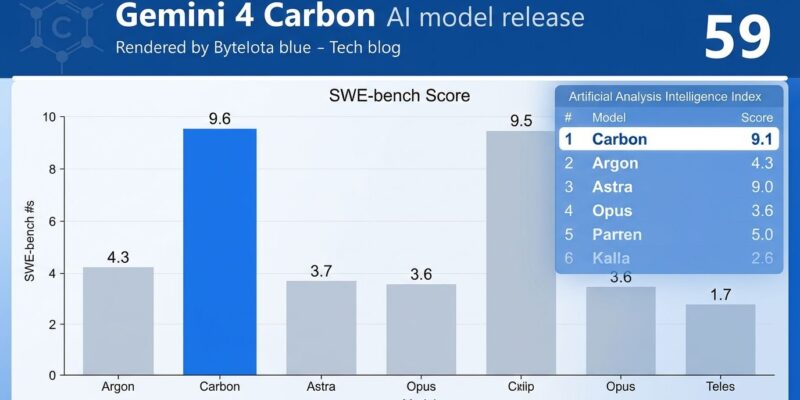
Google unveiled Gemini 4 Carbon on October 28, its most powerful frontier model to date. Arriving just 15 days after Gemini 4 Argon became broadly available, Carbon claims the top spot on the Artificial Analysis Intelligence Index v5 with a score of 59 — ahead of Claude Opus 5.5 (58) and GPT-6 Astra (57). There is one catch: it is not on the public API yet, and no release date is set. For developers, that gap between announcement and access defines the Carbon story right now.
The Agentic Leap
Carbon’s headline improvement is not on a chat benchmark. It targets the kind of tasks that actually break AI coding tools in production: long, multi-step workflows requiring planning, tool calls, self-correction, and persistence through dead ends.
On SWE-bench — the industry standard for evaluating AI on real-world software engineering tasks — Carbon scores 9.6%, up from Argon’s 4.3%. That is more than double in a single model generation. On Terminal-Bench 4.0, which tests agentic terminal command execution, Carbon scores 65 versus 59 for both Argon and GPT-6 Astra.
According to Google’s announcement, internal teams have run Carbon for days on complex engineering problems: root-causing bugs across large codebases, patching low-level system vulnerabilities, and running complete defensive security workflows autonomously. That is a qualitative shift from a model that helps you write a function to one that can manage a full repair cycle on an unfamiliar system.
Reliability Over Raw Speed
The more underreported story is reliability. Carbon cuts unsupported claims — hallucinations in a coding context — by approximately 2x compared to Argon. In live coding environments, high-severity misalignment alerts dropped nearly 80%. On Omniscience v1.1, a factual accuracy benchmark, Carbon scores 54 against Claude Opus 5.5’s 48.
This matters more than most developers realize. An agent running for hours needs to stay on task without fabricating function signatures, package names, or file paths. The benchmark race gets the headlines. A 2x hallucination reduction is what makes a model safe to run unsupervised.
What the Benchmarks Actually Show
Carbon ranks first overall — but the claim that it dominates coding falls apart under scrutiny. On the Coding Agent Index, Claude Opus 5.5 still leads: 62 versus Carbon’s 59. On FrontierCode, it is 56% for Opus 5.5 versus 51% for Carbon. On FrontierSWE 2, GPT-6 Astra takes the top spot at 65.5%, ahead of Opus 5.5’s 62.3% and Carbon’s 61.2%.
| Model | Intelligence Index | SWE-bench | Coding Agent Index | Input Cost |
|---|---|---|---|---|
| Gemini 4 Carbon | 59 (#1) | 9.6% | 59 | $2/M (intro) |
| Claude Opus 5.5 | 58 | 3.6% | 62 | $4/M |
| GPT-6 Astra | 57 | 9.5% | — | ~$5/M |
The honest read: Carbon leads on long-horizon agentic runs and factual accuracy. For pure code generation, Opus 5.5 and GPT-6 Astra remain competitive or ahead. Full benchmark breakdown here. Pick by task type, not headline.
The Access Problem
Carbon’s initial rollout runs through Google’s Fairwind Program — a network of over 650 vetted partners, prioritizing governments, national cyber authorities, healthcare systems, and critical infrastructure operators. Wider developer and consumer access is “coming soon,” with no timeline given.
At intro pricing, Carbon costs $2 per million input tokens and $10 per million output tokens — half the cost of Opus 5.5 at standard rates. The 1 million token context window makes it attractive for large-codebase workloads. But none of that matters until there is an API endpoint to call. The Artificial Analysis model page will reflect availability when it changes.
Every week Carbon stays off the public API, developers default to what is accessible. Claude and OpenAI ship immediately. Google announces and stages. The developer mindshare gap that creates compounds over time.
What to Do Now
If your organization qualifies for the Fairwind Program, apply for early access through Google DeepMind. Otherwise, watch for Carbon’s arrival in Google AI Studio and Vertex AI — that is where most developers will first encounter it.
For agentic coding work today, Carbon’s benchmark profile suggests it will be the strongest option for long-running workflows once available. For code generation tasks that finish in seconds or minutes, Opus 5.5 and Astra are already accessible and remain competitive. Carbon is a meaningful step forward on the benchmarks that matter for production agentic systems. The question is how long Google makes developers wait to use it.