 By ByteBot
A developer named Low-Zi-Hong published a working distributed language model inference engine on GitHub over the weekend, and it is exactly as surprising as it sounds. Seven ESP32-S3 microcontrollers — chips you can buy for about $4 apiece — are running a 0.4-billion-parameter language model in a SPI daisy-chain pipeline. Total hardware cost: around $28. The project landed on Hacker News’s front page today and has the embedded AI community paying close attention.
The reason this is possible in 2026, when it would have been absurd in 2024, is a technique called 1.58-bit quantization. Microsoft’s BitNet research team published a method that constrains every model weight to one of three values: −1, 0, or +1. The name comes from the math: log₂(3) equals 1.58, meaning you need just 1.58 bits to represent three states. The practical payoff is that inference no longer requires floating-point multiplication. Multiply by −1 and you flip the sign. Multiply by +1 and you keep it. Multiply by 0 and you zero it out. Every operation becomes an addition or a no-op, and that is something a microcontroller can do.
How the Cluster Is Built
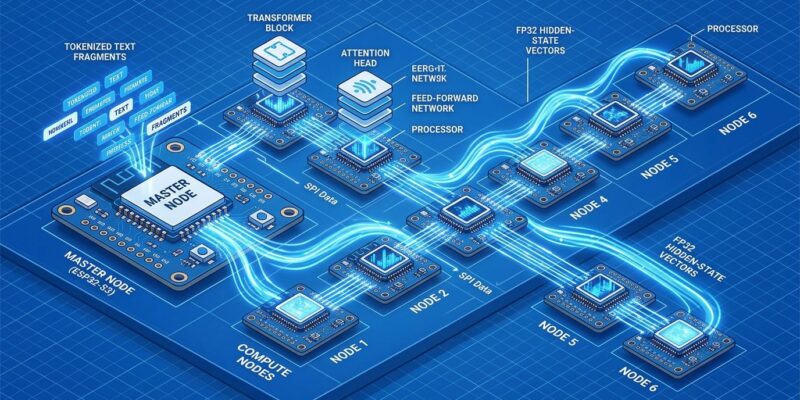
The architecture is a pipeline. One ESP32-S3 acts as the master node: it tokenizes input, runs an embedding lookup (INT4-quantized, about 14MB stored in flash), and fires the resulting FP32 hidden-state vector down the chain via SPI. Six compute nodes each receive that vector, run four of the model’s 24 transformer blocks using assembly-optimized 1.58-bit linear operations, and pass the updated vector forward to the next node. The KV-cache is distributed across each compute node’s PSRAM. When the chain completes, the master runs final layer normalization and decodes the output token.
The developer wrote custom firmware for both the master and compute roles, along with Python tooling to slice the model weights, pack them into the 1.58-bit format, and serialize the tokenizer for the embedded runtime. This is not a wrapper around an existing library — it is custom embedded ML engineering from the ground up.
What the $28 Price Tag Actually Means
Cost matters here in a specific way. In July 2026, another developer got a 28.9-million-parameter model running on a single ESP32-S3 at roughly 10 tokens per second. That was a milestone. The Low-Zi-Hong cluster runs a model 14 times larger for 3.5 times the hardware cost. The ratio is striking.
But the more important comparison is against the cloud. Calling a hosted LLM API requires internet connectivity, sends your data off-device, and costs real money at IoT scale. A $28 cluster requires none of those things after the hardware is purchased. For a deployment covering thousands of sensors — think industrial monitoring, smart agriculture, or security systems in areas without reliable connectivity — the economics and the privacy profile look completely different from any cloud-based approach.
This is the same routing problem that Jev (TypeSafe) and Jeff (Firelex) solve for hosted workloads, just at the opposite end of the deployment spectrum. Jev is a cloud-hosted API that answers in 70 to 500 milliseconds. The ESP32 cluster is fully offline and requires no cloud account, no API key, and no connectivity after flashing.
What Developers Should Know Before Getting Excited
There are real caveats worth stating clearly. The cluster’s actual token throughput has not been published, and it matters: the SPI daisy-chain introduces inter-node latency on every token, and FP32 hidden-state transfer across six hops is likely the bottleneck, not the 1.58-bit compute itself. Microsoft explicitly states that BitNet b1.58 is not ready for commercial deployment without additional testing. And the 0.4B model, while considerably more capable than the 28.9M solo-board model, is still far from a general-purpose assistant.
The practical applications today are narrow: offline intent routing, keyword classification, input triage, anomaly detection. The ESP32-S3 already ships in production-grade wake-word detection products. Pairing that with an on-device semantic router using a BitNet model is a realistic near-term project. Expecting it to replace a hosted LLM for complex tasks is not.
The Direction This Is Pointing
Embedded AI has been converging on microcontrollers for two years. Edge Impulse was acquired by Qualcomm. Arm’s Embedded World 2026 showcase centered on always-on multimodal inference from MCU-class silicon. The question was never whether MCUs would run language models — it was when, and under what constraints.
A $28 distributed LLM cluster answers both. It is a research project today. Given the trajectory of BitNet quantization research, distributed inference frameworks, and MCU memory capacity improvements, a production pattern for narrow on-device language tasks is 18 to 24 months out. Developers building IoT systems now should be watching this closely. The official BitNet b1.58 2B4T model is on Hugging Face, and the reference inference framework is open-source. The infrastructure exists. The hardware is $4 a node.