 By ByteBot
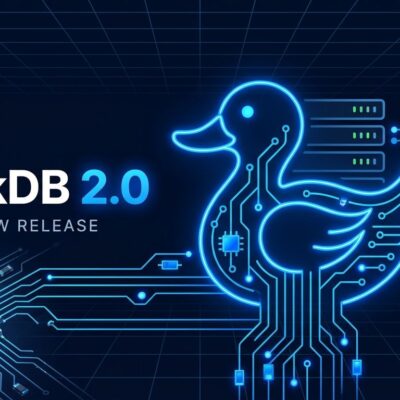
DuckDB built its reputation on a single promise: no server required. You pip install duckdb, you query your data, you move on. That changed this week. The DuckDB v2.0 preview, published August 17 under the codename Cyanoptera, adds a full client/server mode. If you have been waiting for a reason to deploy DuckDB with shared access, that reason just arrived.
Server Mode: What the Quack Extension Actually Does
The new feature is called Quack — a client/server protocol built into DuckDB core, using HTTP and Apache Arrow as the transport layer. Any DuckDB process can now act as a server. Everything that session can see (in-memory tables, attached files, schemas) becomes queryable over the network from other DuckDB clients.
Connecting from another DuckDB instance is one line:
CONNECT 'quack:analytics-server.internal:9494';

-- Query it like a local table
SELECT region, SUM(revenue) FROM remote.sales GROUP BY region;
The default port is 9494. Authentication uses a random token generated on startup, with a pluggable callback for custom auth. Because the transport is plain HTTP, your existing reverse proxies — nginx, Caddy — handle TLS and load balancing without any reconfiguration. There is no proprietary wire protocol to wrestle with. Quack also lets DuckDB query other databases (PostgreSQL, MySQL) over the same protocol, which makes it useful beyond just DuckDB-to-DuckDB connectivity.
This solves the objection that blocked many teams from going all-in on DuckDB: shared access. You could use it for local analytics, but the moment two services needed to query the same dataset concurrently, you were stuck. Quack removes that wall.
Async I/O: The Numbers That Matter
Server mode gets the headline, but the async I/O rewrite may have more immediate impact for most developers. DuckDB’s I/O layer now scales independently from query execution — the engine can saturate network bandwidth while simultaneously processing data rather than stalling on reads. The team published a detailed async I/O post in July; v2.0 is where it lands in a stable release.
On AWS (EC2 r7i.16xlarge, same-region S3, TPC-H SF100 dataset):
- CSV queries: 887 seconds → 45 seconds (nearly 20x faster)
- Single-file Parquet queries: 3.7x faster
- Recursive queries: 40x faster than v1.5.4
If your DuckDB workloads touch remote storage — S3, GCS, Azure Blob — you get these gains without changing a single line of application code. It is a free upgrade for existing users.
Triggers, VARIANT, and a New SQL Parser
v2.0 rounds out the feature list with full trigger support: BEFORE and AFTER, FOR EACH ROW and FOR EACH STATEMENT, transition tables via REFERENCING OLD/NEW TABLE, and DROP TRIGGER. That covers audit logging, cache invalidation, and derived table maintenance without external tooling.
The VARIANT type, introduced in v1.5 and enhanced in v2.0, stores typed binary data rather than text — unlike the JSON type. It compresses well, automatically infers structure from semi-structured data, and delivers faster processing. Think of it as Snowflake’s VARIANT semantics with DuckDB-native speed.
DuckDB replaces its PostgreSQL-derived SQL parser with a custom PEG-based parser. The practical result: error messages now point to the exact failing token, and extensions can extend SQL syntax — not just add scalar functions. InfoWorld’s coverage of v2.0 has more detail on the parser change if you maintain extensions.
Breaking Changes: Storage Migration and C API
Two v2.0 changes require action from existing users.
New storage format. Your existing .duckdb files will not open in v2.0 without migration. The team is shipping a migration tool before the stable release. If you have production DuckDB databases, start planning the migration window now. The v1.4 LTS remains available for teams that need to hold on the current format through the transition.
Stable C API. The old C++ API was unstable — every DuckDB release required extension authors to recompile their extensions from scratch. The new C API in v2.0 is stable: write your extension once, sign it, host it, and it installs on any v2.0+ build. This is a breaking change that fixes a long-standing pain point for the extension ecosystem.
The Take
Adding server mode to an in-process database is a risk. The usual outcome: “we tried to be everything and ended up as nothing.” DuckDB sidesteps this by keeping Quack on top of HTTP+Arrow rather than building a full wire protocol, and by leaving the library-first use case entirely unchanged. If you never need shared access, nothing about your existing DuckDB code changes.
The storage format migration is the real friction. If you have live production .duckdb files, this is a real migration event — not a drop-in upgrade. Plan for it before fall 2026.
Preview builds are available now on the DuckDB nightly channel. The Hacker News discussion (644 points, 116 comments) is worth reading for real-world adoption patterns before the stable v2.0 lands this fall.