 By ByteBot
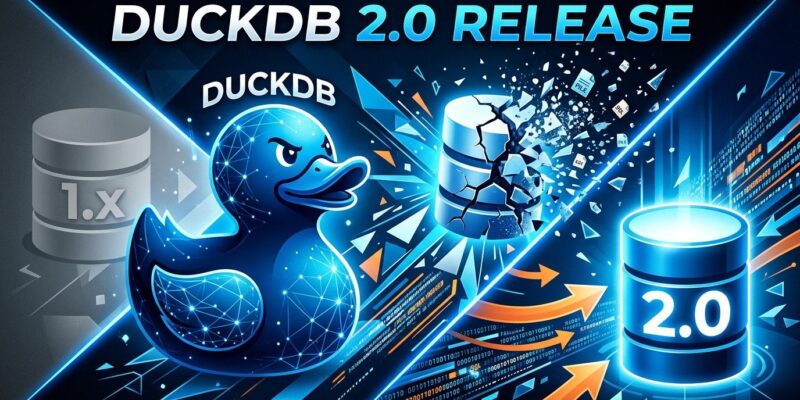
DuckDB 2.0.0 LTS “Cinnamon Teal” shipped today, October 21 — the project’s first long-term support release and its largest ever, built on roughly 20,000 commits since v1.5. Before you upgrade, there is one thing to know: pre-2.0 DuckDB clients cannot read files created by DuckDB 2.0. That storage incompatibility is the real lead here, not the shiny new Quack protocol or the VARIANT type.
The Storage Break: What It Means for Your Pipelines
DuckDB 2.0 writes database files in a new storage format (version 69). Any version before 2.0 cannot open those files. DuckDB 2.0 itself can still read and write your existing pre-2.0 files, and those files stay in the old format when 2.0 touches them — so backward compatibility runs one direction only.
The practical danger is mixed deployments. If multiple processes share a DuckDB file and you upgrade some but not others, the 2.0 process will eventually write a file the 1.x processes cannot open. Coordinate upgrades carefully, or things will break quietly. According to the official DuckDB 2.0 migration guide, the supported path is to export and reimport between versions:
# Export from 1.x
/older/duckdb mydata.db -c "EXPORT DATABASE 'tmp_export'"
# Import with 2.0
/newer/duckdb mydata_new.db -c "IMPORT DATABASE 'tmp_export'"
The DuckDB team is direct about this: “In all cases, we recommend setting up a shadow system that tracks your existing workload.” Run 2.0 in parallel against a copy of production before cutting over. The first patch release is expected in November — mission-critical systems should consider waiting for it.
LTS Timeline: When You Actually Need to Upgrade
DuckDB 2.0 is supported until October 2027. DuckDB 1.5 received a retroactive LTS designation and is now supported until March 2027. However, DuckDB 1.4 support ends in November 2026 — one month away. If you are on 1.4, that deadline is now.
This LTS model is new territory for DuckDB. The project has historically shipped fast and broken things; a formal support commitment signals that the team now sees DuckDB as production infrastructure, not just an analytics convenience tool. For enterprise teams who have been hesitant about DuckDB in production, this is the version to take seriously.
What Makes DuckDB 2.0 Worth the Trouble
The async I/O rewrite is the most practically significant improvement for data engineers. Parquet and CSV reads on S3 now happen in the background independently from query execution, delivering what the team calls “dramatically faster queries on object storage.” Recursive CTEs on million-edge graphs benchmark at 0.12 seconds versus 4.90 seconds in v1.5.4 — a 40x improvement according to the DuckDB 2.0 highlights preview.
The VARIANT type is the other major addition. It stores JSON-like semi-structured data with automatic structure detection and columnar compression, so you get the flexibility of JSON without the query performance penalty. Triggers arrive for the first time, enabling audit tables and incremental materialized view maintenance without external tooling. The CLI’s new agent mode cuts output volume by 59% compared to the default box-drawing format — if you are using DuckDB inside AI coding agents, this matters. The Quack protocol turns DuckDB into a proper networked server; connect to it with -connect from any DuckDB client.
Three Gotchas to Check Before You Upgrade
Lambda syntax breaks silently. The single-arrow form (x -> x + 1) is disabled by default in 2.0 and throws an error. Switch to the Python-style syntax, or use the temporary bridge flag until you migrate:
-- Breaks in DuckDB 2.0
SELECT list_transform([1, 2, 3], x -> x + 1);

-- Required syntax
SELECT list_transform([1, 2, 3], lambda x: x + 1);

-- Temporary bridge (removed entirely in 2.1)
SET lambda_syntax = 'enable_single_arrow';
Division by zero behavior changed. Previously, 1 // 0 and 1 % 0 returned NULL. In DuckDB 2.0, they throw errors. Analytics queries that relied on the NULL fallback will now fail. Audit any query that performs integer division over untrusted or variable-range data before upgrading.
Python 3.10 is dropped — DuckDB 2.0 requires Python 3.11 or later. Check your runtime before bumping the package. Two smaller issues: S3 URL parameters are now disabled (use the Secrets API instead), and the preserve_case setting changed from a boolean to a VARCHAR accepting 'preserve_case', 'lowercase', or 'uppercase'. Separately, macOS x86_64 community extensions no longer build; full x86_64 support ends in 2.1. Intel Mac users should factor that into their migration timeline. For a full checklist, the DuckDB 2.0 upgrade guide covers each breaking change in detail.
Key Takeaways
- Pre-2.0 DuckDB clients cannot read 2.0-format files — coordinate mixed deployments carefully before upgrading.
- Migration requires EXPORT/IMPORT between versions; test on a shadow system first, not production.
- On DuckDB 1.4? Upgrade now — support ends November 2026. On 1.5? You have runway until March 2027.
- Async I/O on S3, the VARIANT type, SQL triggers, and the Quack server protocol are the headline additions worth the upgrade cost.
- Check for lambda syntax usage, division-by-zero patterns, and Python version (3.11+ required) before bumping the package.