 By ByteBot
DeepSeek just challenged one of AI’s most fundamental assumptions: that you need expensive human-labeled reasoning data to build frontier-level models. Their DeepSeek R1 model, released January 20, achieved OpenAI o1-comparable performance using pure reinforcement learning—no supervised fine-tuning required. The result? Open-source reasoning models running on developers’ laptops, downloaded over a million times in their first month.
The Pure RL Breakthrough
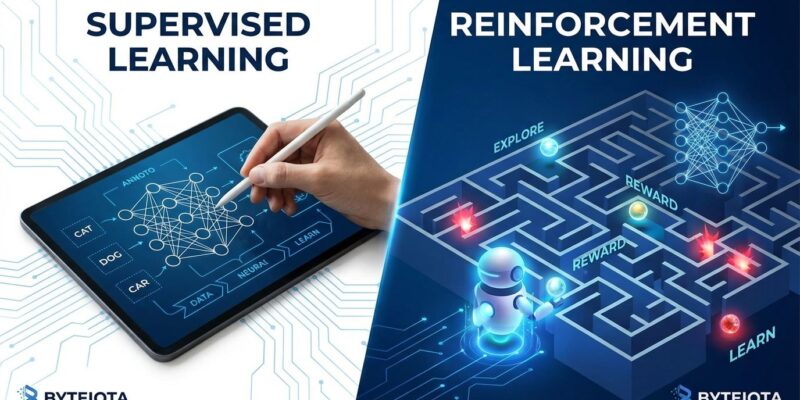
Every major AI lab follows the same playbook: supervised fine-tuning (SFT) first, where humans label correct reasoning steps, then reinforcement learning to refine behavior. ChatGPT uses it. Claude uses it. OpenAI’s o1 presumably uses it. The assumption is that you need human demonstrations before RL can work.
DeepSeek-R1-Zero proves otherwise. Trained purely via reinforcement learning without any SFT preliminary step, it developed capabilities that typically require explicit human guidance: self-verification, reflection, and chain-of-thought reasoning. These behaviors emerged organically from sparse reward signals, not from annotators showing the model how to think.
The technical insight matters: RL tends toward better generalization while SFT tends toward memorization. When DeepSeek published their full methodology in a 60+ page whitepaper expansion, they validated what pure reinforcement learning can achieve. On AIME 2024 math problems, R1-Zero’s score jumped from 15.6% to 71.0% through pure RL alone—eventually reaching 86.7% with majority voting, matching OpenAI’s o1-0912.
Performance That Challenges the Narrative
Benchmarks tell the story. On AIME 2024, DeepSeek-R1 scored 79.8% versus OpenAI o1’s 79.2%. On MATH-500, R1 leads at 97.3% versus o1’s 96.4%. Codeforces rankings are nearly identical: 96.3% versus 96.6%. General knowledge (MMLU) gives o1 an edge at 91.8% versus 90.8%, but the pattern is clear: performance parity.
This matters because of what it challenges. The prevailing narrative says frontier AI requires massive capital, armies of annotators, and US-based compute clusters. DeepSeek achieved comparable results despite resource constraints and export restrictions on advanced chips. Not through bigger budgets—through smarter methodology.
Democratization Through Open Source
The real impact is in accessibility. DeepSeek open-sourced everything: model weights from 1.5B to 70B parameters on GitHub and HuggingFace, distilled models based on Llama and Qwen, and full training documentation. Developers downloaded these models over a million times in the first month.
Their 32B distilled model outperforms OpenAI’s o1-mini on multiple benchmarks while running on consumer hardware. Installation is straightforward using vLLM:
vllm serve deepseek-ai/DeepSeek-R1-Distill-Qwen-32B --tensor-parallel-size 2This enables local deployment with no API costs, full data privacy, and customization freedom. The API, where available, costs over 90% less than OpenAI’s o1. For startups like Perplexity and Lovable building on foundation models, this fundamentally changes the economics.
Timing and the 2026 Shift
DeepSeek’s release aligns perfectly with 2026’s shift from hype to pragmatism. The industry is moving away from “building ever-larger models” toward making AI actually usable. Resource efficiency matters more than scale. Open models compete directly with closed alternatives. Real-world deployment trumps flashy demos.
R1 exemplifies this transition. It proves that innovative training methodology beats brute-force scaling. That open-source AI can match closed-source performance. That reasoning capabilities don’t require monopolistic resources.
What Happens Next
DeepSeek’s V4 model is expected mid-February 2026. Other AI labs will likely explore pure RL approaches now that the methodology is validated. The reasoning premium that justified OpenAI’s pricing is eroding as capabilities commoditize.
The deeper question: what does it mean when a Chinese lab achieves performance parity with OpenAI? Not through catching up on compute, but by rethinking fundamentals. The answer might be that AI’s geographic concentration is ending, that massive budgets aren’t the only path to frontier models, and that 2026’s “accountability phase” demands results over resources.
Pure reinforcement learning won’t replace all AI training methods. But it challenges the orthodoxy about what’s necessary. And when you can run o1-level reasoning on your laptop for free, the entire premise of restricted API access starts looking less like competitive advantage and more like friction.