 By
By DeepSeek shipped Harness v0.1 in developer preview today — an open-source, MIT-licensed agent runtime that puts the company in direct competition with Claude Code. The catch: on the same day, DeepSeek quietly quadrupled prices for its V4-Pro API. That combination tells you everything about the strategy.
Everything Is a Plugin — and That’s the Point
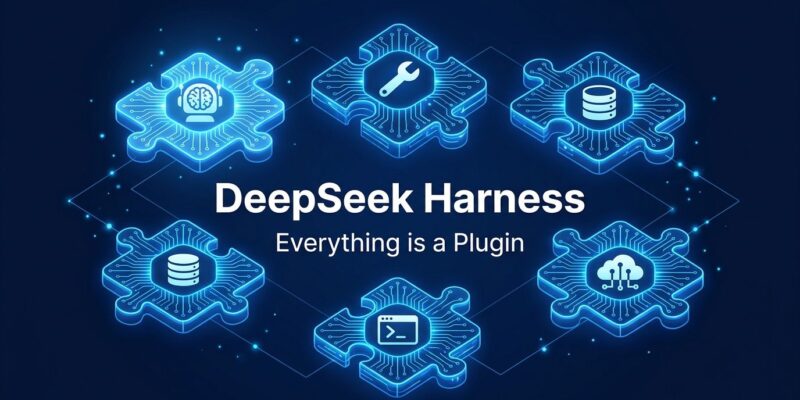
The design philosophy is straightforward: “Everything is a plugin. Every run is traceable.” DeepSeek Harness is built on Cordis, a service-dependency meta-framework that treats every agent capability as a replaceable, hot-swappable component. The model, the tools, the agent loop, the session log, sandboxes, scheduling, and even the UI are all Cordis plugins you can swap from configuration — no source changes required.
Four runtime modes ship with v0.1:
- Standard — full agent with file editing, shell access, web search, and workflow management
- Code — the model generates TypeScript to orchestrate multi-step tool operations
- Minimal — benchmarking only: bash shell plus string-replace editor
- Creator — development environment for authoring and inspecting custom plugins
You can spin it up right now with a single command:
npx @deepseek-ai/dsh webThat launches a Web UI at http://127.0.0.1:3080. Pick a model provider, point it at your workspace, and you’re running agents. For headless automation: dsh --profile headless "run the tests and summarize failures".
It Runs Any Model — Not Just DeepSeek
Despite the name, Harness is model-agnostic. The provider catalog covers DeepSeek, Anthropic, OpenAI, AWS Bedrock, Microsoft Azure, Google Vertex, and any OpenAI-compatible endpoint. This isn’t a marketing footnote — inference is just another Cordis plugin. DeepSeek isn’t betting on model lock-in here; it’s betting on the runtime layer becoming infrastructure developers depend on regardless of which model they choose.
That’s a meaningfully different competitive posture than Claude Code, which is built around Anthropic’s model stack by design.
Session Transparency Is the Technical Edge
Where Harness genuinely differentiates: session logging. Everything the model sees — system prompts, reasoning chains, tool calls, results, context injections — is recorded in an append-only event stream. Developers get a Trajectory view that lets them resume, fork, search, and replay runs from the same log. On Hacker News, this got significant attention; commenters noted it makes visible what closed systems “encrypt or obfuscate.” For teams debugging agents in production, that traceability matters.
The Price Twist You Should Not Miss
Here’s the part worth noting: DeepSeek released an open-source agent harness and raised V4-Pro API prices on the same day. Effective August 16, output token costs jump from $0.87 to $3.96 at peak rates — a 4.6x increase. Even the off-peak price ($1.98) now exceeds what the peak rate used to be. DeepSeek quietly removed earlier statements about “significantly enhanced agent capabilities” after the announcement landed to mixed developer reception.
The read on this: give away the runtime, charge for the inference. Classic razor-and-blades, except the blades just got expensive. Whether the open harness generates enough ecosystem momentum to justify the model price hike is the question that matters for DeepSeek’s next twelve months.
What to Do Right Now
If you’re building agent harness infrastructure, experimenting with plugin-first architectures, or want a fully inspectable alternative to proprietary agents, Harness v0.1 is worth an afternoon. The GitHub repo is live under MIT license and the official docs are at deepseek.com/harness/en.
If you need stability for production systems: wait. Version 0.1.0-rc.5 ships with an explicit warning that breaking changes are coming. The plugin API is not stable, documentation lags the code, and the plugin governance story is still being figured out. The Hacker News thread captures the split well: impressed by the architecture, skeptical about long-term plugin ecosystem health.
The bigger picture: DeepSeek just moved from model provider to developer tooling company. That’s the competitive shift to track. Whether Harness v1.0 delivers on the architecture’s promise will determine whether the agent runtime layer stays Anthropic’s territory or becomes genuinely contested ground.