
 By ByteBot
Cursor shipped its Agent SDK this week, and the pitch is blunt: stop configuring AI agents in dashboards and start treating them like code. Prompts live in Markdown, tools are TypeScript functions, the whole thing goes in Git, and you deploy it with a single CLI command. It’s a genuine shift — with real limitations worth knowing before you commit.
Agents Are a Folder of Files Now
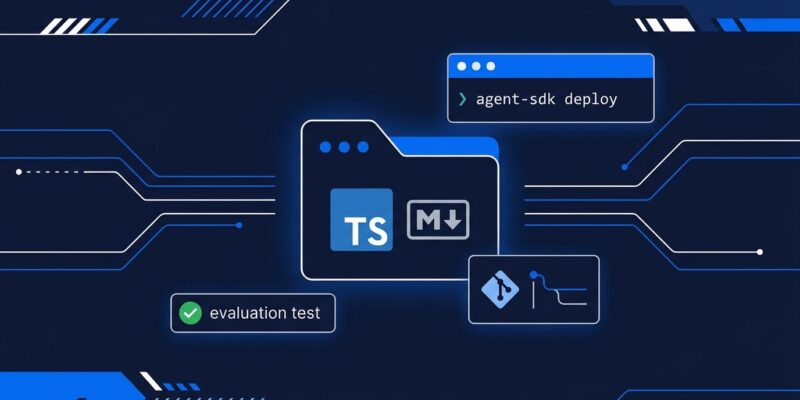
The Cursor Agent SDK defines an agent as a project directory. instructions.md holds the system prompt. A tools/ directory holds typed TypeScript functions the model can invoke. channels/ connects the agent to event sources — GitHub pull requests, GitLab CI runs, Slack mentions, arbitrary webhooks, or cron schedules. evals/ contains the test suite. The whole structure lives in source control like any other service.
npx @cursor/agent-sdk init ./my-bot
agent-sdk dev        # local playground
agent-sdk deploy     # push to Cursor-managed infra
Teams can scaffold from templates: a PR reviewer that leaves inline GitHub comments, a security scanner that runs on every push, an ownership-policy gatekeeper, or an issue triager for Linear or Jira. The Cursor team notes one internal team shipped a knowledge-base reviewer in roughly a day.
Evals Are the Real Story
Most agent SDKs give you a runtime. The Cursor SDK gives you a test harness too, and that distinction matters. Each eval sends a fixed input to the agent and asserts on what happened: which tools ran, with what arguments, and what the response shape looked like. An event replay feature lets you run evals against real historical pull requests without waiting for new code to land.
Developers immediately flagged the eval system as the headline capability. The framing resonates: prompts finally get the same treatment code does. You can iterate on a prompt, lock in the improvement with an eval, and prevent a future change from quietly breaking it. That’s a level of rigor most teams currently achieve only in retrospect, after something breaks in production.
“We’re excited about the SDK as a path to running our own programmatic agents on that same cloud runtime, without managing VMs or working around memory limits.”
— Senior engineering manager at Faire
Deployment: Managed or Self-Hosted
Two paths. agent-sdk deploy pushes the agent to Cursor’s managed infrastructure — it gets a URL, logs, and secret management through a dashboard. agent-sdk serve runs the agent as a single Node.js process on your own infrastructure, useful for teams with data residency requirements or custom routing needs. Pricing follows Cursor’s token-based model; the SDK doesn’t carry a separate tier, but frequent triggers and large eval suites will show up in costs.
What the SDK Doesn’t Do (Yet)
The Agent SDK is TypeScript-only. Python teams can use the Cloud Agents REST API as a workaround, but there’s no Python-native SDK equivalent. Agents are also stateless between runs by default — memory and long-running context are yours to build. Documentation is sparse for non-trivial patterns: multi-agent orchestration and long-running agents are underserved. The license is proprietary, not open-source. And behavior between local and cloud deployments diverges in at least one known configuration area, which is the kind of friction that surfaces mid-project.
These aren’t blockers for every team. But they’re the difference between “worth trying” and “worth adopting as core infrastructure.”
The Bigger Picture
The “agents as code” framing isn’t unique to Cursor — it’s a direction the whole industry is moving. Developers have noted it mirrors the Kubernetes model: declare infrastructure, version it, deploy and observe. Separately, Anthropic’s Agent Skills standard just moved to the Linux Foundation under the same logic — reusable agent instructions should be portable, versionable, and not owned by one vendor. Cursor’s SDK is a more opinionated implementation of the same premise, tightly integrated with an IDE that millions of developers already use daily.
The strategic read: whoever defines how agents are built for a team keeps the developer relationship. Cursor is betting that the right interface isn’t a model API or a chat window — it’s a deployment platform for agent code.
Who Should Pay Attention
The Cursor Agent SDK is worth serious attention if your team is already using Cursor, writes TypeScript, and has recurring workflows running on ad-hoc scripts or fragile prompt engineering. The eval system alone is worth the evaluation time. If you’re Python-first or need open-source guarantees, the picture is murkier — check the REST API route and watch the documentation improve over the next few months.


