 By ByteBot
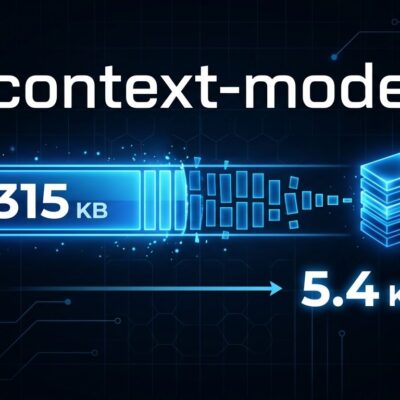
Developers now use AI for roughly 60% of their work. But when Anthropic surveyed its own users, those same developers reported being able to fully delegate only 0–20% of tasks. They are not delegating — they are supervising. The reason is not that the models are too weak. GPT-6 Astra and Claude Fable 5.1 both clear 57% on Terminal-Bench 4.0. The reason is that most teams are still trying to fix broken agent behavior by rewriting prompts. That is the wrong lever. The right lever is context engineering — and Anthropic just published a guide that cut 80% of Claude Code’s own system prompt with no measurable capability loss.
Prompt Engineering Is Not Context Engineering
Prompt engineering is what you write inside the context window. Context engineering is how you decide what fills that window at every step — project conventions, architecture decisions, test patterns, hard rules — managed at the system level, not the conversation level.
When an agent produces wrong output, the reflex is to rewrite the prompt. But the failure almost never lives in the prompt. It lives in everything around the prompt: the files the agent does not know exist, the naming convention it keeps violating, the one command it always gets wrong. You can prompt your way around each of these exactly once. Context engineering fixes them once for everyone on the team.
The numbers back this up. Anthropic’s 2026 Agentic Coding Trends Report found that teams with well-maintained context files see 40% fewer errors and complete tasks 55% faster than those without. A separate study on agentic tasks found task success rates jumping from 30% to 90% just from adding well-structured context files — same model, same prompts, different context.
The AGENTS.md That Actually Works
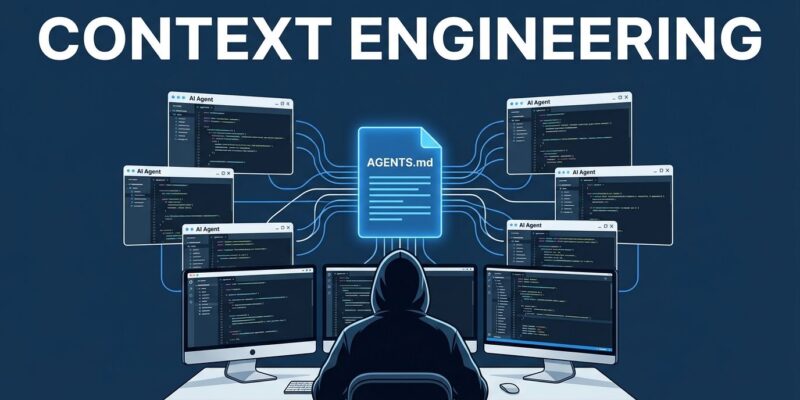
AGENTS.md has become the universal context standard. Claude Code, Codex, Cursor, Aider, GitHub Copilot, Gemini CLI, and Windsurf all read it. You write it once, every agent on your team benefits.
Analysis of 466 open-source projects found three types of entries that produce results:
- Descriptive: what the project is, where things live (
/src/routes/is API,/db/migrations/is never edited manually) - Prescriptive: exact commands, commit format, review steps
- Prohibitive: hard rules the agent must never break (never push to main, never touch generated files)
The rule for what belongs: every entry should trace back to a failure you have actually seen. Generic best practices copied from another team’s template add noise and dilute adherence. Keep the file under 200 lines — beyond that, token cost climbs and the agent’s adherence drops.
Half of all AGENTS.md files analyzed are never updated after the first commit. That is the most common failure mode: writing the file once, treating it like documentation, and wondering why the agent keeps making the same mistakes three months later.
The Six Shifts That Let Anthropic Cut 80% of Their Own Prompt
When Anthropic audited Claude Code’s system prompt, they found it had grown into something nobody would write from scratch. They cut over 80% of it. Performance did not move. Their published breakdown names six specific shifts that made it possible:
- Rules to judgment — Stop micromanaging decisions the model can infer from context
- Examples to interface design — If you need 10 examples to explain something, the interface is wrong
- Upfront context to progressive disclosure — Load on demand, not all at startup
- Repetition to simple descriptions — Stating a rule once is enough; repeating it trains the agent to ignore it
- Manual memory to auto-memory — Use auto-compact and session hooks instead of hand-managing state
- Simple specs to rich references — Link to actual code and docs, not summaries of them
If your CLAUDE.md has 20 rules, nested sub-bullets, and three blocks of examples, it is overconstrained for 2026 models. Anthropic’s claude doctor command can audit it.
Context Rot Is a Real Problem
Every frontier model tested degrades as context length increases. The effect is not linear — it follows a U-shape: information at the start and end of the context survives well; information buried in the middle drops 30%+ in recall accuracy.
This matters more now than it did a year ago. Average Claude Code session length has climbed from 4 minutes in Q1 2025 to 23 minutes in Q1 2026. Longer sessions mean more context accumulation, which means more drift. Agents forget earlier constraints, repeat fixes that already failed, and start mixing requirements from different parts of the session.
The practical fixes: the GSD framework (Gather, Summarize, Dispatch) actively manages context across steps rather than letting it accumulate. Dynamic tool selection — giving the agent a curated loadout per task rather than all available tools — improved performance by 44% in controlled tests, according to Redis’s context rot research. Sub-agent quarantine, where each sub-agent receives a clean context window with only what it needs, is the architectural answer for long-running pipelines.
The Industry Is Betting on This Layer
Factory raised $200M at a $5B valuation in September 2026 — tripling its valuation from five months prior. The pitch is not a better coding assistant; it is a software factory: agents that share organizational context across code review, security testing, documentation, and incident response. One context layer spanning the entire software lifecycle.
That is the direction the enterprise market is moving. Context engineering becomes infrastructure — something you build and maintain alongside your CI/CD pipeline, not a personal trick for getting better completions.
Start This Week
If you are using Claude Code, Codex, or Cursor and you do not have a maintained AGENTS.md, that is the first fix. Keep it under 200 lines. Make every entry trace to a real failure. Add an explicit never-do section at the bottom. Review Anthropic’s 2026 Agentic Coding Trends Report for the benchmark data on what context quality actually costs you in task success rate. Then run claude doctor if you are on Claude Code and see what it flags.
The delegation gap is a context problem, not a model problem. The models are ready. The question is whether your context is.