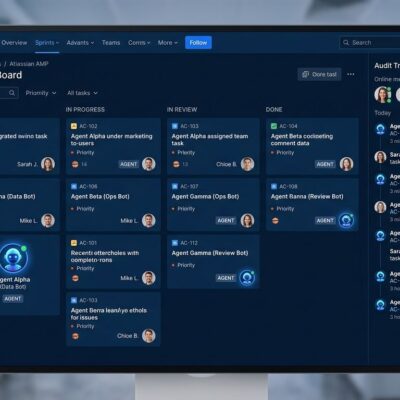
Amazon CloudWatch launched Coding Agent Insights on July 20, 2026, giving engineering teams their first AWS-native dashboard for tracking AI coding tool spend, adoption, and output. It supports Claude Code, GitHub Copilot, and Codex via OpenTelemetry, and it plugs directly into existing CloudWatch infrastructure without a separate SaaS subscription. For engineering leaders who’ve been spending $400K–$600K/year on AI coding tools with no credible way to measure what they’re getting, this is the cloudwatch coding agent insights moment they’ve been waiting for.
What CloudWatch Coding Agent Insights Actually Tracks
The dashboard collects OpenTelemetry metrics that developers and engineering managers actually care about: token spend by developer and team, commit throughput, PR velocity, and cost-per-output ratios. The primary metric is claude_code.token.usage, but it also pulls in session counts, cache performance, code edit counts, and tool call counts. You can set proactive billing alerts — for example, trigger an alarm when hourly costs exceed twice the daily average.
Before this, observability was fragmented. GitHub Copilot had its own dashboard in GitHub. Anthropic Console had basic Claude usage data. Third-party tools like LinearB and Jellyfish tracked PR cycle times but couldn’t see which lines came from AI versus human hands. Engineering leaders were flying blind, relying on developer surveys and self-reported metrics. CloudWatch Coding Agent Insights is the first tool to offer a single view across tools, correlated with actual delivery data, inside the AWS console teams are already using. According to the official AWS announcement, it’s available in all commercial regions except Middle East (UAE), Middle East (Bahrain), and Israel (Tel Aviv).
Setup Takes Five Environment Variables
For individual developers and small teams, the bearer token path is the fastest way in — no collector infrastructure required. Set these five environment variables and Claude Code begins streaming telemetry to CloudWatch’s native OTLP endpoint immediately:
export CLAUDE_CODE_ENABLE_TELEMETRY=1
export OTEL_METRICS_EXPORTER=otlp
export OTEL_EXPORTER_OTLP_PROTOCOL=http/json
export OTEL_EXPORTER_OTLP_ENDPOINT=https://monitoring.<region>.amazonaws.com
export OTEL_EXPORTER_OTLP_HEADERS="Authorization=Bearer <token>"
# Optional: per-developer and per-team attribution
export OTEL_RESOURCE_ATTRIBUTES="user.email=dev@company.com,team.id=platform,department=engineering"
The OTEL_RESOURCE_ATTRIBUTES variable is where the real value shows up for larger teams. Setting user.id, team.id, cost_center, and department gives you per-developer cost tracking and department-level rollups without additional tooling. The AWS CloudWatch and OpenTelemetry blog post walks through the full setup with dashboards.
Enterprise teams have a second path: the Claude apps gateway. This centralizes credential management, enforces model access policies per IdP group, and routes telemetry without individual bearer tokens. It supports Amazon Bedrock, Claude Platform on AWS, Google Cloud, and Microsoft Foundry as upstream providers. The official CloudWatch documentation covers both paths in detail.
The ROI Reality AI Coding Tools Vendors Don’t Lead With
Here’s the context this tool exists to help surface: the 2026 data on AI coding productivity is messier than the marketing implies. DORA 2026 documents a 15% productivity drop over the first three months of AI coding adoption — what researchers call the J-curve. Experienced developers can actually slow down by 19% due to validation overhead: reviewing AI-generated code takes real time. The median real-world throughput gain is 7.76%, not the 30–55% vendors typically cite.
The output metrics tell a similar story. Teams using AI coding tools are generating 98% more PRs, but review times are up 91% and code churn has risen from 3.1% to 5.7%. First-year AI investment in the DORA sample averaged $8.365M, with $3.3M of that absorbed by J-curve transition costs. A 2026 analysis of the AI coding productivity paradox found healthy ROI baselines at 2.5–3.5x and top-quartile performers at 4–6x — but tools returning less than 250% ROI often don’t justify the organizational overhead.
This is precisely the gap CloudWatch Coding Agent Insights closes. Without telemetry, teams can’t distinguish the J-curve dip from permanent underperformance. With it, they can see whether low AI session counts mean low adoption or whether high token spend isn’t translating to delivery improvement. Measurement isn’t the same as improvement, but it’s the prerequisite.
Related: AI Advice Makes Developers 3x Less Accurate, 2x Confident
The Cost Case and the Lock-In Trade-Off
The pricing is almost inconsequential: approximately $0.14 per month for a 200-developer organization at typical session volumes under standard CloudWatch OTel ingestion rates. That undercuts self-hosted alternatives and makes the economic argument for AWS-native teams trivially easy.
However, be clear about what this is strategically. CloudWatch Coding Agent Insights ships alongside the Claude apps gateway and Amazon WorkSpaces for AI agents — AWS is assembling an integrated AI engineering infrastructure stack. The bet is that organizations will centralize AI coding tooling on AWS the same way they centralized app deployment. This is a useful, fairly-priced observability layer today and a meaningful dependency commitment for the long term. Teams not already AWS-native should weigh that trade-off before adopting the gateway path specifically.
Key Takeaways
- CloudWatch Coding Agent Insights launched July 20, 2026 — effectively free for AWS teams at $0.14/month for 200 developers under standard OTel ingestion pricing
- Bearer token setup takes five environment variables; no separate collector infrastructure required for Claude Code integration
- Real-world AI coding productivity gains average 7.76% — not 30–55% — so measure your actual ROI before expanding licenses
- The J-curve is real: expect a 15% productivity dip for the first three months; telemetry helps you see whether you’re still in it
- This is AWS building a platform play, not just a free utility — evaluate the gateway path carefully if you’re not already AWS-native