 By
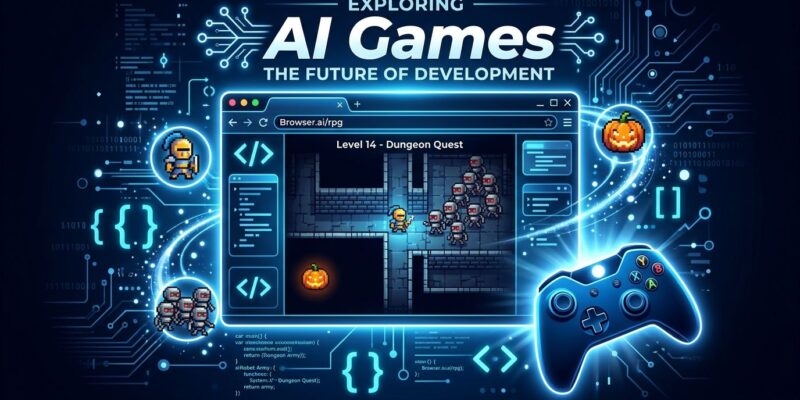
AI models have been generating “games” for a while now. Most of them were technically functional and deeply boring — the right shape of a game, none of the feel. In October 2026, something crossed a threshold. Simon Willison — creator of Django, one of the sharpest AI analysts publishing right now — built four browser games using Claude Opus 5.5. None took more than four hours of his time. All of them were actually fun. That specific word is the threshold that matters, and it is now crossed.
Four Games, Hours of Work, All Playable
Willison documented each experiment in detail on his personal blog. The simplest, Tree Appreciator, needed a single prompt — no follow-up. A spot-the-difference game built around algorithmically generated trees, it runs in your browser today. Emberwick went further: a top-down fantasy RPG with villages, underground caves, a troll boss fight, and a complete narrative arc. Willison mentioned a genuine emotional response to the model-generated ending. The RPG took more iteration but no external tools — just Claude Opus 5.5 in a browser chat.
The clearest evidence is Battle Drones, a Command & Conquer-style RTS built first with Claude Fable 5 in July, then rebuilt with Opus 5.5. Initial versions worked but felt flat. When Willison asked Claude to “Make it a LOT more fun,” the result was not a feature addition — it was a mechanical transformation. The final version supports two to four players, AI versus AI matches, seven maps, a random map generator, rule variants, a medal system, and full replay functionality. It ships under Apache 2.0. The community has already forked it into a steampunk variant called Panache.
The fourth game, Pumpkin Farmer, is a cozy farming simulator about growing giant pumpkins. It runs seasonal mechanics, a weigh-off competition, and ten playable animal characters — pelican, skunk, raccoon, sea otter, harbor seal, and more. Two days of Claude Code processing. The prompt that drove its personality: “surprise and delight the user frequently.” A generated customer review reads: “Carried our pumpkin like a baby. It was heavier than the baby.”
What Actually Changed in Opus 5.5
Willison identifies three specific capability improvements: 3D modeling, music generation, and game design intuition. The first two are iterative progress. The third is the story. Prior models understood game mechanics. Opus 5.5 appears to understand what makes a mechanic enjoyable. That distinction — between a loop that works and a loop you want to play again — has been the hard wall for AI game development. It is not fully gone, but it is significantly lower.
For direct comparison: Willison also ran the same tests with GPT-6 Astra. It can build games. Its sense of fun, in his assessment, does not yet match Opus 5.5. He expects that gap to close by the end of the year.
Epic Games Just Bet the Company on This
This is not only a hobbyist story. The same week Willison published his findings, Epic Games went formally all-in. Tim Sweeney announced “a huge pivot underway at Epic, moving developers around to retool for maximum AI acceleration.” The internal directive: no more hand-written code. The primary tool: Anthropic’s Claude.
The rebuilt Epic Games Launcher is the first public output. Cold launch time: 5.47 seconds. Steam’s: 10.07 seconds. A 46% improvement, independently verified by Keywords Studios across 13 machines. Unreal Engine 6 now integrates Claude and Gemini directly into the development environment.
Epic’s move matters not because their productivity gains are proven at scale — they are not, yet — but because it signals to every studio that AI-accelerated development is now a competitive requirement, not an experiment.
Try It This Weekend
The practical setup that consistently works: use Three.js for 3D or Phaser for 2D (both models know these libraries well), start with a single HTML file and no build pipeline, and write a brief game design document before you start prompting. Add mechanics one at a time. When the core loop works but feels dry, use the exact phrase “Make it a LOT more fun” — it is not a meme, it maps to something the model responds to specifically. For personality and easter eggs, try “surprise and delight the user frequently.”
The Game-Forge tool on GitHub automates the scaffolding further — describe a game, Claude picks a template, builds it, playtests it autonomously by reading screenshots, and fixes what breaks.
The Honest Limits
A randomized controlled trial by METR found experienced open-source developers were 19% slower with AI coding tools. Agentic fatigue is documented: the rapid feedback loops of AI coding sessions are addictive enough to drive 17-hour work stretches. And 45% of vibe-coded output carries vulnerabilities, per a 2026 security analysis.
What changed in October is the ceiling for what a solo developer can ship in a weekend — not what a team can ship in a quarter. Game jams, prototypes, educational tools, demos: these are where this inflection point lands right now. Complex systems design, performance tuning, and multiplayer infrastructure at scale still need experienced engineers making deliberate choices.
For the right problem, though, four hours and a browser tab now produces something playable. That was not true six months ago.