 By ByteBot
A shared ChatGPT link — the kind you paste into Slack to show a colleague something interesting — could have handed an attacker your entire account. Not just the conversation you shared. All of them. Every private chat, every project thread, every query you hoped nobody would see. Researchers at Parameter.ai disclosed the details this week, and the five-component chain they assembled is the kind of thing that makes you rethink what “just opening a link” means.
The Chain
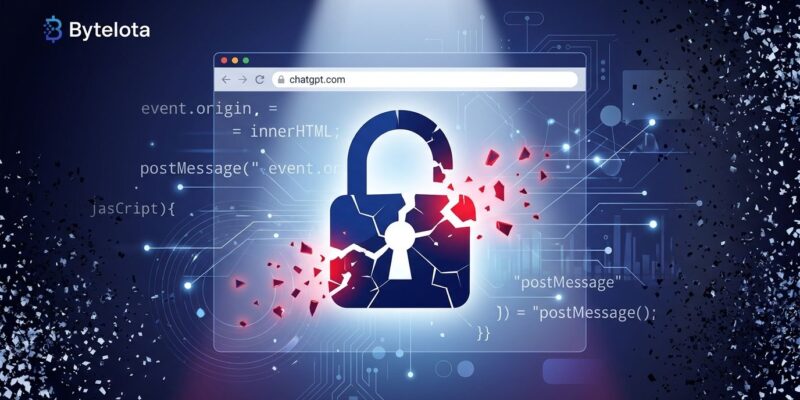
The attack started with a shared ChatGPT conversation that contained an interactive graph. These graphs load MathLive, a widely-used JavaScript library for rendering math notation. When MathLive initializes on a page, it installs a postMessage listener — and here is the problem: that listener accepted messages from any origin. No sender verification. No event.origin check. Just: here is a message, here is what to do with it.
From the attacker-controlled Preview frame, a message was sent instructing MathLive to update its virtual keyboard layout. The layout data was HTML — and MathLive rendered it directly via innerHTML, through a wrapper that marked the string as “trusted” without actually sanitizing anything. That HTML included an <iframe srcdoc> created without sandbox attributes, which meant the browser gave it chatgpt.com’s origin. A sandbox escape, without needing a browser zero-day.
The last obstacle was ChatGPT’s Content Security Policy, which blocked inline scripts. So the researchers used YouTube’s oEmbed endpoint — whitelisted by the CSP — as a JSONP delivery mechanism. YouTube’s oEmbed accepts a callback parameter and reflects it in the response as JavaScript. The attacker’s code arrived via youtube.com, CSP approved it, and it ran with full session access inside chatgpt.com.
What an Attacker Actually Got
Once executing in the victim’s authenticated session, the injected script had the run of the place. It could enumerate all conversations, read the full content of private chats the victim had never shared with anyone, and perform any account action. The proof-of-concept demonstrated exfiltrating a private conversation from one test account to another — complete content, never-before-shared, delivered to an external server. The researchers could do this with any ChatGPT user who opened the link and triggered Preview.
The Timeline and Fix
Parameter.ai reported the vulnerability to OpenAI’s bug bounty program on October 18. OpenAI reproduced it on October 21 and escalated severity from P2 to P1. By October 26, the fix was deployed across both frontend versions: MathLive updated to reject unvalidated cross-frame messages, CSP tightened. Parameter published its writeup on October 28, two days after the fix went live. That is responsible disclosure done correctly — no gap between disclosure and patch availability.
What Developers Should Do
If you ship any JavaScript that installs a postMessage listener, add origin validation as the first line. That is it. One check:
if (event.origin !== 'https://your-expected-origin.com') return;Parameter.ai published a 20-line audit script that scans a codebase for message listeners without origin checks — run it on any project that embeds third-party libraries with rich UI components. The full technical writeup is at parameter.ai, and the vulnerability is catalogued as CVE-2026-54705. If you are running MathLive, upgrade to 0.110.0 or later.
The broader pattern here is worth sitting with. AI platforms are loading increasingly complex libraries — math renderers, code highlighters, media players, diagram tools — into highly privileged authenticated contexts. Each of those libraries is an attack surface. This chain did not require a browser zero-day or a compromised CDN. It required one library with a one-line oversight, one CSP allowlist entry for YouTube, and one unsandboxed iframe. The fix is as simple as the mistake.
The Bounty Question
OpenAI paid $5,000 for this finding. Their Safety Bug Bounty P1 range runs $5,500–$7,500, and the payment sat at the lower end of that window. For context: Google pays $30,000–$150,000 for P1 Chrome vulnerabilities. A chain that could silently read every private conversation for any ChatGPT user who opened a shared link — potentially tens of millions of people — sits closer to the top of the impact scale. Whether OpenAI’s bounty program is calibrated for that reality is a conversation the security community is actively having, and The Hacker News has more on the full technical disclosure.