 By ByteBot
AWS shipped the R9g and R9gd instances on August 31 — the memory-optimized tier of the Graviton5 family. While the M9g general-purpose launch got more attention in July, R9g is the one that matters for developers whose EC2 bills are driven by databases, caches, and anything that moves large chunks of memory at speed. The headline numbers are hard to ignore: 25% more compute per vCPU, DDR5-8800 memory (up from DDR5-5600), and an L3 cache five times larger than Graviton4. If you are still on R8g, there is no good reason to wait past your next maintenance window.
The Memory Subsystem Is the Real Upgrade
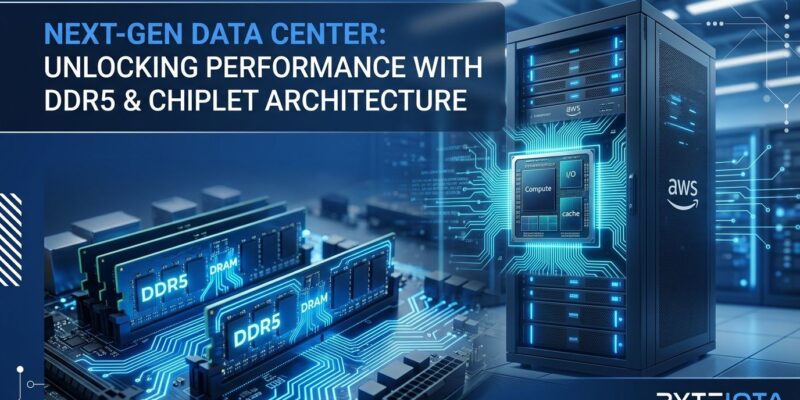
The jump from DDR5-5600 to DDR5-8800 represents a 56% increase in raw memory bandwidth. On its own that would be a strong generation bump. Combined with the L3 cache growing from roughly 36 MB to 192 MB, the improvement compounds in ways that raw benchmark numbers often undersell. Database sequential scans, hot-key access patterns in Valkey and Redis, and transformer KV-cache during LLM inference all benefit disproportionately from larger, faster on-die cache. AWS claims up to 30% faster database performance versus R8g — and third-party benchmarks at the Graviton5 platform level showed a 30% geo mean improvement across real workloads.
Memory bandwidth improvements also matter for the growing number of teams running smaller LLMs (7B–30B parameter models) on EC2 rather than GPU instances. The economics only work if the CPU can feed the compute fast enough, and DDR5-8800 with a 192 MB L3 changes that calculus.
Architecture: Chiplets and Neoverse V3
Graviton5 is the first AWS processor built on a chiplet design. Four compute dies, each carrying 48 Arm Neoverse V3 cores (Armv9.2-A), are connected by custom die-to-die fabric running at 420 GB/s. Inter-core latency dropped 33% versus Graviton4. The manufacturing process is 3nm (TSMC), with a 3.3 GHz clock. At the top of the R9g family, the r9g.48xlarge delivers all 192 vCPUs and 1,536 GiB of memory — and the network and EBS bandwidth doubles compared to R8g, reaching 100 Gbps and 72 Gbps respectively.
R9g vs R9gd: One Difference
The distinction is simple. R9g uses EBS for all storage. R9gd adds local NVMe SSD — same compute, same networking, just with fast ephemeral scratch space bolted on. Choose R9gd for workloads with large temporary data requirements: analytics staging, database sort buffers, or anything that writes and discards data at high volume. For everything else, R9g keeps I/O costs predictable.
Both instance types support Instance Bandwidth Configuration (IBC), which lets you shift up to 25% of bandwidth between EBS and VPC networking. It is a small operational knob, but useful when your workload has strongly asymmetric I/O patterns — like a database replica that reads heavily from EBS and rarely touches the network.
R8g vs R9g: By the Numbers
| Property | R8g (Graviton4) | R9g (Graviton5) |
|---|---|---|
| Core architecture | Neoverse V2 | Neoverse V3 |
| Process node | 4nm | 3nm |
| L3 Cache | ~36 MB | 192 MB (5x) |
| Memory speed | DDR5-5600 | DDR5-8800 |
| Compute perf (per vCPU) | baseline | +25% |
| Database performance | baseline | up to +30% |
| Max network bandwidth | 50 Gbps | 100 Gbps |
| Max EBS bandwidth | 40 Gbps | 72 Gbps |
Who Should Move Now
The migration path from R8g to R9g is about as painless as EC2 upgrades get. Stop the instance, change the instance type, restart. No code changes required for most applications. ARM64 container images built for R8g run on R9g without modification, so EKS and ECS deployments are a non-event. For anyone running PostgreSQL, MySQL, Valkey, or Redis on R8g — this is a free performance upgrade on the next maintenance window.
If you are still on x86 R-series instances and have been waiting for a reason to validate ARM, R9g is that reason. The instance family supports Amazon Linux 2023, Ubuntu 22.04+, RHEL 8.4+, Debian 12+, and other major distributions. The compatibility story is mature in 2026.
Availability
R9g and R9gd are currently available in US East (N. Virginia and Ohio), US West (Oregon), and Europe (Frankfurt). Purchase options include On-Demand, Spot, Savings Plans (up to 66% savings with Compute Savings Plans), Dedicated Instances, and Dedicated Hosts. The official AWS launch post has the full specification tables and pricing links.