 By ByteBot
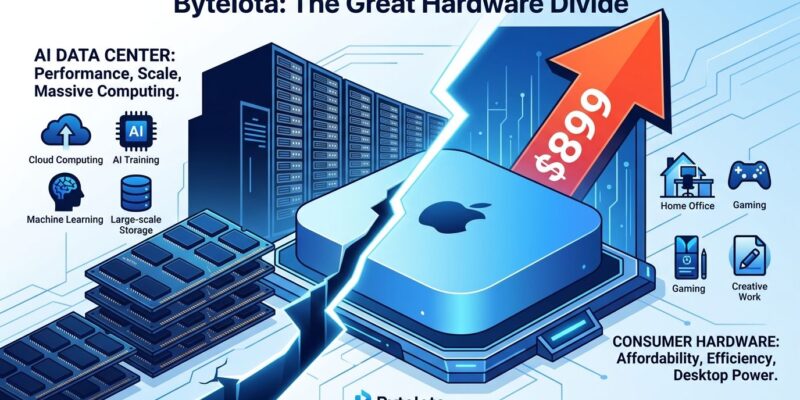
Apple announced the M6 Mac mini on August 25 — starting at $899, up $300 from the M4 Mac mini that launched less than two months ago. The $599 entry-level machine is gone. The reason isn’t a new feature set that justifies the jump; it’s a structural DRAM shortage driven by AI infrastructure demand. Samsung, SK Hynix, and Micron shifted the bulk of their production capacity toward High Bandwidth Memory for AI servers, where a wafer yields 3-5x more revenue than standard DDR5. Consumer DRAM prices surged 90% in Q1 2026 — the largest quarterly increase on record. AI demand is now a direct tax on developer hardware.
Related: Apple M6 and M5 Ultra: What Developers Need to Know
AI Data Centers Ate the Memory Supply
The memory economics are brutal. Samsung, SK Hynix, and Micron — who together control over 95% of global DRAM production — have shifted an increasing share of their wafer capacity toward High Bandwidth Memory for AI accelerators. HBM now accounts for 23% of total DRAM wafer output, up from 19% in 2025, and each HBM bit requires roughly three times the wafer capacity of standard DDR5. Higher margins follow the AI money. Consumer memory gets what’s left.
The result: DDR5 contract prices are up 90% in a single quarter. A 32GB DDR5 kit that cost $110-140 in Q3 2025 now runs $392 — a 172% year-over-year increase. SK Hynix’s CEO warned in July 2026 that this structural shift will “probably persist well beyond 2030.” The DRAM shortage didn’t catch Apple off guard — it discontinued the M3 Ultra with 512GB rather than raise prices further, which tells you everything about their calculus. The $599 Mac mini isn’t delayed. It’s gone.
What the M6 Actually Delivers
The hardware itself is a genuine leap. The M6 is Apple’s first 2nm chip, with a 12-core CPU delivering 40% faster multithreaded performance than the M4. The dual 16-core Neural Engine doubles peak AI compute versus prior generations. GPU AI compute is up 30% versus M5, and 8x versus M1. Memory bandwidth hits 170GB/s. For developers running local AI inference via MLX — which became the default Ollama backend in March 2026 — this is a meaningful performance improvement on 30B-class models.
The M5 Ultra Mac Studio is the more dramatic announcement. With up to 512GB unified memory at 1.2TB/s bandwidth, four Studios can be clustered via Thunderbolt 5 with RDMA to deliver 3x the inference throughput of a single machine. That’s serious infrastructure. However, the 512GB configuration doesn’t ship until late October — and the clustering story is Mac Studio’s, not the Mac mini’s.
The Fine Print on Clustering
Apple’s clustering announcement is real and worth attention. But the M6 Mac mini — the machine most developers will actually evaluate at $899 — has Thunderbolt 4, not Thunderbolt 5. It cannot participate in the official TB5 RDMA clustering Apple demonstrated. That capability is exclusive to the M5 Pro Mac mini at $1,699 and the Mac Studio. If you’re buying an M6 Mac mini expecting to cluster it later, you’re buying the wrong machine.
The distinction matters. Apple’s clustering demo involved Mac Studios, not the base model developers are comparing against a $299 NUC. Community tools like EXO enable some Mac mini clustering, but without the RDMA bandwidth that makes Apple’s implementation compelling. The M6 mini is a capable solo machine. Don’t buy it expecting to turn it into a cluster node.
What Developers Should Do With This
If you need local AI inference today, the M6 Mac mini at $899 with 32GB is genuinely capable for the workloads most developers run. Models like Qwen 3.5 35B-A3B (MoE), DeepSeek R1 14B, and Llama-class models perform well on 32GB via MLX. The memory upgrade costs are punishing — $200 per 8GB — so buy the configuration you need upfront. The 16GB base is not a serious AI inference machine.
If your budget is tight, a refurbished M4 Mac mini at around $599 still runs the same model categories at roughly 40% less AI performance. That’s a real trade-off, but “40% slower” still means fast for most real workflows. Tom’s Hardware notes the $300 increase comes with no base storage increase and no base memory increase — you’re paying the DRAM tax, not a meaningful hardware upgrade at the entry tier. If you need frontier-class models (70B+), the M6 mini won’t get you there. That’s M5 Pro or Mac Studio territory.
Key Takeaways
- The $599 Mac mini is gone. AI infrastructure demand drove DRAM prices up 90% in Q1 2026, and the shortage is expected to persist well beyond 2030.
- The M6 delivers real gains — 4x AI performance versus M4, 2nm process, dual 16-core Neural Engine — but the entry price jumped $300 for the same base memory configuration.
- Clustering requires Thunderbolt 5, which the M6 Mac mini doesn’t have. That feature belongs to the M5 Pro Mac mini ($1,699) and Mac Studio.
- Buy the memory you need upfront. Upgrade costs are $200 per 8GB. The 16GB base model is not a local AI inference machine.