 By
Anthropic just shipped its first new API version in three years. API version 2026-10-21 removes temperature, top_p, and top_k from the Messages API entirely — and the breakage is nastier than it looks, because sending those parameters at their default value also throws a 400. If you upgraded to any of the new SDK major versions that shipped alongside this release (Python 2.0, TypeScript 1.0, Go 2.0, and five others), you are already on this API version by default.
The Temperature Trap Is Worse Than You Think
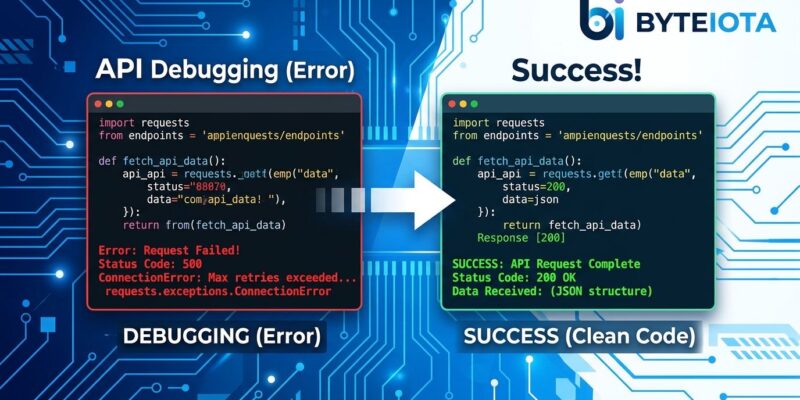
The obvious migration instruction is: delete temperature, top_p, and top_k from every messages.create() call. That is necessary, but incomplete. The trap catches developers who set temperature=1.0 explicitly to document intent — a common pattern in large codebases. On 2026-10-21, that call returns a 400 just the same as temperature=0.1 does. Any value, including the default, is rejected.
The same restriction applies to messages.stream(), token counting endpoints, and the Message Batches API. If you have a shared client factory or middleware wrapper that injects sampling parameters into every outbound request, upgrading the SDK will silently break every call in your application.
Anthropic’s reasoning is sound, even if the disruption is real. Modern reasoning models like Claude 4.7 and later run multi-pass internal verification — branching chain-of-thought loops and self-correction passes before producing output. External temperature controls collapse those reasoning paths into a single greedy line, undermining the architecture. OpenAI made the same move with o1, o3, and GPT-5. This is not a quirk; it is the direction the industry is heading.
If you genuinely need sampling control — for reproducibility testing, format stability, or older models that still support it — the official recommendation is to stay on API version 2023-06-01. That version is not deprecated, and Anthropic has not announced a timeline for removing it.
Check Your SDK Version Before You Deploy
All new SDK major versions default to API version 2026-10-21. Simply running pip install --upgrade anthropic or npm update @anthropic-ai/sdk will bump you into the new major version and onto 2026-10-21 automatically. Pin your SDK version in requirements.txt or package.json if you want to upgrade on your own schedule.
- Python: 2.0.0
- TypeScript/JavaScript: 1.0.0
- Go: 2.0.0
- Java: 3.0.0
- C#: 13.0.0
- PHP: 1.0.0
- Ruby: 2.0.0
- CLI (ant): 2.0.0
The before/after for Python is straightforward:
# Before (SDK 0.x — API version 2023-06-01)
client.messages.create(
    model="claude-opus-4-7",
    max_tokens=1024,
    temperature=0.2,
    messages=[{"role": "user", "content": "Summarise this."}],
)

# After (SDK 2.0 — API version 2026-10-21)
client.messages.create(
    model="claude-opus-4-7",
    max_tokens=1024,
    messages=[{"role": "user", "content": "Summarise this."}],
)
Two More Breaking Changes You Might Miss
Document blocks in assistant messages. If your code places a document block directly inside an assistant-role message, that now returns a 400. Move document blocks into user messages. The exception is document blocks nested inside tool results within an assistant message — those still work.
The auth header shifted. New SDK versions send your API key as Authorization: Bearer sk-ant-... instead of the old X-Api-Key header. The Claude API itself accepts both headers, so direct API callers are unaffected. Any proxy, gateway, or logging layer that inspects or forwards X-Api-Key will see requests with no visible key. Update your infrastructure to read Authorization instead, or configure your HTTP client to restore the legacy header via the auth function described in the community upgrade guide.
What You Get for Upgrading
The disruption comes with a real upside. API version 2026-10-21 unlocks browser use and computer use tool classes in the Python and TypeScript SDKs (currently in beta). The pattern is clean: subclass BrowserUseTool or ComputerUseTool, implement your handler methods for each browser action or desktop interaction, and the SDK manages the agent loop, URL and file policies, and approval callbacks. These tools are not available on 2023-06-01.
The Decision Is Binary
You need temperature control for your use case: stay on 2023-06-01, pin your SDK to the previous major. The old version is stable and supported.
You want browser and computer use agents, or you want current Claude models with their built-in reasoning defaults: upgrade to 2026-10-21, audit every call site for sampling parameters, and update any infrastructure reading X-Api-Key.
The official Anthropic migration guide covers each breaking change with specific code examples. Check your requirements.txt or package.json today — if you are on an unpinned dependency, the breaking change may already be in your next deployment.