
 By
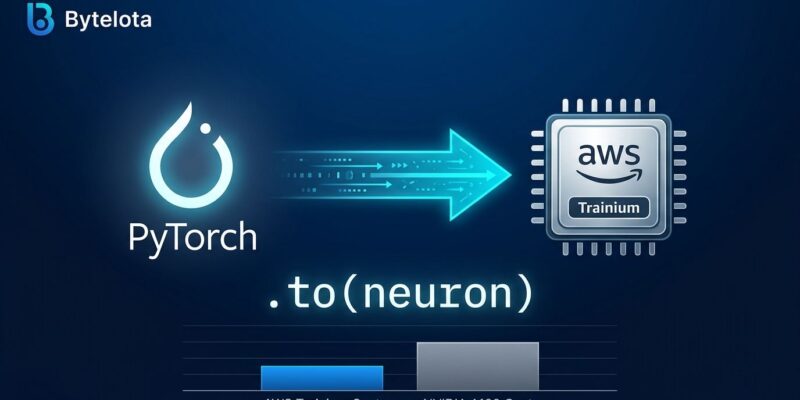
Amazon opened AWS Trainium to every PyTorch developer on October 20 — no rewrite, no separate SDK, no porting guide. The tool is TorchNeuron, a native PyTorch backend built by Annapurna Labs and released under Apache 2.0. One configuration change moves existing PyTorch code from CUDA to Trainium:
model = MyModel().to('neuron') # was .to('cuda')That’s the marketing claim. It’s accurate — with one important asterisk every production engineer should know before touching their training pipeline.
What TorchNeuron Actually Does
TorchNeuron plugs into PyTorch’s official PrivateUse1 device extension point — the same mechanism other hardware vendors use to register non-NVIDIA devices. This is not a translation shim bolted on top. It’s a first-class PyTorch backend: swap the device string, run your code, operations execute directly on Trainium hardware in eager mode.
For production throughput, you’ll want torch.compile. That path captures your computation graph via TorchDynamo, lowers it to Neuron IR, and lets the Neuron Compiler apply hardware-specific optimizations before generating Trainium instructions. Distributed training APIs — FSDP, DTensor, DDP, Tensor Parallelism — are all supported.
Here’s the asterisk: torch.compile on Neuron currently requires static input shapes. Every new shape triggers a fresh compilation. For batch training with fixed-length inputs, that’s fine. For production inference with variable-length sequences — the common case in NLP — you need to bucket inputs by shape or pad aggressively. Solvable, but not zero-effort. The AWS Neuron documentation has the full constraints list.
The Cost Math Is Real
Whether TorchNeuron is worth your attention depends on which side of the training/inference divide you sit on.
Trainium3 instances run at roughly $1 per chip per hour. NVIDIA H100 instances run at roughly $3. For large-scale batch training, that’s not a rounding error. Deepgram reported processing 70% more audio per dollar after moving voice AI training to Trainium. Uber cut training costs by 50% versus NVIDIA with a Trainium3 deal. For teams running more than 10,000 GPU-hours of training per month, production benchmarks show Trainium2 delivering 20-35% lower TCO than comparable H100 setups.
Latency is a different story. Single-chip inference on a 7B-parameter model runs 35-50ms on Trainium2 versus 15-25ms on H100. If you’re running a latency-sensitive inference API, Trainium is not your answer today. If you’re running overnight training jobs or batch inference pipelines, the cost math is hard to ignore.
Who TorchNeuron Is Actually For
NVIDIA’s real lock-in isn’t the hardware — it’s the software ecosystem. Four million registered CUDA developers and 40,000+ organizations have built training pipelines and CI/CD infrastructure that assumes NVIDIA tooling. TorchNeuron does nothing for teams with custom CUDA kernels. If your codebase has .cu files, you’re not a target user yet.
But most PyTorch users aren’t writing custom kernels. They’re calling torch.nn, using Hugging Face Transformers, running standard optimizers. For that population, TorchNeuron makes Trainium genuinely accessible without a platform rewrite. More than 30 early customers are already in: robotics teams, drug discovery researchers at the Lieber Institute, world model builders, voice AI companies, finance firms. The Apache 2.0 license means no IP concerns for startups.
What You Should Do Right Now
TorchNeuron is in public beta as part of Neuron 2.33. Here’s how to think about it:
- Training workloads with fixed shapes: Test now. The one-line migration is real and cost savings are meaningful at scale.
- NLP/transformer inference with variable lengths: Wait for dynamic shape support, or implement input bucketing first.
- Custom CUDA kernels: Not your path today.
- Batch inference pipelines: Worth testing — latency disadvantage matters less when you’re not serving real-time requests.
The Bigger Picture
Every previous NVIDIA alternative has competed at the hardware layer while leaving the CUDA software stack intact. TorchNeuron attacks a different surface: the PyTorch abstraction itself. If developers write portable PyTorch and the hardware is price-competitive, the software lock-in dissolves on its own.
That’s not guaranteed — NVIDIA still wins on latency, ecosystem depth, and tooling maturity. But for batch training at scale, Amazon just made the alternative workable without asking teams to rebuild their stack. The developer community has already started poking at the limitations, and the static shapes constraint will drive the real adoption curve. When dynamic shapes land, the calculus changes substantially.


