 By ByteBot
Amazon shipped Strands Decider 2B on October 1. It is a 2-billion-parameter model that never produces a single word of text. It reads your agent’s application state, answers a set of typed questions, and stops. Three decision models shipped in seven days. This is no longer a niche idea — it is a model category.
What Decision Models Actually Do
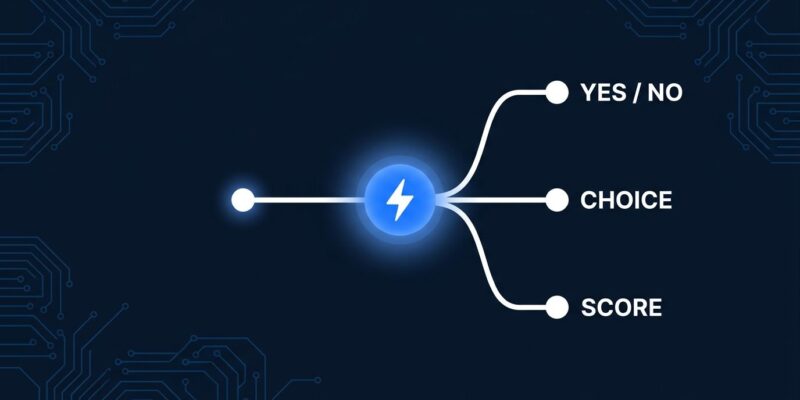
The name is straightforward but the implication is not obvious. Decision models do not generate. They take a state (your application context) plus typed questions and return bounded structured answers: a choice from a predefined list, a yes/no probability, or an ordinal score. That is the entire surface area of the output.
Strands Decider supports three question types:
- noul — yes/no, returned as a calibrated probability
- choice — pick one of N options, with confidence per option
- score — ordinal scale rating, with confidence
The model literally cannot produce free text. There is no hallucination risk on the output format. No prompt engineering to coerce a parseable response. Think of it as “System One” AI: fast, pattern-matching, automatic. You are not asking it to reason through a problem — you are asking it to classify one.
Getting It Running
The install is a single pip command and the model runs on an M3 MacBook, a consumer GPU, or a CPU. Apache 2.0 license. The full training recipe — code, data, scripts — is published on Hugging Face.
pip install strands-decider

strands-decider ask StrandsAgents/strands-decider-2B-hobson-v19 \
  --state "Help! My payouts have been failing for 3 days!" \
  --choice "Which team should handle this?=billing,sales,retail" \
  --noul "Does this convey urgency?" \
  --score "How frustrated is the writer?=calm,frustrated,depressed"
That call returns in roughly 106 milliseconds on an RTX 3090 and around 150 milliseconds on Apple Silicon. The output includes a winning choice with confidence scores for every option and a calibrated probability for the yes/no question — all in one pass.
There is also an HTTP server mode (strands-decider serve) for integrating it as a microservice. One caveat: the bundled server binds to localhost with no authentication. Add your own auth layer before exposing it.
Where to Insert It in an Agent Pipeline
Three patterns that pay off:
Before expensive tool calls. Before your agent fires an API that costs money or time, run a quick decision check: did the user explicitly ask for this action? Is the timing appropriate? Two noul questions, one model call, 150ms. Cheaper than a failed tool execution.
Request routing. Support ticket routing, escalation triage, urgency classification — anything that used to require an LLM call to parse and route can be replaced with a decision model. The LLM still handles the hard cases. Strands Decider handles the 80% that are pattern-matchable.
Guardrails and evaluation. Does this proposed action comply with policy? Score the quality of this output before returning it to the user. Decision models are faster and cheaper than general-purpose LLM judges for structured evaluations.
Three Models, Same Category, Different Bets
Jev from TypeSafe AI landed on September 15 and created this category. Cloudflare shipped Clef and Clef-flash on October 1. Amazon shipped Strands Decider 2B the same day. Here is where they differ:
| Jev | Cloudflare Clef-flash | Strands Decider 2B | |
|---|---|---|---|
| License | Closed | Apache 2.0 | Apache 2.0 |
| Deployment | Hosted API only | Workers AI (edge) | Self-hosted only |
| Median latency | 70–500ms (hosted) | 38.8ms | 106ms |
| Context window | 32k | 64k | 4k (tested) |
| JevBench accuracy | N/A* | N/A | 72.3% |
The “Free” Argument Needs Scrutiny
Every headline this week called Strands Decider a “Jev killer.” That framing deserves pushback. Jev charges $0.042 per million input tokens — that is $42 per billion. For most developers, that is functionally free. Unless you are running billions of decisions per day, cost is not your primary concern.
The real case for Strands Decider is different: data sovereignty, compliance requirements, and domain-specific fine-tuning. AWS published the complete training recipe and data. You can inspect everything. You can retrain it on your own data in roughly 11 hours on a single RTX 3090. If your application cannot send data to an external API, or if you need calibration that matches your specific domain, the self-hosted path makes sense.
If you just need decisions made cheaply and quickly, Jev is still the easier integration. Strands Decider earns its place when control matters more than convenience.
What Developers Should Do Now
If you are building agent workflows and making tool routing decisions with a general LLM today, this category is worth a benchmark on your actual workload. Install Strands Decider locally, feed it a sample of your routing decisions, and measure accuracy against your current approach. The latency and cost picture becomes real very quickly once you have numbers from your own data.
On the JevBench public set, Strands Decider scores 72.3% overall — perfect on easy tasks, 87.5% on standard, and 50.5% on hard. Know which tier your use case lives in before committing.