 By ByteBot
Amazon wants to eliminate human handlers from its last-mile delivery stations. A leaked internal planning document, obtained by GeekWire, describes Project Tetromino: a phased, $530 million initiative to fully automate the final step in Amazonâs delivery chain using AI, robotics, and computer vision. The stated goal is 2.5x the throughput of todayâs manual stations. The name, borrowed from Tetris, is more honest than most project codenames â because the core software problem is genuinely, provably hard.
Itâs Called Tetromino for a Reason
Tetrominos are the geometric shapes in Tetris. You arrange them, they pile up, and the challenge gets harder as volume increases. That is precisely the engineering problem inside a delivery station: thousands of packages of irregular shapes, sizes, and weights must be stored temporarily and then released in exactly the right order for each delivery vanâs route.
What looks like a logistics problem is actually a compound computational problem. The storage assignment portion is a variant of the bin packing problem, which is NP-hard â meaning no algorithm can find the mathematically optimal solution for large instances in feasible time. Layered on top is the vehicle routing problem (also NP-hard): sequencing hundreds of packages across dozens of delivery stops per van, in the correct drop-off order. Real-time updates â a late package, a route change, a van swap â mean the system must re-solve continuously, not just once.
This is what separates Tetromino from typical âadd more conveyor beltsâ automation stories. The solution is not a faster machine. It is a continuous approximation engine running deep reinforcement learning and classical heuristics simultaneously, trading computational optimality for the speed a live facility requires.
How the System Actually Works
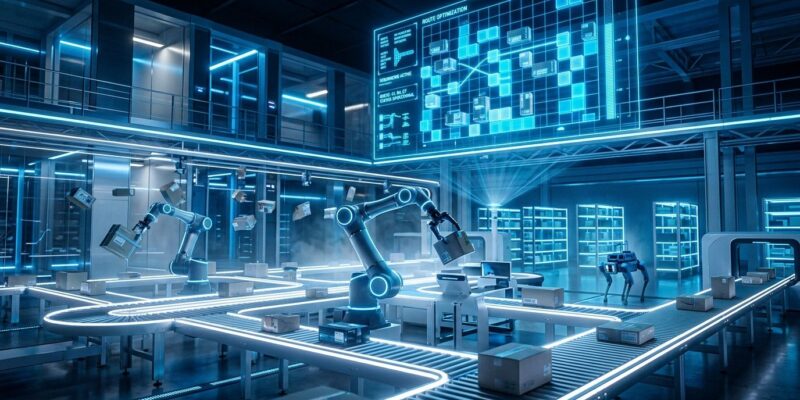
A key piece of the Tetromino stack is reportedly Boxbot, an AI and supply chain robotics startup. The pipeline Boxbot describes is straightforward in concept and genuinely difficult in execution:
- A package arrives on a conveyor belt
- Machine vision reads its dimensions, estimates weight, and scans the destination barcode
- The package is moved to a temporary tray and placed in a storage grid automatically
- When a delivery van arrives, the AI sequences the tray release order to match the vanâs route
- Packages flow into the vehicle in delivery-stop order, requiring no manual sorting by the driver
Boxbot claims this process is up to 10 times faster than manual vehicle loading. The technically interesting part is step 4. The system does not sort once and wait â it must maintain awareness of every package in the grid and every package still incoming, re-sequencing dynamically as new arrivals change the optimal order.
Tetromino Is the Orchestration Layer
Project Tetromino does not exist in isolation. It sits on top of an ecosystem Amazon has been assembling for years.
Vulcan is Amazonâs first robot with tactile sensing â force-feedback pads, a spatula-like probe, and conveyor-belt fingers that let it feel package contours and fragility before lifting. It handles roughly 75% of Amazonâs catalog SKUs at human-level speed and is currently expanding into German facilities. Proteus (second generation, June 2026) is an autonomous mobile robot that accepts natural language commands â workers say âbring this to bay 12â and it figures out priority, route, and timing without a programming interface. RIVR, acquired in March 2026, is an ETH Zurich-spinout quadruped robot that carries 60-plus pounds at 8.7 mph and handles steps, curbs, and uneven terrain for doorstep delivery.
The vision, if Tetromino succeeds, is a fully automated pipeline: packages picked by Vulcan arms in fulfillment centers, sorted by AI at delivery stations, handed off to RIVR-enabled autonomous vans, and deposited at doorsteps by quadruped robots â no human touchpoint from pick to delivery on standard orders.
The Uncomfortable Paradox
Amazon crossed one million deployed robots in mid-2025. Tetrominoâs roadmap, if accurate, would accelerate displacement at delivery stations specifically â with industry projections suggesting up to 600,000 Amazon jobs could be affected by automation by 2027. The irony worth noting: Amazon laid off more than 100 white-collar robotics engineers in March 2026, the same team responsible for designing the automated systems now being expanded. The people building the automation are not immune to it. For software and ML engineers watching this space, the demand signal is in exception handling, simulation engineering, and robotics fleet management â the roles that do not disappear when the routine work is automated.
Reality Check: Amazon Disputes Its Own Leaked Plans
Amazonâs official response to the GeekWire report is that Project Tetromino remains an âearly-stage conceptâ and that the leaked documentâs financial figures and timelines âdo not reflect current plans.â That is worth taking seriously. Amazon cancelled Project Blue Jay â an ambitious multi-arm robotics system â within six months of rapid development. Its newer âOrbitalâ modular warehouse system signals a strategic pivot is already underway.
The $103 million pilot facility, reportedly planned for 2028, would be the first real signal that Tetromino is more than a planning document. Until then, it sits in a familiar category: an internal project that is either the future of logistics or one more item that never made it out of the concept phase.
What to Watch
If Tetromino proceeds to pilot, the engineering benchmarks that matter are not the headline throughput number. They are: what percentage of packages cause exceptions requiring human intervention, how the system performs during peak periods when delivery volumes double, and whether Boxbotâs sequencing claims hold up outside of controlled demonstrations. Those are the numbers that determine whether $530 million becomes $5 billion â or a line item in an internal post-mortem.