 By ByteBot
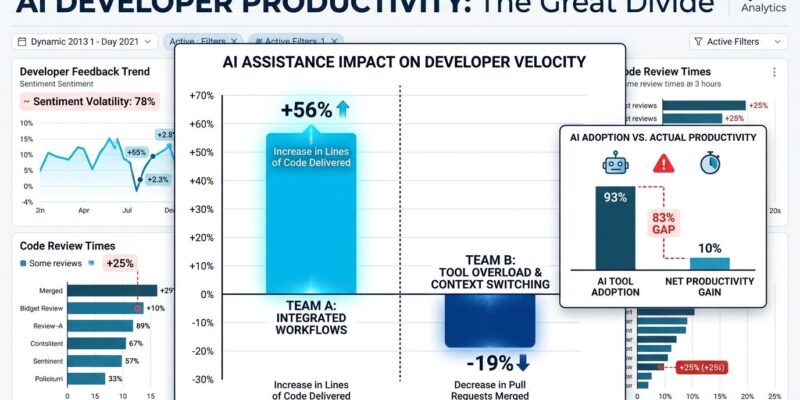
Ninety-three percent of developers now use AI coding tools. Productivity gains from that adoption are stuck at roughly 10%. Meanwhile, METR’s 2025 randomized controlled trial — the most rigorous study on record — found experienced developers took 19% longer with AI tools than without. Those same developers estimated they were 20% faster. That 39-point gap between what developers feel and what the clock shows is the story every engineering manager needs to understand before making another AI tooling decision in 2026.
The noise in this debate isn’t random. Studies on AI developer productivity range from +55.8% faster to -19% slower — a 75-point swing — and most coverage treats this as contradiction. It isn’t. The range maps directly to context. Understanding which context applies to your team is worth more than any single headline number.
AI Developer Productivity Studies: Why Results Range from +56% to -19%
In 2022–2023, researchers from Microsoft, GitHub, and MIT ran 95 freelance developers through a single task: build an HTTP server from scratch. With AI tools, they finished 55.8% faster. This is the number vendors cite most often, and it isn’t fabricated — but the task was greenfield, isolated, and completed on code nobody had ever touched before. That’s about as far from daily maintenance work as you can get.
At the other end, METR’s 2025 randomized controlled trial ran 16 experienced open-source developers through 246 real issues — bugs, features, refactors — on their own repositories averaging over a million lines of code. These developers knew their codebases well. They used Cursor Pro with Claude 3.5 and 3.7 Sonnet, frontier models at study time. Result: 19% slower. Two field trials at Microsoft, Accenture, and a Fortune 100 company spanning 4,867 developers landed in between at +26% more tasks completed — real work, but a broader task mix than METR’s complexity level.
The context variable is straightforward: AI tools generate code fastest when there’s no institutional knowledge required. Greenfield tasks, boilerplate, test scaffolding, and documentation see 40–90% speedups consistently. However, complex debugging, architectural changes, and maintenance work in familiar production codebases don’t benefit the same way. AI code is roughly 70% correct on average, meaning developers must understand the AI’s approach, identify the errors, and fix or redirect. For experienced engineers on familiar systems, that overhead exceeds the autocomplete benefit.
The AI Productivity Perception Gap: 39 Points Between Feeling and Reality
METR’s most troubling finding isn’t the 19% slowdown — it’s the perception gap. Developers predicted a 24% speedup before tasks. They reported feeling 20% faster afterward. They measured 19% slower. That’s a 39-point overestimate, and it appeared consistently across the study. Furthermore, 69% of participants continued preferring AI tools after seeing their own timing data.
This happens for a clear reason: developers accurately perceive effort reduction — fewer keystrokes, faster first-draft code, less time staring at a blank file. What they systematically underestimate is cognitive overhead — reviewing AI output, context-switching between coding and prompting, debugging suggestions that are almost-right but not quite. METR’s follow-up study in February 2026 ran into a different version of the same problem: 30–50% of participants began withholding tasks they expected AI to help most, making the control condition meaningless. The study design broke because developers wouldn’t work without AI tools even in an experiment designed to measure the difference.
Related: AI Coding Agents Write 30% More Code, Ship No More Software
The practical consequence is direct: developer self-reports overestimate AI productivity gains by 20–40 points in every study that compared them to objective measurements. Asking your team “Is AI helping?” will consistently overstate the real gain. The only reliable signal is objective measurement — task timing, not surveying.
What Speed Studies Miss: Code Quality Is Declining
Speed and throughput metrics capture only part of the picture. GitClear analyzed 623 million code changes from 2023 to 2026 and found every quality signal moving in the wrong direction. Code block duplication climbed 81% — from 40.3 to 73.0 occurrences per million changed lines. Refactoring activity dropped 70%, falling from 21% of all changes in 2022 to 3.8% in 2026. Legacy code maintenance collapsed from 1.7% to 0.46% of changes.
In 2022, developers showed a 2x preference for refactoring over copy-paste. By 2026, that ratio has inverted to 5x in favor of copy-paste. AI optimizes for local correctness — generating code that passes the immediate requirement — while quietly deferring the invisible work that keeps a codebase maintainable over time. The Opsera 2026 benchmark of 250,000+ developers found that AI pull requests contain 15–18% more security vulnerabilities than human-written code, wait 4.6 times longer for code review, and get accepted at 32.7% versus 84.4% for human PRs. The initial speed gain is real. So is the debt it creates downstream.
How to Measure AI Developer Productivity Accurately
Given that self-reports inflate results and PR volume is easily gamed by AI-generated boilerplate, what should engineering managers actually measure? Establish an objective baseline before adoption, then measure task completion time for specific, repeatable task types — not aggregated output across all work. Segment by task type: greenfield feature work and production debugging produce genuinely different results, and averaging them hides both signals.
Track downstream quality signals alongside speed metrics: code duplication trend, two-week churn rate, and change failure rate from DORA metrics. Laura Tacho’s research across 121,000 developers found a stark organizational divergence: teams with strong documentation, fast CI/CD, and clear goal-setting saw 50% incident reduction with AI tools; teams without those foundations saw double the customer-facing incidents. The AI tools didn’t cause the divergence — the organizational structure amplified it. If your infrastructure is weak, AI tools accelerate the problems you already have.
Key Takeaways
- The +56% to -19% range maps to task type, not contradictory methodology. Greenfield and boilerplate deliver real gains; experienced developer on a familiar complex codebase expects slowdowns.
- Developer self-reports overestimate AI productivity gains by 20–40 points in every study. Objective task timing is the only reliable signal.
- GitClear’s analysis of 623 million code changes shows duplication up 81%, refactoring down 70% since 2022 — speed gains are creating unmeasured maintainability debt.
- AI PR acceptance rate sits at 32.7% versus 84.4% for human PRs; AI-generated code waits 4.6x longer in review. Speed-to-PR is real; total cycle time often isn’t.
- Measure task-type-segmented completion times, code duplication trend, and change failure rate. Don’t ask developers if AI is helping — measure it.