 By ByteBot
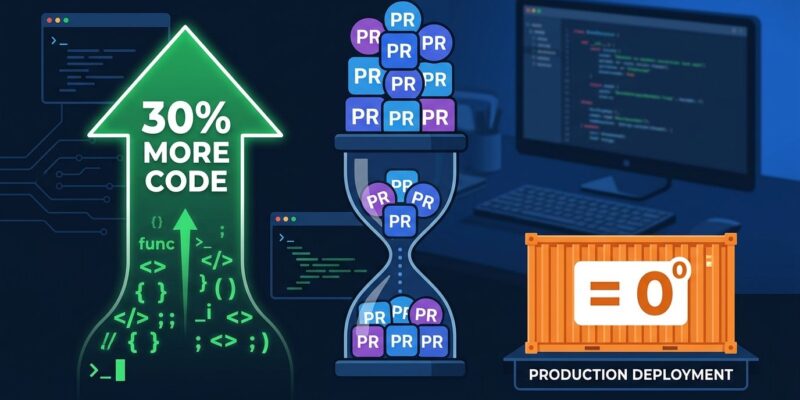
A Harvard working paper has measured something engineering managers have been quietly noticing for months: AI coding agents make developers write substantially more code, but they don’t make teams ship more software. The bottleneck didn’t disappear. It moved to code review.
Economists Fiona Chen and James Stratton analyzed roughly 300 million work events across more than 700 software companies from 2021 through early 2026. Their finding is hard to dismiss — this is not a developer satisfaction survey or a vendor case study. After firms adopted AI coding agents in the Claude Code, Cursor, and Devin class, per-worker code volume rose about 30%. Commits climbed 20%. Pull requests went up 23%. Issue and epic resolution rates — the actual measure of shipped work — did not move.
The Numbers That Matter
To understand where the productivity went, look at what happened to pull requests after firms deployed AI coding agents. Average time between PR submission and merge rose 49% — roughly 3.45 additional days per PR. Revision requests nearly doubled. Comments per PR increased 35%. And 14% more workers were being pulled into reviews.
That math is straightforward: AI agents generated more PRs faster than human reviewers could process them. The queue grew. The pipeline stalled. The commits kept coming.
Independent research from Faros AI adds texture to why. AI-generated code produces 1.7 times more issues than human-written code. Logic and correctness errors are up 75%. Algorithm errors appear more than twice as often — and those are the errors that require a senior engineer to catch. You can’t automate your way past that with a linter.
The AI Review Tool Trap
Here is where it gets interesting. By March 2026, 80% of firms in the study were already running AI-assisted code review tools — presumably to solve exactly this problem. Yet only 23% of review comments were AI-generated. Human review time kept climbing anyway.
The issue is architectural, not a matter of adoption. AI review tools are good at catching style inconsistencies, security anti-patterns, and test coverage gaps. They are not good at detecting intent mismatches — whether the code actually does what it was supposed to do. That requires knowing the original specification, understanding the business context, and making judgment calls that current AI reviewers cannot make reliably.
What Developers Are Actually Saying
The frustration is visible. A 2026 Sonar survey found that 38% of developers say AI-generated code requires more review effort than code from a colleague, and 96% do not fully trust AI-generated code to work correctly. Builder.io published a post titled “I Didn’t Become a Developer to Review AI Slop” that touched a nerve across developer communities. Engineering teams are watching senior developers spend growing portions of their time on review queues instead of architecture and design.
What You Can Actually Do About It
The study identifies the problem. The engineering community has been running experiments on fixes. A few approaches that have real evidence behind them:
- Hard PR size limits. Enforce a 250-line ceiling per PR. A 40-line diff takes five minutes to review. A 600-line diff gets deferred, re-reviewed three times, and still ships with bugs. Instruct agents to break work into smaller tasks before generating PRs.
- Two-pass review. Route agent-generated PRs through an AI first pass for style, security, and CI gate checks. Then route to humans specifically for architecture and intent verification. Teams running this approach reported catching 60% more real issues while reducing human review time by 25%.
- Specification-first prompting. Write a detailed spec before running the agent. The review bottleneck partly comes from misalignment — the agent built something functional but wrong. Catching that at the specification stage is cheaper than catching it at review.
- Risk-based routing. Not all PRs need the same review depth. Payment flows and auth changes always get human eyes. Low-risk utility code with high test coverage gets a confidence score and a shorter queue.
The Deeper Pattern
The study captures a specific moment in a recurring cycle: AI tools accelerate one stage of development, and the constraint immediately moves to the next. Code generation used to be the bottleneck. It is not anymore. Review is. If the industry invests heavily in AI review tools without addressing the intent-verification problem, the constraint will shift again — to architecture, to integration, to deployment verification.
The teams shipping more software in 2026 are not the ones with the most AI agents. They are the ones who figured out that adding more code to the front of the pipeline does nothing if the middle is clogged. GitHub has published guidance on reviewing agent PRs — a useful tactical resource as teams navigate the adjustment.