
 By ByteBot
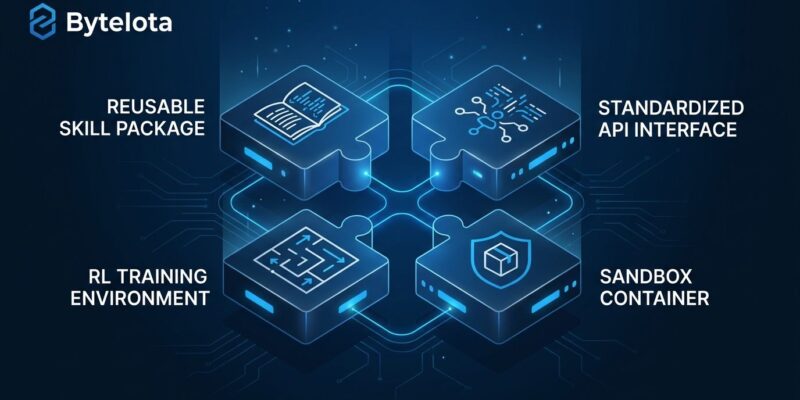
Four companies — Anthropic, OpenAI, HuggingFace, and Alibaba — donated four open-source projects to the Agentic AI Foundation this week at AGNTCon in San Jose. Clean win for open standards? Mostly. But not all four projects are production-ready, and treating them equally will waste your time. Here’s the breakdown.
What Is AAIF (and Why It Keeps Getting Projects)
The Agentic AI Foundation is a Linux Foundation directed fund that launched in December 2025 with three projects — MCP, goose, and AGENTS.md. It now hosts ten. The model is deliberately Kubernetes-style: no single company controls any project, and AAIF CTO Manik Surtani put the philosophy bluntly: “When one company holds the keys to a project, open is decided one release at a time.”
MCP proves the model works. After Anthropic donated it to AAIF in December 2025, the protocol hit 97 million monthly SDK downloads. The governance shift unlocked adoption that single-vendor control would have throttled.
Use These Two Today
Agent Skills (Anthropic)
Agent Skills is an open format for packaging reusable agent procedures into portable, folder-based packages. A skill is a directory with a required SKILL.md file — YAML frontmatter (name, description, optional metadata) plus Markdown instructions. Optional scripts/, references/, and assets/ subdirectories can ship alongside it.
my-skill/
├── SKILL.md
├── scripts/summarize.py
└── references/style-guide.md
The smart part is progressive disclosure: agents load only the skill name and description at startup, keeping context small. The full SKILL.md only activates when a task matches the description — letting an agent host dozens of skills without ballooning its context window.
What makes Agent Skills immediately practical is existing adoption. Over 70 agent platforms already support it, including ChatGPT, GitHub Copilot, Cursor, and VS Code. Codex reads skills from .agents/skills; Copilot accepts .github/skills, .claude/skills, or .agents/skills. Write a skill once; it works across all of them. One caveat: Anthropic hasn’t shipped formal security guidance yet. Until they do, treat SKILL.md files like any code dependency — review before installing.
Open Responses (OpenAI)
Open Responses standardizes the request/response schema and streaming event format for LLM API calls across providers. Describe your request once; route it to Claude, GPT-6, Gemini, or a self-hosted model without rewriting adapter logic each time you swap providers.
It has the markers of a production-ready standard: Apache 2.0 license, a governance charter, and 17 compliance tests you can run today:
bun run test:compliance --base-url http://localhost:8000/v1 --api-key ""Amazon Bedrock, Vercel AI Gateway, and Databricks Model Serving already pass the suite. Ollama’s /v1/responses endpoint passes most tests but lacks stateful features like previous_response_id. One notable gap: Anthropic’s Messages API is a separate specification and is not Open Responses-compliant. If Claude is in your routing mix, you still need an adapter layer for it specifically.
Monitor These Two — Don’t Deploy Yet
OpenEnv (HuggingFace)
OpenEnv provides a Gymnasium-compatible framework for building RL training environments for agents. Your agent client calls reset(), submits actions via step(), and reads observations and rewards from state(). A real benchmark — Turing’s Calendar Gym — showed ~90% task success with explicit identifiers versus ~40% with natural-language descriptions.
But the project itself flags the limitation: APIs may still change. Version-pin everything if you experiment with it now. Watch for API stabilization before building production pipelines on it.
OpenSandbox (Alibaba)
OpenSandbox is a sandbox execution platform for agents running generated code — dual lifecycle and execution APIs, Docker and Kubernetes runtimes, and SDKs in Python, TypeScript, Go, Java, and C#. Getting a local instance running takes three commands:
uvx opensandbox-server init-config ~/.sandbox.toml --example docker
uvx opensandbox-server
curl http://127.0.0.1:8080/health
The problem is the missing threat model. Security isolation depends entirely on how you configure container runtime, mounts, and network policies — and that configuration guidance isn’t formalized yet. For sandboxing agent-generated code in any serious workload, that’s a significant gap. Monitor the project; hold off on production use until the security story ships.
The Bigger Picture
These four projects map out distinct layers of the agent infrastructure stack: skill acquisition (Agent Skills), model communication (Open Responses), RL training environments (OpenEnv), and runtime execution (OpenSandbox). Combined with existing AAIF projects — MCP, A2A, AGENTS.md, goose — the foundation is assembling a full open stack for agents that no single company controls.
Whether that reduces vendor lock-in depends on adoption, not announcements. Agent Skills and Open Responses are past the announcement stage. OpenEnv and OpenSandbox aren’t there yet — but the AAIF track record suggests they’ll get there faster under neutral governance than they would under a single company.
What to Do This Week
- Add an
.agents/skillsdirectory to your repo and start packaging reusable agent procedures as Agent Skills — 70+ platforms will pick them up immediately - Run the Open Responses compliance suite against your AI gateway if you’re routing to multiple providers
- Bookmark the AAIF project list — the foundation is adding projects at a pace worth tracking
- Hold on OpenEnv and OpenSandbox until APIs stabilize and formal security documentation ships


