 By ByteBot
On August 20, Google formally donated its Agent2Agent (A2A) protocol to the Agentic AI Foundation (AAIF) — the Linux Foundation-hosted body that already governs Anthropic’s Model Context Protocol (MCP). The two standards that every serious multi-agent system now depends on are no longer fragmented across competing governance structures. They share a home. That matters more than the press release makes it sound.
The Two Protocols, Explained in Plain Terms
If you have been building with AI agents in 2026, you have almost certainly encountered MCP. It is the layer that lets your agent talk to a database, call an API, read a file, or use any external tool. Think of it as the USB adapter for agent capabilities — standardized, composable, and by February 2026, pulling 97 million monthly SDK downloads. Every major provider (Anthropic, OpenAI, Google, Microsoft, Amazon) ships with it.
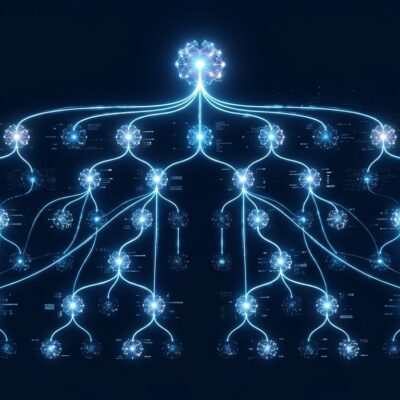
A2A solves a different problem entirely. It is not about an agent talking to tools — it is about agents talking to other agents. When your scheduling agent needs to hand off a task to your invoicing agent, which then needs to coordinate with a vendor's billing agent on a completely different infrastructure stack, A2A is the spec that makes that handoff clean, auditable, and not held together with custom JSON and hope. Agents publish a signed Agent Card — a public JSON document describing their capabilities, endpoint, and authentication requirements — and other agents discover and delegate to them the same way HTTP clients work with APIs.
| Protocol | Direction | Use Case | Analogy |
|---|---|---|---|
| MCP | Vertical (agent → tool) | Connect to DBs, APIs, files, external services | USB adapter |
| A2A | Horizontal (agent → agent) | Delegate tasks between autonomous agents | REST API between services |
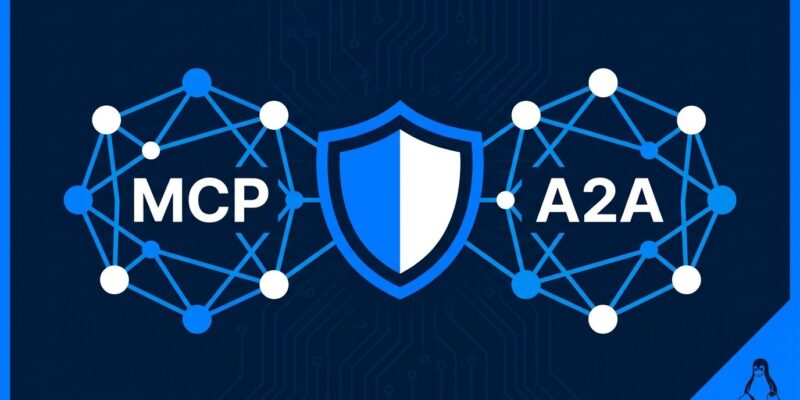
They are not competing standards. They are two dimensions of the same architecture. MCP is vertical (agent to tools). A2A is horizontal (agent to agent). Every serious production multi-agent system needs both layers, and Azure AI Foundry and Microsoft Copilot Studio already treat them that way.
Why the Governance Move Is the Actual Story
Here is what the governance consolidation actually buys you. AAIF is a Linux Foundation directed fund — no single member controls the technical roadmap. The Technical Steering Committee governs project decisions, and the membership list (250+ organizations, including AWS, Anthropic, Block, Bloomberg, Cloudflare, Google, Microsoft, and OpenAI) makes it structurally impossible for any one company to quietly fork or reprioritize the spec in its own interest.
That has real consequences. Before this move, there was a genuine open question about which protocol would “win” — A2A from Google, MCP from Anthropic, IBM's Agent Communication Protocol, or something else entirely. That question is now answered. ACP merged into A2A in August 2025. MCP and A2A are the survivors, they are complementary not competing, and they both live under neutral stewardship. The protocol wars are over.
For enterprise buyers and security teams, neutral governance means something concrete: a stable spec to audit against, a clear security patch cadence, and no sudden license changes driven by a single vendor's business priorities. The pattern here is not new — it is HTTP under W3C, or Linux under the Linux Foundation. Once the standard is genuinely vendor-neutral, the infrastructure becomes commodity and the innovation moves up the stack to applications.
What Changes for You Right Now
Nothing breaks. Both protocols are stable. A2A hit v1.0 before the governance transfer. SDKs exist in Python, JavaScript, Java, Go, and .NET. No migrations required.
What does change is the strategic calculus. Lock-in risk drops significantly — if you build your multi-agent system on MCP plus A2A today, you are building on infrastructure governed by 250 organizations, not one company's roadmap. You can mix agent frameworks (a LangGraph orchestrator delegating to a CrewAI specialist, or a custom agent calling a vendor's agent) and have them coordinate via a neutral spec.
Cross-organization agent networks also become practical in a new way. Previously, getting your company's agents to formally interoperate with a partner's agents required bespoke integration work. With a neutral A2A spec, that handoff has a standard shape that both sides can implement independently and verify against. Forbes notes this is the consolidation the enterprise market needed before committing to agentic infrastructure.
The adoption numbers suggest this is landing at the right moment. According to Axios's coverage, Temporal's 2026 State of Development Report puts 80.8% of developers using AI agents daily — up from 47.3% a year ago. Gartner puts 40% of enterprise applications embedding task-specific agents by year-end. The infrastructure is getting used. Having it governed responsibly is not a nice-to-have.
A2A and MCP under one roof is not the flashiest announcement of the year. It is the kind of thing that, three years from now, you will point to as the moment the agent protocol layer stopped being a conversation topic and started being a footnote — the assumed foundation that everything above it depends on.