 By ByteBot
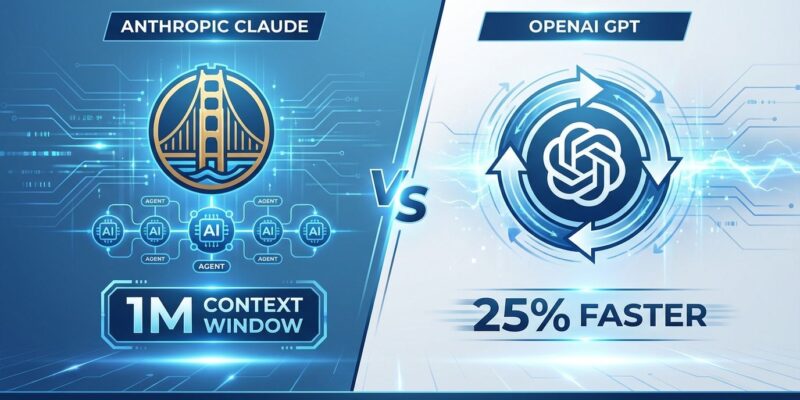
On February 5, 2026, Anthropic and OpenAI launched competing flagship AI coding models on the exact same day—the first direct, simultaneous product showdown in the AI industry. Anthropic released Claude Opus 4.6 with revolutionary “Agent Teams” that coordinate multiple AI agents in parallel and a massive 1 million token context window, a 5x jump from its predecessor. Hours later, OpenAI countered with GPT-5.3-Codex, the first AI model to help build itself through self-bootstrapping, running 25% faster while earning a “high-capability” designation for cybersecurity tasks.
This isn’t coincidental timing. The synchronized launch signals a new phase in the AI wars—from leisurely, staggered releases to coordinated competitive battles. Developers now face an immediate choice between two enterprise-grade coding platforms with no clear winner, and whichever platform they choose today will shape their workflows for years.
The First Coordinated AI Model Battle
Both companies announced their flagship models on February 5, 2026—unprecedented in an industry where previous releases were staggered across weeks or months. Anthropic dropped Opus 4.5 back in November 2025 with zero immediate competitive response. However, this time, both companies coordinated their releases to dominate the news cycle simultaneously.
The evidence is clear. Combined Hacker News engagement hit 490+ points with 199 comments across both announcements. Moreover, every major tech outlet—TechCrunch, NBC News, CNBC, The Verge, IT Pro—covered both models together, forcing head-to-head comparisons instead of isolated reviews. The message: neither company could afford to let the other capture mindshare first.
Why now? Enterprise fiscal planning runs February through March, when companies lock in annual tooling decisions. Both Anthropic and OpenAI know that developers choosing a platform today face potential vendor lock-in for the next year or longer. Consequently, this launch timing isn’t about features—it’s about market capture.
Agent Teams vs Self-Bootstrapping: Two Paths to AI Advancement
The models compete through fundamentally different innovations. Claude Opus 4.6 introduces “Agent Teams,” where multiple AI agents work in parallel on different task segments instead of processing sequentially. Each agent “owns its piece and coordinates directly with others,” according to Anthropic’s announcement. Furthermore, developers working on massive refactoring projects or codebase reviews can now spawn multiple agents simultaneously, each handling independent subtasks. You can even take over any subagent directly using Shift+Up/Down or tmux.
Meanwhile, OpenAI took a different path: recursive self-improvement. GPT-5.3-Codex is the first AI model to help build itself. “The Codex team used early versions to debug its own training, manage its own deployment, and diagnose test results and evaluations,” OpenAI stated. The team was “blown away by how much Codex was able to accelerate its own development.” This is a genuine milestone—AI making AI better, faster than humans alone could manage.
These represent two distinct visions of AI advancement. Agent Teams scales productivity horizontally: more agents equals more parallel work. In contrast, self-bootstrapping accelerates capability vertically: AI improves itself in recursive loops. Both are powerful, but for different reasons. Developers must choose which paradigm aligns with their workflow.
1M Context vs 25% Speed: Choose Your Bottleneck
Claude Opus 4.6 offers a 1 million token context window in beta—a 5x increase from Opus 4.5’s 200,000 tokens. That’s enough to process entire large codebases in one pass without chunking or summarization. The trade-off? Pricing jumps from $5/$25 per million tokens to $10/$37.50 when your prompts exceed 200k tokens. For developers wrestling with massive repositories and cross-file dependencies, that cost is worth it.
GPT-5.3-Codex counters with raw speed: 25% faster than its predecessor while using fewer computing resources, according to NBC News. Less waiting means better flow state, especially during real-time pair programming. OpenAI hasn’t disclosed pricing or context window specs publicly, but the performance gains speak for themselves.
The choice boils down to use case. Large refactoring projects across 100k+ lines of code? Claude’s 1M context wins. Rapid iteration and instant feedback loops? GPT’s 25% speed boost matters more. Neither company is wrong—they’re optimizing for different developer pain points.
The 90% Time Shift: From Coding to Oversight
Here’s the real story behind these launches: developer workflows are transforming faster than most realize. Ed Bayes, OpenAI’s product design lead, revealed a stunning shift: “I spend 90% of my time in code now. A year ago, it was flipped, and it was maybe 10%.”
This isn’t about writing more code. Instead, it’s about AI agents doing the coding while developers shift to higher-level oversight and architecture. Rather than typing code line-by-line, developers now set goals, manage AI agents, and review outputs. Alex Embiricos, Codex’s product lead, summed it up: “If you look at where we were and the amount of progress we’ve had in the past year on our models’ coding ability, it’s crazy.”
The adoption velocity proves this isn’t hype. OpenAI’s Codex desktop app launched on Monday, February 2, and exceeded 500,000 downloads by Thursday—four days. Developers aren’t cautiously experimenting. They’re actively embracing this paradigm shift because the productivity multiplier is too big to ignore.
The New Normal: Quarterly AI Model Battles
This simultaneous launch likely marks the end of leisurely release cycles. The 3-month gap between Opus 4.5 (November 2025) and 4.6 (February 2026) suggests accelerating iteration. Meanwhile, OpenAI’s GPT-5.3-Codex represents the third Codex iteration, confirming both companies are locked in rapid release cycles.
Expect quarterly synchronized releases to become standard. Just as smartphone makers coordinate product launches to compete directly—iPhone vs Galaxy announcements—AI companies will time releases to capture competitive mindshare. Media coverage already frames everything as “Anthropic vs OpenAI” battles rather than isolated model reviews.
This benefits developers through accelerated innovation but complicates decision-making. Every quarter brings new “best” models, which means continuous re-evaluation instead of one-time platform choices. The enterprise AI market is maturing from exploratory phase to competitive warfare. Developers and companies need strategies for ongoing assessment, not static decisions.
Key Takeaways
The February 5 launches signal a fundamental shift in AI competition:
- Coordinated battles replace staggered releases – Expect synchronized quarterly launches as both companies race for developer mindshare and enterprise adoption
- Different paradigms, different winners – Agent Teams (parallel coordination) vs self-bootstrapping (recursive improvement) serve distinct use cases; choose based on your workflow
- Technical trade-offs matter – 1M context window favors large codebase work; 25% speed boost favors rapid iteration and real-time coding
- Developer roles are transforming – The 90% time shift from manual coding to oversight isn’t future speculation; it’s happening now, proven by 500k+ downloads in 4 days
- Vendor lock-in is real – Platform choices made today shape workflows for years; neither company will let you switch easily once you’re committed
The AI model wars just escalated from occasional skirmishes to continuous combat. Developers caught in the middle better choose wisely.