 By ByteBot
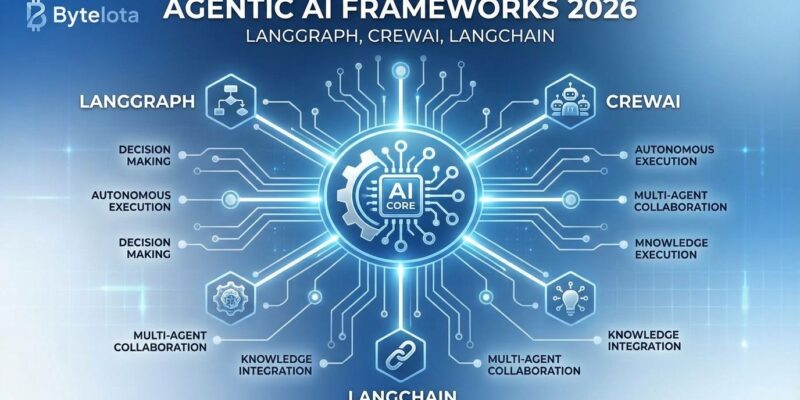
The agentic AI framework market is exploding in 2026—surging from $7.8 billion to a projected $52 billion by 2030. Gartner predicts 40% of enterprise applications will embed AI agents by year’s end, up from less than 5% in 2025. But with 8+ major frameworks—LangChain, CrewAI, LangGraph, AutoGen, LlamaIndex, DSPy, Semantic Kernel—developers face a critical choice: which framework fits your use case?
Choosing the wrong framework means high latency, production failures, or governance nightmares. LangGraph delivers the lowest latency, CrewAI excels at multi-agent collaboration, and LlamaIndex dominates retrieval tasks. The decision shapes your entire agentic architecture.
The Speed Gap: LangGraph vs LangChain
LangGraph achieves the lowest latency and token usage across all benchmarks, while LangChain has the highest. The performance gap isn’t minor—it’s architectural. LangGraph’s graph-based approach (DAG) predetermines tool execution at each step, minimizing LLM involvement. LangChain relies on the LLM to select tools via natural language understanding, adding overhead at every decision point.
That overhead multiplies. If your agent makes 20 tool calls in a workflow, LangChain’s redundant context passing compounds the latency. One Reddit developer captured the relief: “After struggling with Microsoft’s Autogen, switching to LangGraph was a relief…I can now control all the cycles the LLM is doing.”
The verdict is clear: use LangChain for rapid prototyping when you need a broad feature set and extensive integrations. Switch to LangGraph for production deployments where performance matters. The graph-based architecture isn’t just faster—it’s more predictable and easier to debug.
Example: LangGraph’s Graph-Based Workflow
from langgraph.graph import StateGraph

workflow = StateGraph(state_schema=AgentState)
workflow.add_node("research", research_node)
workflow.add_node("analyze", analyze_node)
workflow.add_edge("research", "analyze")
app = workflow.compile()
This deterministic structure eliminates the LLM from routing decisions—tools execute in predefined order, slashing latency.
Centralized vs Decentralized: Control or Autonomy?
Frameworks split into two camps on orchestration philosophy. Centralized approaches (LangGraph, Semantic Kernel) give developers workflow control similar to Airflow or Temporal—every step is deterministic, traceable, and reproducible. Decentralized frameworks (CrewAI, AutoGen) let agents reason and invoke each other independently, embracing true autonomy.
The trade-off is brutal: control vs debugging difficulty. Centralized workflows excel at logging, state management, and reproducibility. Every decision point is explicit, making failures easy to diagnose. However, decentralized workflows offer genuine agent autonomy at the cost of observability. Developers complain that “the multi-agent ecosystem lacks lifecycle management, state models, governance, auditability, and reproducibility” across major decentralized frameworks.
Enterprises prioritize centralized control for good reason—accountability matters when agents make business decisions. Startups experimenting with cutting-edge autonomy accept the debugging pain for breakthrough capabilities. The architecture choice isn’t right or wrong—it’s a deliberate decision about what you’re optimizing for.
Related: Agent Skills Tutorial: Build AI Agent Capabilities Fast
Which Framework for Your Use Case?
No single “best” framework exists—use case drives selection. Here’s the decision matrix developers should follow:
Simple retrieval and document Q&A → LlamaIndex. Its RAG-first architecture specializes in data indexing and retrieval, making it the clear winner for document-heavy applications. If your primary need is querying large document sets, LlamaIndex agents are built for exactly that.
Performance-critical production systems → LangGraph. The lowest latency and token usage across benchmarks makes it the only choice when speed matters. Its graph-based approach also delivers better state management and debugging capabilities.
Multi-agent collaboration and specialized teams → CrewAI. Role-based agent design with task delegation (allow_delegation=True) enables sophisticated team coordination. Agents specialize, collaborate, and share tasks naturally.
Example: CrewAI Multi-Agent Team
researcher = Agent(role="Researcher", goal="Find data", allow_delegation=True)
analyst = Agent(role="Analyst", goal="Analyze findings")

crew = Crew(
    agents=[researcher, analyst],
    tasks=[research_task, analysis_task],
    process=Process.sequential
)
Enterprise integration and Microsoft/Azure ecosystems → Semantic Kernel. .NET-native with built-in Azure services integration, security, and compliance features. For enterprises already invested in Microsoft tools, Semantic Kernel reduces friction.
Research and high-stakes optimization → DSPy. Program synthesis for reasoning pipelines focuses on systematic evaluation and optimization. When correctness matters more than time-to-market, DSPy’s eval-focused approach delivers.
General-purpose and rapid prototyping → LangChain. The largest community, most integrations, and broadest feature set make it ideal for exploration. Just don’t deploy it to production without addressing the latency gap.
Example: LangChain Simple Agent
from langchain.agents import create_react_agent
from langchain.tools import Tool

agent = create_react_agent(
    llm=ChatOpenAI(),
    tools=[search_tool, calculator_tool],
    prompt=agent_prompt
)
The Hard Truth: Why Production Fails
Agentic reliability math is unforgiving: 95% accuracy per step equals 36% accuracy over 20 steps. This is why practitioners remain skeptical despite the “2026 is the year of agents” hype flooding tech media. Production deployments face three critical barriers that framework selection alone cannot solve.
First, governance remains unclear. When an autonomous agent makes a business decision, who’s accountable? Current frameworks provide little guidance on audit trails, decision provenance, or rollback mechanisms. Small companies cite performance quality as their primary concern (45.8%), but accountability gaps block enterprise adoption even when performance meets standards.
Second, non-deterministic behavior is inherent to LLM-based agents. Same input, different outputs. This unpredictability requires extensive testing regimes and systematic evaluation frameworks that most teams haven’t built yet. Developers admit: “Many people feel uncertain about best practices for building and testing agents.”
Third, token costs add up faster than expected. Reasoning-heavy agents burn thousands of tokens per task, and that multiplies across agent teams. The economics of agentic workflows force hard trade-offs between autonomy and budget.
McKinsey’s research reveals the winning pattern: “Focusing on the workflow instead of the agent enabled teams to deploy the right technology at the right point.” The shift from “full autonomy” to “hybrid human-AI workflows” reflects production reality. Agents excel at specific tasks within controlled workflows, not end-to-end autonomous operation.
72% of Enterprises Already Using Agentic AI
Agentic AI is no longer experimental—it’s mainstream. 72% of medium-sized companies and large enterprises currently use agentic AI, with another 21% planning adoption within two years (93% total). The question isn’t “should we adopt?” but “which framework for our use case?”
Top use cases reveal where agentic workflows deliver ROI today. Autonomous AI SDRs identify high-intent leads from CRM data, launch personalized outreach emails, reply to follow-ups, and book demos with zero human intervention. Sales teams report significant productivity gains, though exact metrics vary by implementation.
Customer service sees the most aggressive adoption. Gartner predicts agentic AI will resolve 80% of user issues without human assistance by 2029. Current deployments handle Tier-1 and Tier-2 support across chat, email, and voice by integrating with CRMs and ticketing systems.
Insurance companies deploy agents that understand policy rules, assess damage using images and scanned PDFs, and manage entire claims lifecycles autonomously. Supply chain agents analyze delays, rebalance inventory, and reroute logistics in real time. Healthcare operations use agents for patient scheduling, bed occupancy prediction, and staff allocation.
The diversity of use cases proves agentic frameworks have moved beyond demos. Developers who understand framework trade-offs will lead their teams to successful deployments while others struggle with production failures and governance gaps.
Key Takeaways
- LangGraph for production performance (lowest latency), LangChain for prototyping (fastest iteration)—switch frameworks as you mature
- Centralized orchestration (LangGraph, Semantic Kernel) wins for enterprise control and debugging; decentralized (CrewAI, AutoGen) delivers true autonomy at the cost of observability
- Match framework to use case: LlamaIndex for retrieval, CrewAI for multi-agent teams, Semantic Kernel for Microsoft shops, DSPy for research optimization
- The 95%-per-step reliability problem means 36% accuracy over 20 steps—plan for systematic evaluation, human-in-the-loop workflows, and clear governance before production
- 93% enterprise adoption incoming (72% current, 21% planned)—framework selection matters now, not later
The agentic AI market is moving fast, but framework architecture fundamentals remain stable. Choose based on use case, performance requirements, and team capabilities. The right framework today shapes your autonomous systems for years.