 By ByteBot
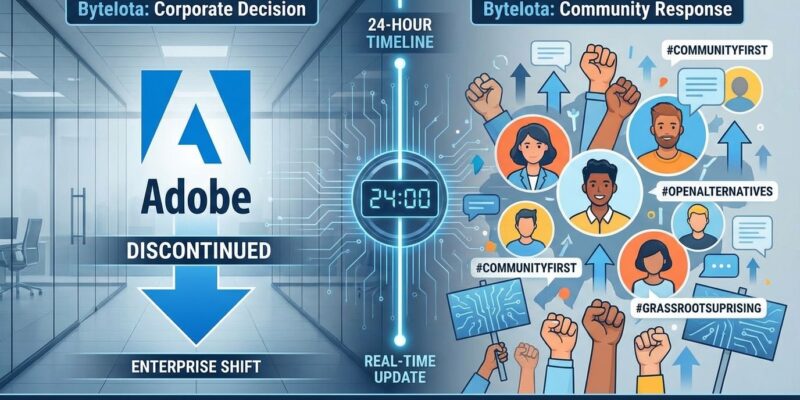
Adobe announced on February 2 that it would discontinue Adobe Animate by March 1, citing its focus on AI-powered creative tools. Twenty-four hours later, the company reversed course after a flood of protests from its 3 million users – animators, game developers, and educators who depend on the 30-year-old software. Animate now survives in “maintenance mode,” receiving security updates but no new features. The swift corporate retreat exposes the tension between Adobe’s AI-first strategy and the creative professionals who still need traditional tools.
The 24-Hour Reversal That Shouldn’t Have Worked
Adobe’s February 2 email hit users like a gut punch. The discontinuation notice gave them one month before sales stopped. Technical support would end March 2027 for most users, March 2029 for enterprise customers. The message was clear: Adobe was moving on.
The animation community wasn’t having it. Cartoon Brew, an industry publication, reported being “flooded with emails and DMs from artists, techs, directors, and producers reacting with anger, disbelief, and anxiety.” One artist’s response captured the sentiment: “Fuck Adobe, and fuck AI.” Social media erupted. Professional forums organized. By February 4, Adobe posted its reversal. The company apologized for “confusion and angst within the community” and announced Animate would continue indefinitely in maintenance mode.
Corporate reversals this fast are rare. Moreover, twenty-four hours from announcement to retreat suggests Adobe badly miscalculated how organized and vocal its user base would be. The precedent matters – it shows coordinated community backlash can force billion-dollar companies to back down.
Maintenance Mode Isn’t a Win
Don’t mistake Adobe’s reversal for a victory. Maintenance mode is corporate speak for “slow death.” The company will provide security patches and bug fixes, but no new features. Consequently, Animate stops evolving while competitors improve. Over time, the feature gap widens until migration becomes inevitable.
Maintenance mode can last years. Historical precedents suggest 5-10 years for major software products. However, the endpoint is the same: eventual shutdown. What users bought is time, not a future. Studios dependent on Animate production pipelines got a reprieve to plan migrations, but they’re still planning migrations.
Adobe made its strategic priorities clear. Animate isn’t part of the company’s future. The reversal doesn’t change that calculation – it just spreads the timeline.
Adobe’s AI Bet Is Forcing Hard Choices
The discontinuation attempt wasn’t random corporate cruelty. Adobe is reallocating resources from legacy tools to AI-powered creative software. Furthermore, the company’s data justifies the shift: 86% of creators use AI in daily workflows, and two-thirds of Photoshop beta users employ generative AI daily. Adobe Firefly, the company’s all-in-one creative AI studio, now integrates models from Runway, Flux, and Google alongside Adobe’s own offerings.
Development teams are finite. Investing in Firefly, Project Moonlight (an AI assistant), and Project Graph (visual AI workflows) means less bandwidth for traditional tools. From Adobe’s perspective, Animate’s 3 million users don’t justify continued investment when Firefly serves 30 million Creative Cloud subscribers.
But here’s the problem with that math: those 3 million Animate users include production studios with multi-year pipelines built on the software. TV shows like My Little Pony, Total Drama, and Metalocalypse depend on Animate workflows. Educational institutions train animation students on it. Game developers rely on its vector graphics tools. Additionally, telling them to “just use AI” or switch tools mid-production isn’t a strategy – it’s abandonment.
Adobe’s AI focus makes business sense. Dropping working tools that professionals depend on does not. The backlash was predictable.
Why No Alternative Works
The community didn’t protest just because they like Animate. They protested because migration is expensive and imperfect. Animate’s 30-year lineage (from FutureSplash to Flash to Animate) created workflows and project structures that don’t port to other tools. Project files use proprietary .fla format. Symbol libraries, custom scripts, and timeline structures don’t transfer cleanly.
Alternatives exist but come with trade-offs. Toon Boom Harmony is the industry standard for TV animation, but it costs more and has a steeper learning curve. Moho offers superior bone rigging but requires relearning core workflows. OpenToonz is free but features a challenging interface. Blender’s Grease Pencil tool places 2D animation in a 3D environment – powerful but not purpose-built like Animate.
For studios mid-production, switching means retraining entire teams, rebuilding asset libraries, and accepting productivity losses during transition. That’s not a technical problem. It’s an economic one. Therefore, Adobe’s one-month notice wasn’t enough time to plan that kind of disruption.
What This Precedent Means
Adobe’s reversal joins a growing pattern. OpenAI reinstated GPT-4o access after users canceled subscriptions when the company removed legacy model options. Sony partially reversed its PlayStation Store shutdown for PS3, PSP, and Vita after protests. The common thread: swift, organized community response forcing corporate backtracking.
The message to other companies is clear. Discontinuation announcements now face organized scrutiny. Social media enables rapid coordination. Industry press amplifies user concerns. Corporate reputation risk factors into decisions that once were purely financial calculations.
Adobe’s 24-hour retreat won’t stop other companies from sunsetting legacy products, but it will make them more cautious about timelines and communication. That’s not nothing. For communities facing similar threats, the precedent is encouraging: organized backlash works.
Animate bought time in maintenance mode. The war isn’t won, but the battle showed users still have power when they organize and push back. That’s the real story here.