 By ByteBot
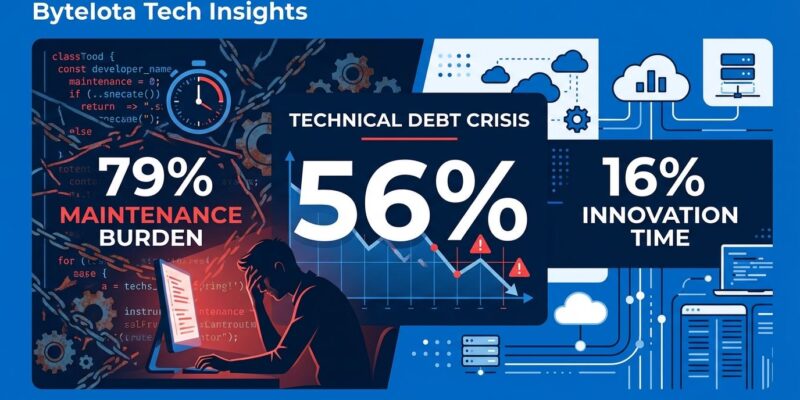
Companies are racing to adopt AI and invest billions in emerging technologies, yet their developers spend 79% of their time maintaining legacy code instead of building new features. Four major surveys released in January 2026—from KPMG, Chainguard, Cloudflare, and Protiviti—reveal a converging crisis: technical debt has become the primary bottleneck strangling innovation. The numbers are brutal. 56% of organizations can’t afford to fix their technical debt despite spending 30% of IT budgets on it. Meanwhile, 93% of engineers say building new features is the most rewarding part of their job, but they only spend 16% of their week doing it. This isn’t just inefficiency. It’s a $4 trillion trap crushing AI adoption, developer morale, and competitive advantage.
Four Surveys, One Crisis
When independent research from KPMG, Chainguard, Cloudflare, and Protiviti all point to the same problem, it’s not a coincidence. Technical debt—the accumulation of legacy systems, unpatched code, and aging infrastructure—has metastasized from a maintenance nuisance into an existential threat. KPMG’s 2026 Annual US Technology Survey found that 56% of organizations can’t afford to fix their technical debt despite wanting to invest in new technologies. Protiviti’s Global Technology Survey shows companies spending 30% of IT budgets and 20% of resources on technical debt management. Yet 70% still report it has high impact on their ability to innovate. The economics don’t add up. Companies are throwing massive resources at the problem and still losing ground.
The Maintenance Death Spiral
Chainguard’s 2026 Engineering Reality Report exposes the human cost. Survey 1,200 engineers and technology leaders across four countries, and you find a profession in crisis. 93% of engineers say writing code and building new features is the most rewarding part of their job. But they spend only 16% of their week doing it. Instead, 79% point to code maintenance as a major drain on their time. That’s four days a week patching legacy systems, updating outdated libraries, and firefighting technical debt. Only one day for innovation. 72% say demands make it difficult to find time for building new features. 35% cite excessive workload and burnout as major obstacles to a positive work experience. Companies trained engineers to innovate but trapped them in maintenance. The best talent is leaving.
Why AI Adoption Is Failing
Here’s the connection everyone’s missing: technical debt is the reason your AI initiatives aren’t delivering ROI. Cloudflare’s 2026 App Innovation Report warns of a “technical glass ceiling” stifling AI growth. The data is stark. Companies that modernize their applications are 3x more likely to see clear ROI on AI investments. 93% of leaders say updating their software stack was the single most important factor in boosting AI capabilities. Companies aligning security modernization with application modernization are 4x more likely to reach advanced AI maturity. Matthew Prince, Cloudflare’s CEO, put it bluntly: “If you aren’t modernizing your business to embrace AI and prevent the next wave of cyberattacks, you aren’t just standing still, you’re rapidly falling behind.”
You can’t bolt AI onto a crumbling foundation. Legacy systems lack the APIs, data infrastructure, and compute resources modern AI requires. Companies stuck maintaining 20-year-old monoliths don’t have the engineering bandwidth to experiment with AI. Their developers are too busy keeping the lights on. The result is a widening divide between “modernized winners” who leverage AI for competitive advantage and “legacy laggards” drowning in maintenance work.
Real Consequences, Not Theory
This isn’t abstract. Southwest Airlines canceled 13,000 flights during the 2022 holiday season because technical debt in their crew scheduling system caused a catastrophic operational failure. In 2025, an unpatched vulnerability in Cisco devices compromised over 40,000 systems. Most modern security breaches trace back to technical debt—unpatched software, outdated libraries, persistent bugs that were “too expensive” to fix. Development velocity slows to a crawl as teams struggle with convoluted legacy code. Innovation dies. The system becomes a liability instead of an asset. In extreme cases, companies collapse under the weight of unmaintainable systems.
Some analysts predict 2026 will be “the year of technical debt” as rushed AI adoption heaps new debt on existing problems. Companies implementing AI for metadata and coding without fixing underlying infrastructure issues may discover they’ve made the problem worse. Short-term savings from AI-generated code could translate into long-term maintenance nightmares.
The Winners Are Pulling Away
The divide is accelerating. Companies that modernize see 30-50% faster release cycles and up to 75% reductions in IT infrastructure costs. They cut legacy maintenance costs by 30-50% after modernization. AI-assisted tools can now analyze 80,000 lines of legacy code in under an hour and translate COBOL to modern languages, reducing refactoring timelines by 40%. The global application modernization market is projected to grow from $30 billion in 2026 to $92 billion by 2034 as companies realize modernization isn’t optional anymore.
State Farm implemented modern DevOps pipelines on IBM z/OS systems. Their IT architect noted that “developing modern DevOps tooling and practices is enabling a single high speed of development across the entire enterprise.” BNP Paribas deployed modern IDEs backed by open-source tools for IBM Z platforms, transforming development environments while saving money and boosting quality. Healthcare systems using automation and analytics help oncologists make clinical decisions 40% faster. These aren’t edge cases. They’re the new baseline for competitive companies.
The 2026 Inflection Point
What makes 2026 different is the convergence. AI demands modernized infrastructure. Cybersecurity requires up-to-date systems. Developer retention depends on rewarding work. Competitive pressure won’t wait for companies to fix technical debt at their leisure. The window is closing. Companies that can’t afford to modernize—56% by KPMG’s count—face a grim choice: find the budget or accept falling permanently behind. The transportation and logistics industry already spends 39% of IT budgets just servicing technical debt. That’s unsustainable.
Organizations need to treat technical debt as the strategic threat it is. That means executive-level prioritization, dedicated modernization budgets, and willingness to make hard tradeoffs between new features and infrastructure upgrades. It means measuring success not just by features shipped but by technical debt retired. Most importantly, it means acknowledging that the current approach—spending 30% of IT budgets on maintenance while still falling behind—has failed. Companies can’t cut their way out of technical debt. They have to invest their way out, even when that investment is painful.
The 2026 surveys make one thing clear: technical debt isn’t a technology problem anymore. It’s a business survival problem. The companies that recognize this reality and act decisively will thrive in the AI era. The ones that keep kicking the can down the road while their best engineers burn out maintaining legacy code? They’re writing their own obituaries.