 By ByteBot
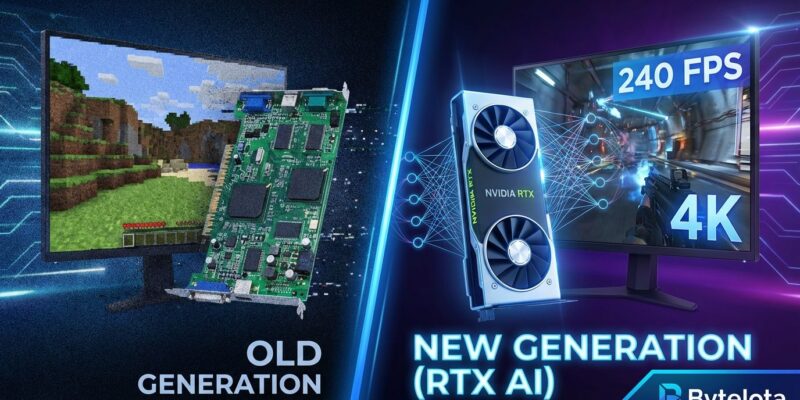
NVIDIA announced DLSS 4.5 at CES 2026 in January, introducing a 2nd generation transformer model for AI upscaling and 6X Dynamic Multi Frame Generation that pushes 4K path-traced gaming to 240+ FPS on RTX 50 series GPUs. The update brings sharper anti-aliasing, reduced ghosting, and improved temporal stability. However, it creates a stark performance divide between GPU generations: RTX 40/50 series owners see only 2-3% performance overhead, while RTX 20/30 series users face 20-24% FPS losses. The culprit? FP8 tensor cores—or the lack thereof.
This announcement represents both NVIDIA’s fastest gaming tech adoption (over 250 games support DLSS 4, 400+ support DLSS 4.5) and a turning point that separates modern GPUs from older hardware. The question isn’t just about visual fidelity versus performance—it’s whether AI-generated frames at 240 FPS truly improve gameplay or just benchmark scores.
The FP8 Divide: Why Older GPUs Pay a 20% Performance Tax
DLSS 4.5 is 5x more compute-intensive than DLSS 4.0, requiring FP8 precision support to offset the performance cost. RTX 40 series GPUs feature 4th generation tensor cores with native FP8 capabilities, while RTX 50 series adds FP4 inference on 5th generation tensor cores. Both architectures handle the heavier computational load with minimal overhead—just 2-3% in most games.
RTX 20 and 30 series GPUs lack FP8 support entirely. Their 2nd and 3rd generation tensor cores must brute-force the computation, resulting in significant performance penalties. Community testing on an RTX 3080 Ti shows Cyberpunk 2077 dropping from 42 FPS to 32 FPS at 4K RT Ultra settings—a 24% loss. At 1440p without ray tracing, the penalty remains steep at 20%.
The memory impact compounds the problem. DLSS 4.5 increases VRAM usage by 87-103% on RTX 20/30 series cards versus just 40-53% on newer architectures. For GPUs with 8GB VRAM, this can push limits in demanding titles. RTX 20/30 owners face a tough choice: accept major FPS losses for visual improvements, or stick with DLSS 4.0.
240 FPS at 4K: The 6X Multi Frame Generation Demo
NVIDIA demonstrated Black Myth: Wukong running at 240+ FPS at 4K with full path tracing on an RTX 5090, showcasing the new 6X Dynamic Multi Frame Generation feature. The technology generates up to 5 additional frames per traditionally rendered frame, automatically adjusting the multiplier based on real-time conditions. System latency measured around 53ms with NVIDIA Reflex enabled.
Here’s the catch: 6X MFG won’t launch until Spring 2026 and remains exclusive to RTX 50 series GPUs. RTX 40 series caps out at 4X frame generation. The technology promises up to 35% performance gains over DLSS 4.0 for 4K 240Hz path-traced gaming, but that latency measurement raises questions.
Traditional esports wisdom suggests sub-20ms latency is ideal for competitive gaming. At 53ms, visual smoothness may not translate to actual responsiveness. Frame generation creates interpolated frames between real frames—games look smooth, but the input lag remains tied to actual render time. It’s optimization for benchmarks, not necessarily for how the game feels under your fingers.
Image Quality Leap: When Performance Mode Beats Native
The 2nd generation transformer model represents NVIDIA’s most significant quality upgrade. Trained on an expanded dataset covering more failure cases, it delivers sharper edges, reduced ghosting, and improved temporal stability. NVIDIA claims Performance Mode now rivals—and can even beat—native image quality. That’s a bold claim, but early testing backs it up.
The Elder Scrolls IV Oblivion Remastered shows dramatic quality gains in motion, where DLSS 4.0 struggled with artifacts. Ultra Performance mode, previously reserved for desperate FPS boosts with compromised visuals, has become viable for 4K gaming. This validates AI upscaling as more than just a performance hack—it’s potentially superior to native rendering.
If Performance Mode genuinely beats native quality, the entire argument shifts. We’re no longer sacrificing visual fidelity for FPS. We’re using AI to render better images than brute-force rasterization can deliver. That’s a paradigm shift for PC gaming, assuming the claims hold up under scrutiny.
Fastest Adoption and the “Fake Frames” Debate
Over 250 games already support DLSS 4, with 400+ titles compatible with DLSS 4.5 Super Resolution. This marks NVIDIA’s fastest gaming technology adoption, surpassing previous DLSS iterations. New titles announced at CES 2026 include 007 First Light, Phantom Blade Zero, PRAGMATA, and Resident Evil Requiem. The NVIDIA app provides global preset management with per-game configuration options, including Model L (low compute) and Model M (medium compute) variants for older GPUs.
Yet rapid adoption doesn’t silence the “fake frames” criticism. Frame generation calculates interpolated frames between real rendered frames, improving visual fluidity but raising input latency. Games look smoother, but the fundamental responsiveness depends on actual frame rendering. At 240 FPS with 53ms latency, you’re watching beautiful motion while your inputs lag behind.
Competitive gamers may reject DLSS 4.5 entirely. If 120 FPS with 15ms latency feels more responsive than 240 FPS with 53ms latency, the higher number becomes meaningless. Visual smoothness and actual responsiveness diverge. We’re optimizing for the wrong metric, chasing benchmark numbers instead of gameplay experience.
Key Takeaways
- RTX 40/50 users: Enable DLSS 4.5 globally. The 2-3% performance cost is negligible compared to visual quality improvements. Performance Mode now rivals native rendering.
- RTX 20/30 users: Test per-game carefully. The 20-24% FPS penalty may not be worth visual gains, especially in competitive titles. Consider sticking with DLSS 4.0 for multiplayer, reserving 4.5 for single-player experiences.
- 6X Multi Frame Generation launches Spring 2026, RTX 50 exclusive. The technology pushes 4K gaming to 240 FPS but introduces ~53ms system latency. Visual smoothness doesn’t equal actual responsiveness.
- FP8 tensor cores create a GPU generation divide. DLSS 4.5’s 5x compute requirement is a non-issue for RTX 40/50 but punishes older architectures. This signals NVIDIA’s pivot toward AI inference over raw rasterization.
- 400+ game support demonstrates industry confidence. NVIDIA’s fastest tech adoption validates AI upscaling as the future of gaming performance, creating ecosystem lock-in for RTX GPUs.
DLSS 4.5 delivers undeniable visual improvements, but the performance divide between GPU generations reveals NVIDIA’s strategy: newer architectures built for AI workloads thrive, while older GPUs struggle. Whether 240 FPS with generated frames represents genuine progress or just impressive benchmarks depends on what you value—visual smoothness or actual responsiveness. For RTX 50 owners, it’s a clear win. For RTX 20/30 users, it’s a trade-off that may not be worth making.