 By ByteBot
The Efficiency Revolution Is Here
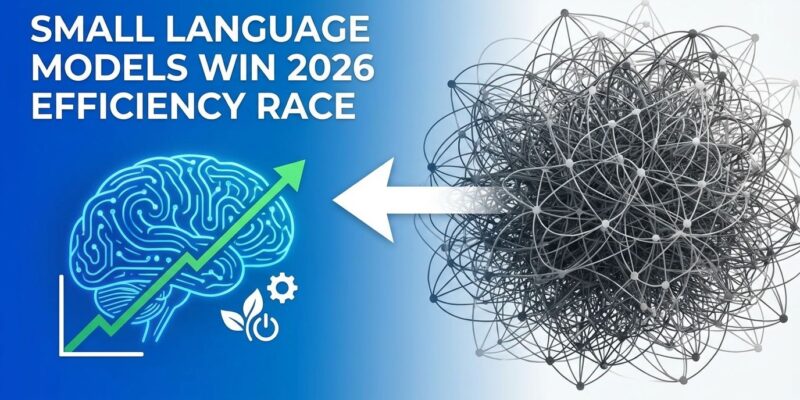
In April 2025, Gartner predicted organizations will use task-specific AI models three times more than general-purpose large language models by 2027. This wholesale rejection of “bigger is better” gospel already shows proof: Commonwealth Bank runs over 2,000 specialized AI models achieving 70% scam reduction, Microsoft’s Phi-3.5 matches GPT-3.5 performance using 98% less compute, and 2 billion smartphones now run local small language models.
Welcome to 2026, where efficiency beats scale.
From $4.2 Million to $1,000 Monthly
The economics are brutal. A mid-sized enterprise handling 10,000 daily customer queries pays $4.2 million monthly through GPT-5 APIs. Deploy a self-hosted 7B-parameter SLM on an A10G GPU? Under $1,000 monthly—a 99.98% reduction.
Per-token economics tell the same story: GPT-5 at $30 per million tokens versus self-hosted SLMs at $0.12-$0.85—a 79× differential. One-time $6,000 GPU investment replaces $8,808 annual cloud fees. A 50-engineer software company deploying SLM code completion generated $904,800 annual productivity value against $11,400 costs—7,838% ROI.
AT&T’s Chief Data Officer confirmed: “Fine-tuned SLMs will become a staple used by mature AI enterprises in 2026, as cost and performance advantages drive usage over out-of-the-box LLMs.”
Commonwealth Bank’s 2,000 Models Prove It Works
Commonwealth Bank of Australia operates 2,000+ AI models in production—one of the world’s largest corporate AI deployments. These models process 157 billion data points daily, making 55 million decisions. Real-time scam detection cut scam losses 70%, customer scam losses 50%, and reported fraud 30%.
This required hundreds of task-specific models, each optimized for discrete functions. The specialized approach extends globally: automotive suppliers using Phi-3 cut inspection time 87%, e-commerce platforms slashed costs 93% ($32K to $2.2K monthly) with hybrid routing, and healthcare networks added $3.75M revenue capacity through 67% faster documentation.
Specialization beats generalization in dollars, performance, and production reliability.
Phi-3.5 Matches GPT-3.5 at 2% Compute
Microsoft’s Phi-3.5 demolished the myth that quality requires massive parameters. With 3.8 billion parameters, Phi-3-mini scored 68.8% on MMLU versus GPT-3.5’s 71.4%—96% performance at 2% computational cost. The Phi-3.5 series achieves above 90% of GPT-4o-mini performance and beats Gemini 1.5 Flash, Llama 3.1, and even GPT-4o in some cases.
Samsung Research pushed further: their 7-million-parameter Tiny Recursive Model—10,000× smaller than typical LLMs—outperformed larger counterparts on reasoning tasks. “Reasoning isn’t a magical byproduct of trillion-parameter scale; it is an engineering problem solvable by architecture.”
Deployment metrics confirm benchmarks: 45-265ms latency, 18-95 queries/second on single A10G GPUs, Llama 3.2 fitting in 650MB. Light enough for iPhones and consumer hardware, eliminating cloud dependency.
Gartner’s 3× Prediction Signals Fundamental Shift
Gartner’s forecast that task-specific models will be used 3× more than general LLMs by 2027 reflects seismic change already underway. Domain-specific GenAI models will represent over 50% of enterprise deployments by 2027, up from 1% in 2023—a 50× shift in four years.
Edge AI accelerates the trend: 2 billion smartphones run local SLMs, with device counts projecting to 2.5 billion by 2027 (108% growth). Hybrid architectures route 90-95% queries to edge SLMs, reserving 5-10% complex requests for cloud LLMs—optimizing cost while maintaining quality.
GlobalData frames 2026 as the “year of efficiency,” where privacy, security, and regulatory compliance accelerate SLM adoption. SLMs will “complement or displace” LLMs for specific applications—not replace entirely, but dominate by volume.
Why Your 100B-Parameter Model Is a Liability
Trend Micro’s January 2026 analysis didn’t mince words: we’ve entered an “LLM bubble” driven by inefficient scaling. “Using a GPT-5 class model for every task is like hiring a Nobel Prize-winning physicist to do your data entry.”
Inference costs make agentic AI economically unviable. Workflows involving 100 steps burn $3+ per execution at $0.03 per step. Monolithic models create single points of failure—compromise one LLM, compromise entire systems. SLMs enable compartmentalization: separate public-facing agents from transaction-executing agents, isolate sensitive workloads. Example: “A health monitoring agent could analyze biometric data on your watch without sensitive info leaving your wrist.”
Environmental costs compound economic ones. LLMs carry massive carbon footprints. SLMs consume significantly less energy. Trend Micro frames this as ethical imperative: “If tasks can execute efficiently, wasteful approaches become ethically indefensible given grid strain.”
The future isn’t one giant brain—it’s specialized SLM swarms coordinated by routers, integrated via Model Context Protocol, dynamically swapped using LoRA adapters at pennies versus dedicated instances. Collective intelligence of specialists outperforms any generalist.
Efficiency Won the Scale Race
Silicon Valley spent years in an arms race for parameter counts. The 2026 data proves otherwise: when 3.8B parameters match 175B at 2% cost, when 2,000 specialized models outperform one general model, when enterprises achieve 70% scam reduction and 7,838% ROI—the debate ends.
Gartner’s 3× prediction isn’t aspirational. It’s recognition of what’s already happening. The efficiency revolution shipped.